


An academic-government-faith partnership to build disaster mental health preparedness and community resilience
- PMID: 25355980
- PMCID: PMC4187312
- DOI: 10.1177/00333549141296S413
An academic-government-faith partnership to build disaster mental health preparedness and community resilience
Abstract
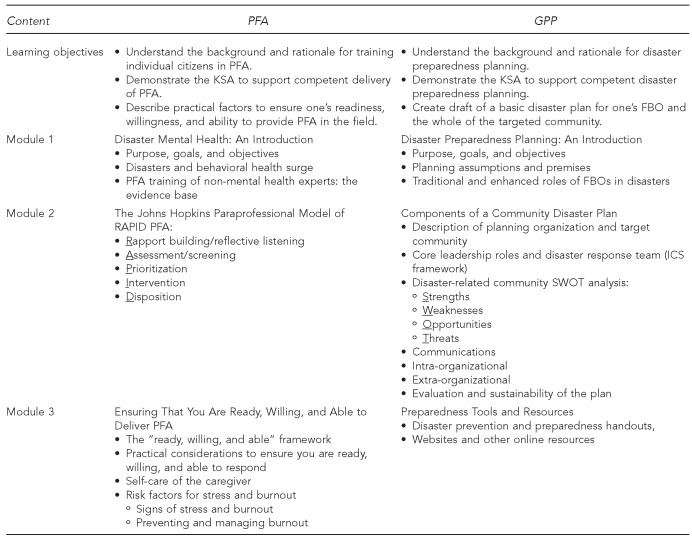
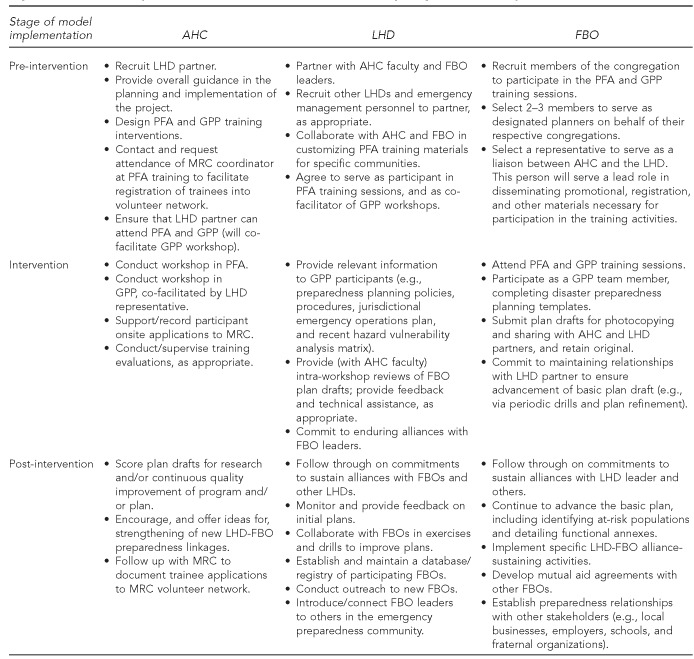
Objectives: Faculty and affiliates of the Johns Hopkins Preparedness and Emergency Response Research Center partnered with local health departments and faith-based organizations to develop a dual-intervention model of capacity-building for public mental health preparedness and community resilience. Project objectives included (1) determining the feasibility of the tri-partite collaborative concept; (2) designing, delivering, and evaluating psychological first aid (PFA) training and guided preparedness planning (GPP); and (3) documenting preliminary evidence of the sustainability and impact of the model.
Methods: We evaluated intervention effectiveness by analyzing pre- and post-training changes in participant responses on knowledge-acquisition tests administered to three urban and four rural community cohorts. Changes in percent of correct items and mean total correct items were evaluated. Criteria for model sustainability and impact were, respectively, observations of nonacademic partners engaging in efforts to advance post-project preparedness alliances, and project-attributable changes in preparedness-related practices of local or state governments.
Results: The majority (11 of 14) test items addressing technical or practical PFA content showed significant improvement; we observed comparable testing results for GPP training. Government and faith partners developed ideas and tools for sustaining preparedness activities, and numerous project-driven changes in local and state government policies were documented.
Conclusions: Results suggest that the model could be an effective approach to promoting public health preparedness and community resilience.
Figures
References
-
- Golan E, Arad M, Atsmon J, Shemer J, Nehama H. Medical limitations of gas masks for civilian populations: the 1991 experience. Mil Med. 1992;157:444–6. - PubMed
-
- North CS, Nixon SJ, Shariat S, Mallonee S, McMillen JC, Spitznagel EL, et al. Psychiatric disorders among survivors of the Oklahoma City bombing. JAMA. 1999;282:755–62. - PubMed
-
- Schlenger WE, Caddell JM, Ebert L, Jordan BK, Rourke KM, Wilson D, et al. Psychological reactions to terrorist attacks: findings from the National Study of Americans' Reactions to September 11. JAMA. 2002;288:581–8. - PubMed
-
- Department of Homeland Security (US) National planning scenarios: created for use in national, federal, state, and local homeland security preparedness activities. 2006. [cited 2014 Jul 25]. Available from: URL: https://www.llis.dhs.gov/sites/default/files/NPS-LLIS.pdf.
-
- Pfefferbaum B, Flynn BW, Schonfeld D, Brown LM, Jacobs GA, Dodgen D, et al. The integration of mental and behavioral health into disaster preparedness, response, and recovery. Disaster Med Public Health Prep. 2012;6:60–6. - PubMed
Publication types
MeSH terms
Grants and funding
LinkOut - more resources
Full Text Sources
Other Literature Sources
Medical
