. 2014 Sep 15;7(9):2541-9.
eCollection 2014.

Response gene to complement 32 (RGC-32) in endothelial cells is induced by glucose and helpful to maintain glucose homeostasis

Affiliations

Response gene to complement 32 (RGC-32) in endothelial cells is induced by glucose and helpful to maintain glucose homeostasis

Shuzhen Guo et al. Int J Clin Exp Med. .

Abstract

Endothelium dysfunction has been understood primarily in terms of abnormal vasomotor function, which plays an important role in the pathogenesis of diabetes and chronic diabetic complications. However, it has not been fully studied that the endothelium may regulate metabolism itself. The response gene to complement 32 (RGC-32) has be considered as an angiogenic inhibitor in the context of endothelial cells. We found that RGC-32 was induced by high fat diet in vivo and by glucose or insulin in endothelial cells, and then we set out to investigate the role of endothelial RGC-32 in metabolism. DNA array analysis and qPCR results showed that glutamine-fructose-6-phosphate aminotransferase [isomerizing] 1 (GFPT1), solute carrier family 2 (facilitated glucose transporter), member 12 (SLC2A12, GLUT12) and glucagon-like peptide 2 receptor (GLP2R) may be among possible glucose metabolism related downstream genes of RGC-32. Additionally, in the mice with endothelial specific over-expressed RGC-32, the disposal of carbohydrate was improved without changing insulin sensitivity when mice were faced with high fat diet challenges. Taken together, our findings suggest that RGC-32 in the endothelial cells regulates glucose metabolism related genes and subsequent helps to maintain the homeostasis of blood glucose.

Keywords: The response gene to complement 32; endothelial cells; glucose homeostasis.


Figures
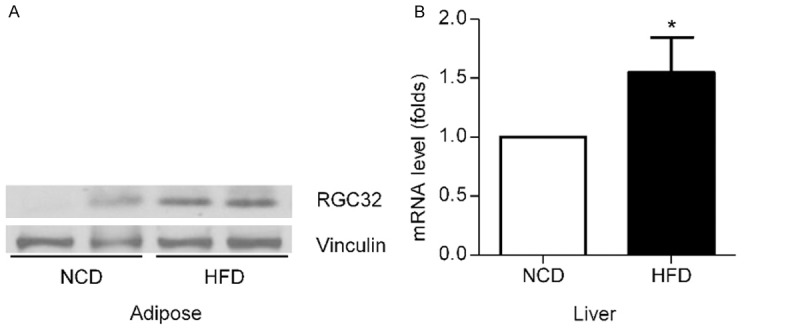
Figure 1
Figure 1
Effect of high fat diet on RGC-32 expression in wild type mice. A. RGC-32 expression in adipose tissue was assessed after either high fat diet or normal chow diet treated mice by western blot. B. RGC-32 expression in liver was assessed after either high fat diet or normal chow diet treated mice by qPCR. Results are mean ± SEM, *P<0.05.
Figure 2
Figure 2
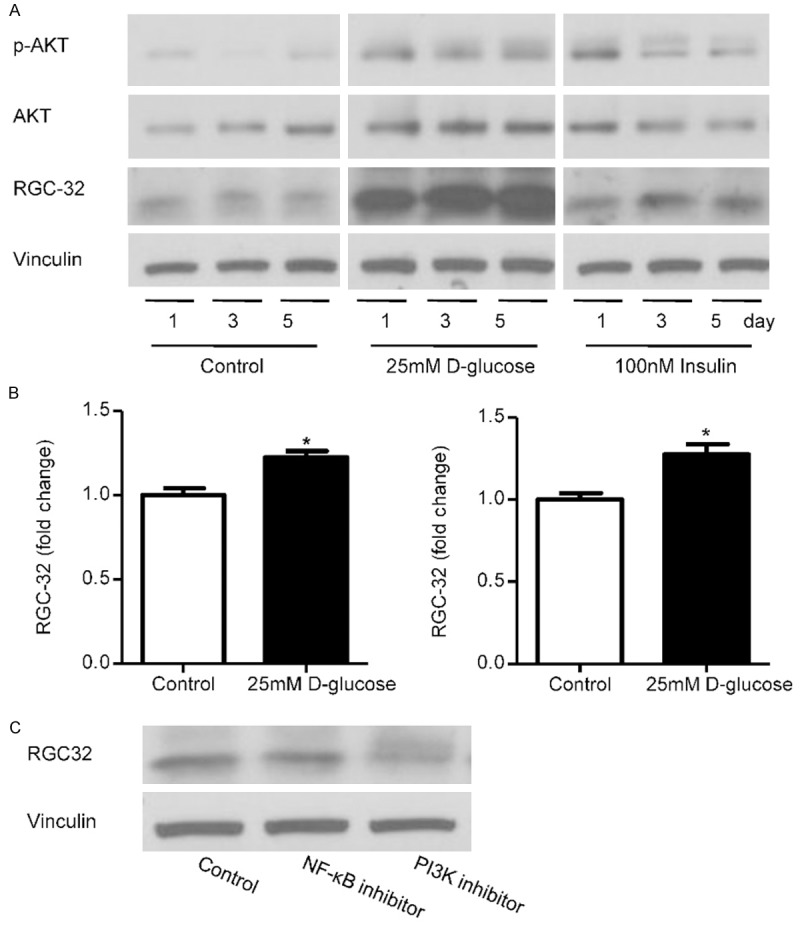
Effect of glucose and insulin in RGC-32 expression in HMEC-1. A. Immunoblot analysis of RGC-32, phosphate-AKT and AKT in HMEC-1 cells after 25 mM D-glucose or 100 nM insulin treated for 1, 3 or 5 days. Upper panel showed represent blot and the lower panel showed the result analyzed by Image J. B. Quantitative real-time polymerase chain reaction (QPCR) analysis of RGC-32 mRNA levels in human microvascular endothelial cells (HMEC-1) after 1 or 3 days treatment by 25 mM D-glucose. C. Immunoblot analysis of RGC-32 in HMEC-1 cells treated with selective PI3-K inhibitor LY294002 or IKK α/β inhibitor Wedelolactone. *P<0.05.
Figure 3
Figure 3
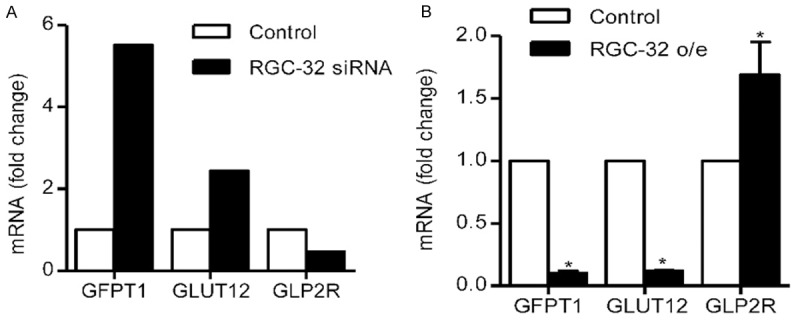
Effect of RGC-32 on glucose metabolism related genes. A. DNA array analysis of GFPT1, GLUT12 and GLP2R mRNA levels in RGC-32 siRNA infected HMEC-1 cells. B. qPCR analysis of GFPT1, GLUT12 and GLP2R mRNA levels in RGC-32 o/e HEMC cells. Results are mean ± SEM based on 3 experiments. *P<0.05.
Figure 4
Figure 4
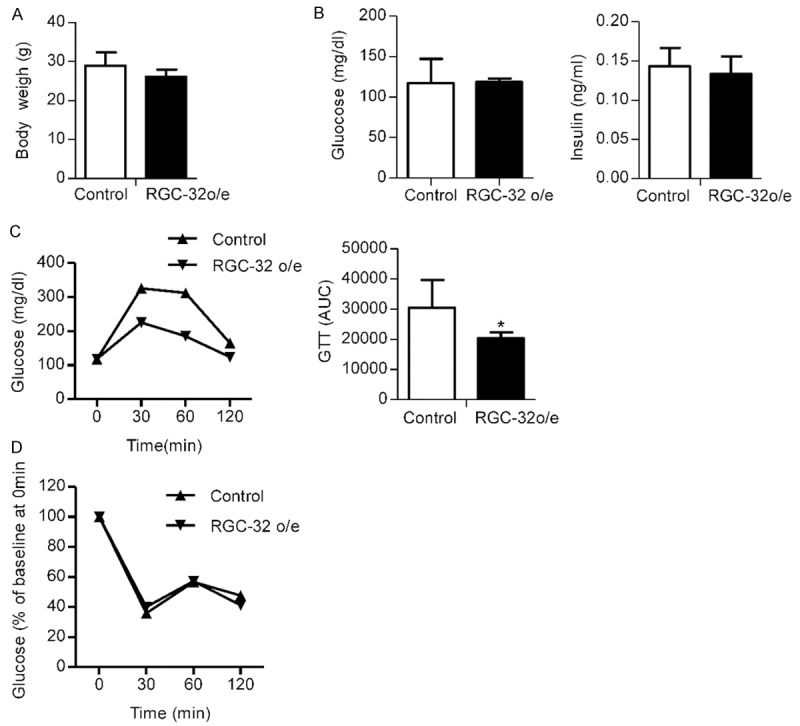
Effect of RGC-32 on glucose homeostasis and insulin sensitivity. A. Body weight was obtained on endothelial-specific RGC-32 o/e and their littermate control mice after being fed with a high-fat diet for 6 weeks. B. Fasting blood glucose (left panel) and insulin (right panel) concentration in endothelial-specific RGC-32 o/e and their littermate control mice. C. Glucose tolerance test in endothelial-specific RGC-32 o/e and their littermate control mice. Glucose was measured before and 30, 60, and 120 minutes after intraperitoneal glucose injection at 11 weeks of age (left panel). The AUC of glucose levels during glucose tolerance tests is shown (right panel). D. Insulin induced hypoglycemia in endothelial-specific RGC-32 o/e and their littermate control mice was analyzed; glucose was measured before and 30, 60, and 120 minutes after intraperitoneal insulin injection, and then glucose disposal rate comparing to baseline at different time points was shown.

References

    1. Cleaver O, Melton DA. Endothelial signaling during development. Nat Med. 2003;9:661–668. - PubMed
    1. Steinberg HO, Chaker H, Leaming R, Johnson A, Brechtel G, Baron AD. Obesity/insulin resistance is associated with endothelial dysfunction. Implications for the syndrome of insulin resistance. J Clin Invest. 1996;97:2601–2610. - PMC - PubMed
    1. Meigs JB, Hu FB, Rifai N, Manson JE. Biomarkers of endothelial dysfunction and risk of type 2 diabetes mellitus. JAMA. 2004;291:1978–1986. - PubMed
    1. Brownlee M. Biochemistry and molecular cell biology of diabetic complications. Nature. 2001;414:813–820. - PubMed
    1. Vlaicu SI, Tegla CA, Cudrici CD, Danoff J, Madani H, Sugarman A, Niculescu F, Mircea PA, Rus V, Rus H. Role of C5b-9 complement complex and response gene to complement-32 (RGC-32) in cancer. Immunol Res. 2013;56:109–121. - PubMed

LinkOut - more resources