Review
. 2014 Oct 29:3:18.
doi: 10.1186/2046-7648-3-18. eCollection 2014.

Are we being drowned in hydration advice? Thirsty for more?

Affiliations
Review

Are we being drowned in hydration advice? Thirsty for more?

James David Cotter et al. Extrem Physiol Med. .

Abstract

Hydration pertains simplistically to body water volume. Functionally, however, hydration is one aspect of fluid regulation that is far more complex, as it involves the homeostatic regulation of total body fluid volume, composition and distribution. Deliberate or pathological alteration of these regulated factors can be disabling or fatal, whereas they are impacted by exercise and by all environmental stressors (e.g. heat, immersion, gravity) both acutely and chronically. For example, dehydration during exercising and environmental heat stress reduces water volume more than electrolyte content, causing hyperosmotic hypohydration. If exercise continues for many hours with access to food and water, composition returns to normal but extracellular volume increases well above baseline (if exercising upright and at low altitude). Repeating bouts of exercise or heat stress does likewise. Dehydration due to physical activity or environmental heat is a routine fluid-regulatory stress. How to gauge such dehydration and - more importantly-what to do about it, are contested heavily within sports medicine and nutrition. Drinking to limit changes in body mass is commonly advocated (to maintain ≤2% reduction), rather than relying on behavioural cues (mainly thirst) because the latter has been deemed too insensitive. This review, as part of the series on moving in extreme environments, critiques the validity, problems and merits of externally versus autonomously controlled fluid-regulatory behaviours, both acutely and chronically. Our contention is that externally advocated hydration policies (especially based on change in body mass with exercise in healthy individuals) have limited merit and are extrapolated and imposed too widely upon society, at the expense of autonomy. More research is warranted to examine whether ad libitum versus avid drinking is beneficial, detrimental or neither in: acute settings; adapting for obligatory dehydration (e.g. elite endurance competition in the heat), and; development of chronic diseases that are associated with an extreme lack of environmental stress.

Keywords: Adaptation; Dehydration; Exercise; Renal; Thirst; Water.


Figures
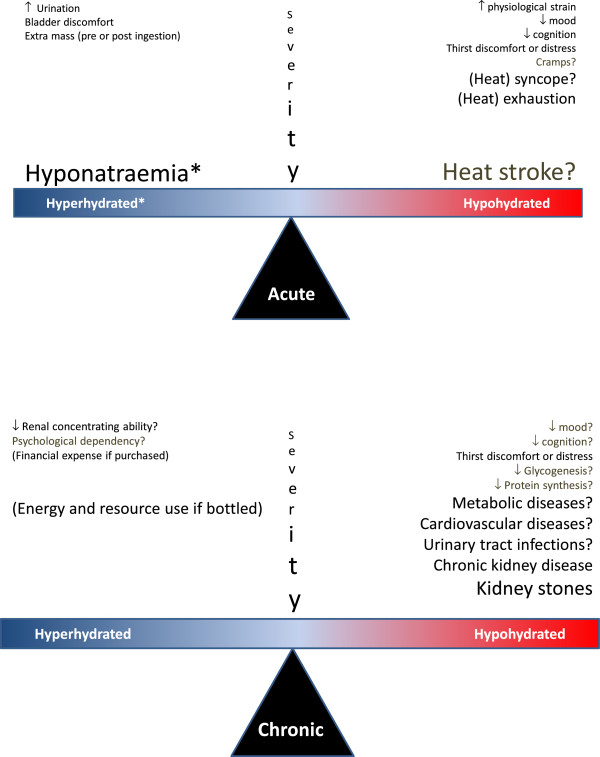
Figure 1
Figure 1
Personal and societal effects of acute/chronic consumption of water above/below that required for fluid homeostasis. The three incrementing font sizes denote outcomes causing a nuisance, morbidity and potential mortality. Outcomes with question marks are those for which we are not aware of any direct supporting evidence for humans behaving autonomously. Asterisk denotes that hyponatraemia can occur without hyperhydration per se, due to excess water relative to sodium content. The longer lists for hypohydration are not intended to convey higher relative importance. For example, hyponatraemia may be implicated in multiple adverse outcomes chronically (see [24-26]).
Figure 2
Figure 2
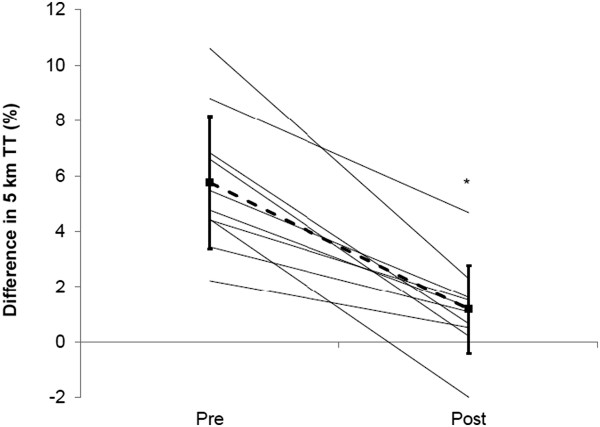
Effect of hypohydration on exercise performance before and after familiarisation to the hypohydration. Reprinted from Fleming J, James LJ. Repeated familiarisation with hypohydration attenuates the performance decrement caused by hypohydration during treadmill running. Appl Physiol Nutr Metab., 39: 124–129, Figure 3 (2013), with permission, © Canadian Science Publishing or its licensors.
Figure 3
Figure 3
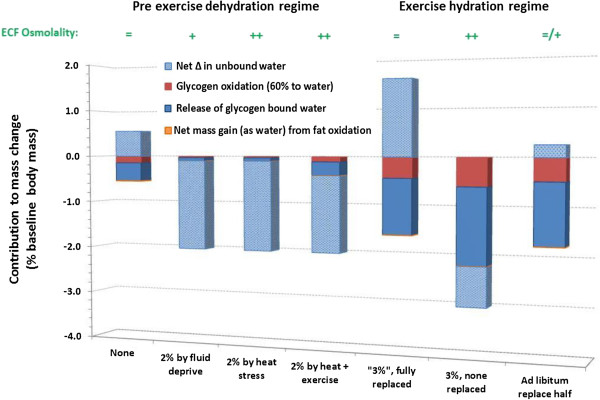
Indicative contributions of different sources to changes in body mass for hypohydration induced before or during strenuous exercise.Bar A represents starting exercise euhydrated when rehydrated from an overnight fast (14 h), whereas bars B–D represent starting exercise 2% hypohydrated obtained as primary hypohydration (fluid deprivation alone over 24 h: B), heat stress alone (C) or light exercise in the heat (D). Bars E–G each represent strenuous intermittent or endurance exercise sufficient to oxidise 300 g of glycogen in a 70-kg person and produce 3% 'hypohydration’ (mass deficit), with full 'rehydration’ (3% mass restoration: E), no rehydration (F) or ad libitum rehydration (G; see [11]). Within the bars, 'Glycogen bound water’ (solid blue) refers to water that was previously complexed to and possibly within [94] glycogen before its oxidation. This contribution was assumed to be 2.7 times larger than the mass of glycogen oxidised, based on estimations in the literature of 3–4 times larger [95]. 'Unbound water’ (stippled light blue) refers to water that is not bound to glycogen molecules or created during oxidative metabolism. The mass difference from triglyceride metabolism is small (13% net gain, as water), so this component is difficult to see. A 10% energy deficit was assumed with 24 h of primary hypohydration [70]. An additional 111 g of glycogen oxidation in F versus E is based on measurements with 2–4% dehydration during exercise in temperate and hot laboratory environments [30,32], and an additional 30 g is estimated for G versus E. Bars E and G only show the appearance of not summating to 3% gross mass exchange because some of the ingested fluid would cancel out an attenuated mass of glycogenolysis-released water. See text for more interpretation of these differing circumstances and discussion of the implications, suffice to say here that the net volume of free water exchange depends on the hydration protocol used and thus needs to be considered when interpreting physiological, psychological and performance effects of dehydration studies.

References

    1. Sawka MN, Cheuvront SN, Carter R 3rd. Human water needs. Nutr Rev. 2005;63:S30–S39. - PubMed
    1. Adolph EF. Physiology of Man in the Desert. New York: Interscience; 1947.
    1. Grandjean AC, Reimers KJ, Buyckx ME. Hydration: issues for the 21st century. Nutr Rev. 2003;61:261–271. doi: 10.1301/nr.2003.aug.261-271. - DOI - PubMed
    1. Jequier E, Constant F. Water as an essential nutrient: the physiological basis of hydration. Eur J Clin Nutr. 2010;64:115–123. doi: 10.1038/ejcn.2009.111. - DOI - PubMed
    1. Cheuvront SN, Carter R 3rd, Sawka MN. Fluid balance and endurance exercise performance. Curr Sports Med Rep. 2003;2:202–208. doi: 10.1249/00149619-200308000-00006. - DOI - PubMed

LinkOut - more resources