


Incidence of Hansen's Disease--United States, 1994-2011
- PMID: 25356604
- PMCID: PMC5779477
Incidence of Hansen's Disease--United States, 1994-2011
Abstract
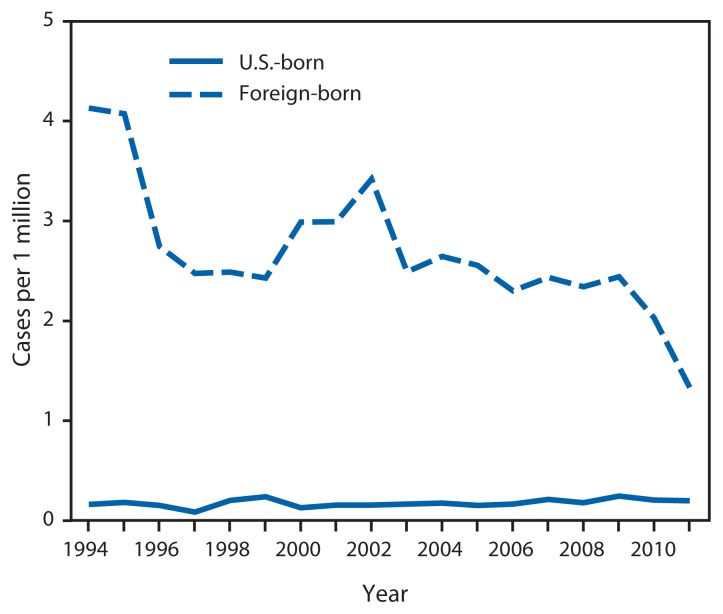
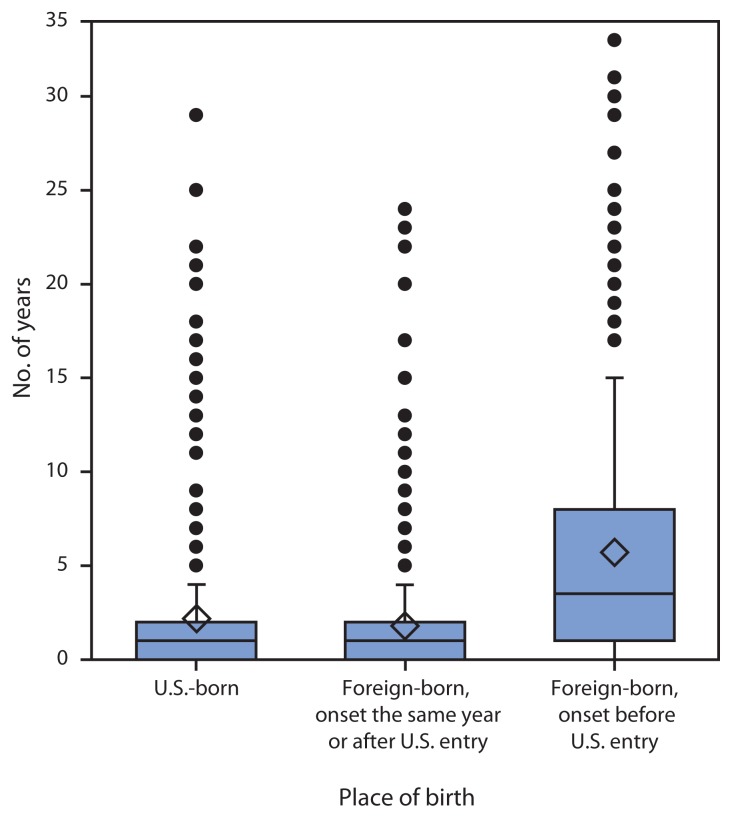
Hansen's disease (HD), or leprosy, is caused by the bacterium Mycobacterium leprae and is reportable in many states. It is a chronic disease affecting the skin and nerves, commonly presenting as pale or reddish skin patches with diminished sensation. Without treatment, it can progress to a severely debilitating disease with nerve damage, tissue destruction, and functional loss. An important factor in limiting HD morbidity is early diagnosis and prompt initiation of therapy. Because HD is rare, clinicians in the United States are often unfamiliar with it; however, HD continues to cause morbidity in the United States. To better characterize at-risk U.S. populations, HD trends during 1994-2011 were evaluated by reviewing records from the National Hansen's Disease Program (NHDP). When the periods 1994-1996 and 2009-2011 were compared, a decline in the rate for new diagnoses from 0.52 to 0.43 per million was observed. The rate among foreign-born persons decreased from 3.66 to 2.29, whereas the rate among U.S.-born persons was 0.16 in both 1994-1996 and 2009-2011. Delayed diagnosis was more common among foreign-born persons. Clinicians throughout the United States should familiarize themselves with the signs and symptoms of HD and understand that HD can occur in the United States.
Figures
References
-
- Davey TF, Rees RJ. The nasal dicharge in leprosy: clinical and bacteriological aspects. Lepr Rev. 1974;45:121–34. - PubMed
-
- Walker SL, Lockwood DN. The clinical and immunological features of leprosy. Br Med Bull. 2006;77–78:103–21. - PubMed
-
- World Health Assembly (WHA) resolution to eliminate leprosy. Geneva, Switzerland: World Health Assembly; 1991. Available at http://www.who.int/lep/strategy/wha/en.
-
- US Census Bureau. TheDataWeb: DataFerrett. Current population survey. Available at http://dataferrett.census.gov.
MeSH terms
LinkOut - more resources
Full Text Sources
Medical
