


Limiting postpartum weight retention through early antenatal intervention: the HeLP-her randomised controlled trial
- PMID: 25358909
- PMCID: PMC4221718
- DOI: 10.1186/s12966-014-0134-8
Limiting postpartum weight retention through early antenatal intervention: the HeLP-her randomised controlled trial
Abstract
Background: Pregnancy is a recognised high risk period for excessive weight gain, contributing to postpartum weight retention and obesity development long-term. We aimed to reduce postpartum weight retention following a low-intensity, self-management intervention integrated with routine antenatal care during pregnancy.
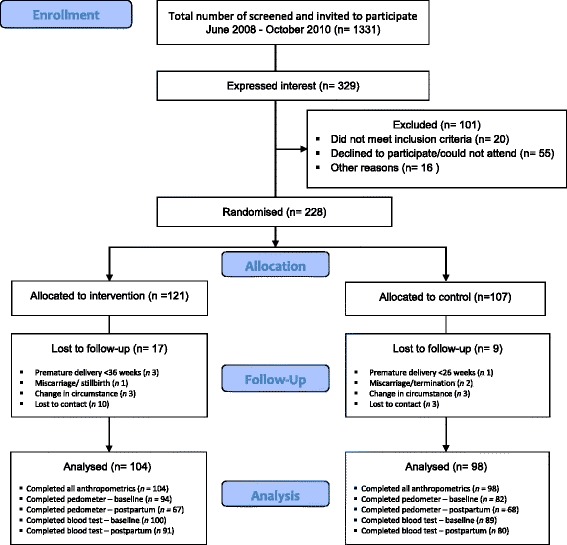
Methods: 228 women at increased risk of gestational diabetes, <15 weeks gestation were randomised to intervention (4 self-management sessions) or control (generic health information). Outcomes, collected at baseline and 6 weeks postpartum, included anthropometrics (weight and height), physical activity (pedometer) and questionnaires (health behaviours).
Results: Mean age (32.3 ± 4.7 and 31.7 ± 4.4 years) and body mass index (30.4 ± 5.6 and 30.3 ± 5.9 kg/m2) were similar between intervention and control groups, respectively at baseline. By 6 weeks postpartum, weight change in the control group was significantly higher than the intervention group with a between group difference of 1.45 ± 5.1 kg (95% CI: -2.86,-0.02; p < 0.05) overall, with a greater difference in weight found in overweight, but not obese women. Intervention group allocation, higher baseline BMI, GDM diagnosis, country of birth and higher age were all independent predictors of lower weight retention at 6 weeks postpartum on multivariable linear regression. Other factors related to weight including physical activity, did not differ between groups.
Conclusions: A low intensity intervention, integrated with standard antenatal care is effective in limiting postpartum weight retention. Implementation research is now required for scale-up to optimise antenatal health care.
Trial registration: Australian New Zealand Clinical Trial Registry Number: ACTRN12608000233325. Registered 7/5/2008.
References
-
- Cameron AJ, Welborn TA, Zimmet PZ, Dunstan DW, Owen N, Salmon J, Dalton M, Jolley D, Shaw JE. Overweight and obesity in Australia: the 1999–2000 Australian Diabetes, Obesity and Lifestyle Study (AusDiab) MJA. 2003;178(9):427–432. - PubMed
-
- Kopelman PG. Obesity as a medical problem. Nature. 2000;404(6778):635–643. - PubMed
-
- Adamson L, Brown W, Byles J, Chojenta C, Dobson A, Fitzgerald D, Hockey R, Loxton D, Powers J, Spallek M, Waters B, Watson M: Women’s Weight: Findings from the Australian Longitudinal Study on Women’s Health.Aus Govt Dept of Health Ageing 2007.
Publication types
MeSH terms
Associated data
LinkOut - more resources
Full Text Sources
Other Literature Sources
Medical
