. 2014 Nov 18;111(46):16395-400.
doi: 10.1073/pnas.1418126111. Epub 2014 Oct 30.

K-RasV14I recapitulates Noonan syndrome in mice

Affiliations

K-RasV14I recapitulates Noonan syndrome in mice

Isabel Hernández-Porras et al. Proc Natl Acad Sci U S A. .

Abstract

Noonan syndrome (NS) is an autosomal dominant genetic disorder characterized by short stature, craniofacial dysmorphism, and congenital heart defects. NS also is associated with a risk for developing myeloproliferative disorders (MPD), including juvenile myelomonocytic leukemia (JMML). Mutations responsible for NS occur in at least 11 different loci including KRAS. Here we describe a mouse model for NS induced by K-Ras(V14I), a recurrent KRAS mutation in NS patients. K-Ras(V14I)-mutant mice displayed multiple NS-associated developmental defects such as growth delay, craniofacial dysmorphia, cardiac defects, and hematologic abnormalities including a severe form of MPD that resembles human JMML. Homozygous animals had perinatal lethality whose penetrance varied with genetic background. Exposure of pregnant mothers to a MEK inhibitor rescued perinatal lethality and prevented craniofacial dysmorphia and cardiac defects. However, Mek inhibition was not sufficient to correct these defects when mice were treated after weaning. Interestingly, Mek inhibition did not correct the neoplastic MPD characteristic of these mutant mice, regardless of the timing at which the mice were treated, thus suggesting that MPD is driven by additional signaling pathways. These genetically engineered K-Ras(V14I)-mutant mice offer an experimental tool for studying the molecular mechanisms underlying the clinical manifestations of NS. Perhaps more importantly, they should be useful as a preclinical model to test new therapies aimed at preventing or ameliorating those deficits associated with this syndrome.

Keywords: MEK inhibitors; RASopathies; developmental disorders; heart defects; myeloproliferative disorders.


Conflict of interest statement

The authors declare no conflict of interest.

Figures

Fig. 1.
Fig. 1.
NS-like developmental defects in K-RasV14I mice. (A) Growth curves of male mice in mixed B6/129 and 129 (F5) genetic backgrounds. (Upper) Body weight of wild-type (n = 24 and 14, respectively) (open circles), K-Ras+/V14I (n = 36 and 22, respectively) (gray circles), and K-RasV14I (n = 18 and 8, respectively) (solid circles) male mice. (Lower) Body length of wild-type (n = 6 and 14, respectively) (open circles), K-Ras+/V14I (n = 14 and 22, respectively) (gray circles), and K-RasV14I (n = 7 and 8, respectively) (solid circles) male mice. Error bars indicate SD. *P < 0.05; **P < 0.01; ***P < 0.001. (B) Representative image of 4-mo-old wild-type (+/+), K-Ras+/V14I (+/V14I), and K-RasV14I (V14I) male mice. (C) Survival curve of wild-type (n = 25) (+/+, open circles), K-Ras+/V14I (n = 68) (+/V14I, gray circles), and K-RasV14I (n = 30) (V14I, solid circles) mice in mixed B6/129 genetic background. (D) Representative micro-CT scans of skulls from 4-mo-old wild-type (+/+), K-Ras+/V14I (+/V14I), and K-RasV14I (V14I) male mice in mixed B6/129 genetic background. See Table S2 for morphometric measurements.
Fig. 2.
Fig. 2.
Heart defects in 4-mo-old K-RasV14I male mice. (A) Heart/body weight ratio of wild-type (n = 22) (+/+, open bars), K-Ras+/V14I (n = 30) (+/V14I, gray bars), and K-RasV14I (n = 13) (V14I, solid bars) mice. (B) Histology of the heart. (Top) Formalin-fixed hearts. (Scale bar: 0.5 cm.) (Middle) H&E-stained heart ventricular sections. Interventricular wall (IV), right ventricle (RV), and left ventricle (LV) are indicated. (Scale bar: 1 mm.) (Bottom) H&E-stained aortic valves. Solid arrowheads point to aortic valves. (Scale bar: 50 μm.) (C) Cardiomyocyte hyperplasia. Relative cardiomyocyte number (Upper) and cardiomyocyte area (Lower) per ventricle of 4-mo-old wild-type (n = 8) (+/+, open bars), K-Ras+/V14I (n = 12) (+/V14I, gray bars), and K-RasV14I (n = 3) (V14I, solid bars) mice. (D) Percentage of Ki67-positive cardiomyocytes in wild-type (n = 5) (+/+, open bars), K-Ras+/V14I (n = 5) (+/V14I, gray bars), and K-RasV14I (n = 5) (V14I, solid bars) mice. Error bars indicate SD. *P < 0.05; **P < 0.01; ***P < 0.001.
Fig. 3.
Fig. 3.
Hematological disorders in K-RasV14I mice. (A) Spleen/body weight ratio in 4-mo-old wild-type (n = 13) (+/+, open bars), K-Ras+/V14I (n = 22) (+/V14I, gray bars), and K-RasV14I (n = 12) (V14I, solid bars) male mice. (B) H&E-stained paraffin-embedded sections of spleen and peripheral blood smears stained with May–Grünwald/Giemsa of 4-mo-old wild-type (+/+) and K-RasV14I (V14I) mice. White and red pulp are indicated by arrows and arrowheads, respectively. (Scale bars: 100 μm for spleen; 20 μm for blood smears). (C) Flow cytometry analysis of Gr1+ and CD11b+ cells in spleens of 4-mo-old wild-type (+/+) and K-RasV14I (V14I) mice. (D) Number of myeloid colonies formed by BM cells obtained from 4-mo-old wild-type (n = 3) (open circles), K-Ras+/V14I (n = 3) (gray circles), and K-RasV14I (n = 3) (solid circles) mice in the absence or presence of the indicated concentrations of IL-3 and GM-CSF. Error bars indicate SD. **P < 0.01; ***P < 0.001.
Fig. 4.
Fig. 4.
Aberrant hematopoiesis in 4-mo-old K-RasV14I mice. (A) Flow cytometry analysis of freshly harvested BM cells of wild-type (+/+) and K-RasV14I (V14I) mice using antibodies against c-Kit and Sca-1. The percentage of LSK cells is indicated. (B) Percentage of LSK cells in the BM of wild-type (n = 11) (+/+, open bars), K-Ras+/V14I (n = 15) (+/V14I, gray bars), and K-RasV14I (n = 9) (V14I, solid bars) mice. (C) Frequencies of CLP, CMP, MEP, and GMP populations in BM cells were quantified in wild-type (n = 11) (+/+, open bars), K-Ras+/V14I (n = 15) (+/V14I, gray bars), and K-RasV14I (n = 9) (V14I, solid bars) mice. Error bars indicate SD. *P < 0.05.
Fig. 5.
Fig. 5.
Treatment of K-RasV14I mice with the MEK inhibitor PD0325901 during embryonic and early postnatal development prevents developmental defects. (A) Representative hearts of 4-mo-old wild-type (+/+) and K-RasV14I (V14I) male mice exposed to vehicle or PD0325901 from E7.5 to P21. (Scale bar: 5 mm.) (B) Relative number of cardiomyocytes in the right and left ventricles of 4-mo-old wild-type (+/+, open bars), K-Ras+/V14I (+/V14I, gray bars), and K-RasV14I (V14I, solid bars) male mice exposed from E7.5 to P21 to vehicle (n = 11, n = 13; n = 6, respectively) or to PD0325901 (n = 4, n = 8; n = 8, respectively). Error bars indicate SD. *P < 0.05; **P < 0.01; ***P < 0.001.
Fig. 6.
Fig. 6.
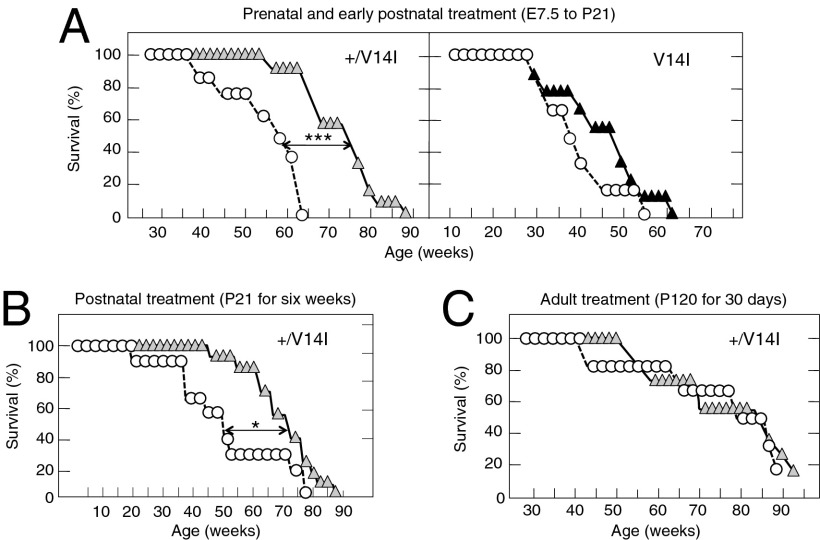
Survival of K-Ras+/V14I and K-RasV14I mice exposed to the MEK inhibitor PD0325901 at prenatal, postnatal, and adult stages. (A) Survival of K-Ras+/V14I (+/V14I) and K-RasV14I (V14I) mice exposed from E7.5 to P21 to vehicle (n = 8 and n = 6, respectively; open circles, dashed lines) or to PD0325901 (n = 12 and n = 9, respectively; gray and solid triangles, respectively, solid lines). ***P < 0.001. (B) Survival of K-Ras+/V14I (+/V14I) mice exposed for 6 wk beginning at P21 (until P64) to vehicle (n = 11, open circles, dashed line) or to PD0325901 (n = 12, gray triangles, solid line). *P < 0.05. (C) Survival of K-Ras+/V14I (+/V14I) mice exposed at 4 mo of age (P120) for 30 d to vehicle (n = 6, open circles, dashed line) or to PD0325901 (n = 11, gray triangles, solid line).

References

    1. Noonan JA, Ehmke DA. Associated noncardiac malformations in children with congenital heart disease. Midwest Soc Pediatr Res. 1963;63:468–470.
    1. Schubbert S, Shannon K, Bollag G. Hyperactive Ras in developmental disorders and cancer. Nat Rev Cancer. 2007;7(4):295–308. - PubMed
    1. Rauen KA. The RASopathies. Annu Rev Genomics Hum Genet. 2013;14:355–369. - PMC - PubMed
    1. Roberts AE, Allanson JE, Tartaglia M, Gelb BD. Noonan syndrome. Lancet. 2013;381(9863):333–342. - PMC - PubMed
    1. Jongmans MC, et al. Cancer risk in patients with Noonan syndrome carrying a PTPN11 mutation. Eur J Hum Genet. 2011;19(8):870–874. - PMC - PubMed

Publication types

MeSH terms

Substances

LinkOut - more resources