. 2014 Dec 12;289(50):34838-50.
doi: 10.1074/jbc.M114.601849. Epub 2014 Oct 30.

Regulation of USP28 deubiquitinating activity by SUMO conjugation

Affiliations

Regulation of USP28 deubiquitinating activity by SUMO conjugation

Yang Zhen et al. J Biol Chem. .

Abstract

USP28 (ubiquitin-specific protease 28) is a deubiquitinating enzyme that has been implicated in the DNA damage response, the regulation of Myc signaling, and cancer progression. The half-life stability of major regulators of critical cellular pathways depends on the activities of specific ubiquitin E3 ligases that target them for proteosomal degradation and deubiquitinating enzymes that promote their stabilization. One function of the post-translational small ubiquitin modifier (SUMO) is the regulation of enzymatic activity of protein targets. In this work, we demonstrate that the SUMO modification of the N-terminal domain of USP28 negatively regulates its deubiquitinating activity, revealing a role for the N-terminal region as a regulatory module in the control of USP28 activity. Despite the presence of ubiquitin-binding domains in the N-terminal domain, its truncation does not impair deubiquitinating activity on diubiquitin or polyubiquitin chain substrates. In contrast to other characterized USP deubiquitinases, our results indicate that USP28 has a chain preference activity for Lys(11), Lys(48), and Lys(63) diubiquitin linkages.

Keywords: Proteolytic Enzyme; SUMO-interacting Motif (SIM); Sumoylation; Ubiquitin; Ubiquitin-dependent Protease.


Figures

FIGURE 1.
FIGURE 1.
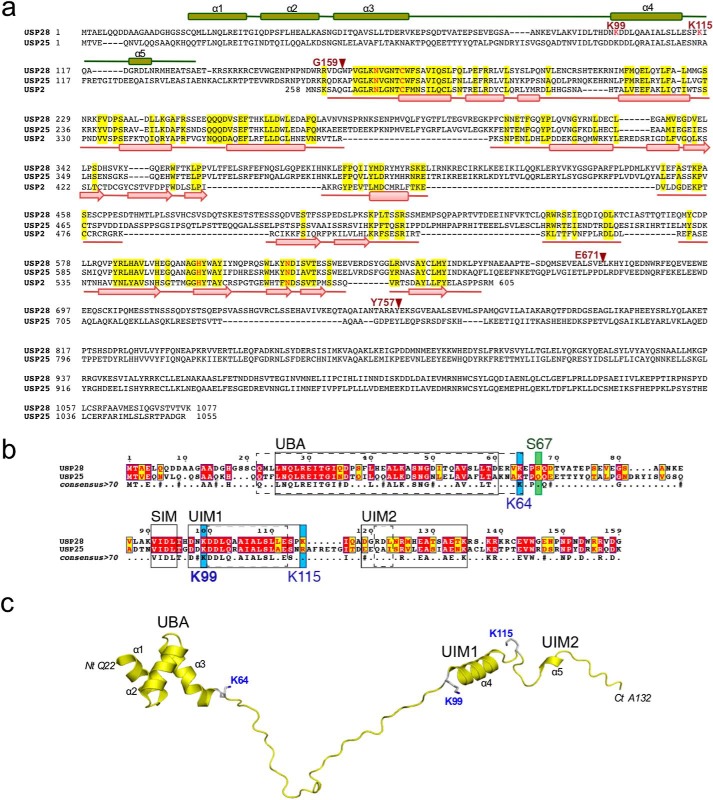
a, sequence alignment of USP2, USP25, and USP28. Secondary structure elements are based on USP2 structure (Protein Data Bank code 2HD5) and on the N-terminal USP28 NMR structure (Protein Data Bank code 2HD5) and shown below and above the sequences, respectively. USP28 active site residues are shown in red. Red arrows indicate the last residue of the USP28 constructs used in this work. b, Sequence alignment of the ubiquitin and SUMO binding motifs in USP28 and USP25. Secondary structure elements are labeled. The UBA, UIM, and SIM motifs predicted in USP25 are indicated by solid lines (34). Domains predicted by the NMR structure of USP28 are shown as dashed lines. Sequences were aligned using T-coffee, and the figure was generated using ESPript. Ser67, a target for DNA damage-induced phosphorylation, is indicated by a green box. Primary SUMOylation sites identified in Table 1 are indicated by blue boxes. c, NMR structure of the N-terminal domain of USP28. Ribbon representation of the deposited NMR structure (Protein Data Bank code 2LVA) of the N-terminal region of USP28 (residues 22–132) (37). Lys64, Lys99, and Lys115 side chains are labeled and shown in stick representation. Structural domains and secondary structure elements are labeled.
FIGURE 2.
FIGURE 2.
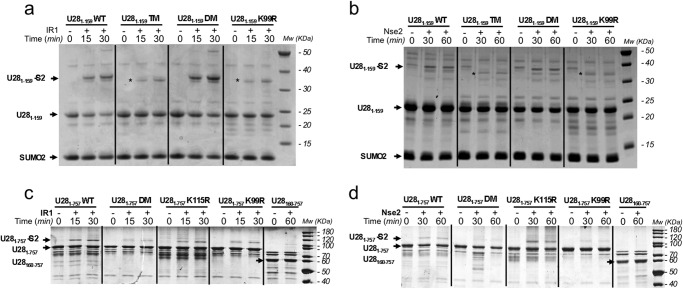
SUMO conjugation reaction with USP constructs. a, time course SUMO conjugation reaction with IR1 E3 ligase using different point mutants of the N-terminal region construct of USP28 (USP281–159). b, similar reaction as in a but using Nse2 as SUMO E3 ligase. c, time course SUMO conjugation reaction with IR1 E3 ligase using different point mutants of the catalytic domain construct of USPS28 (USP281–757). d, similar reaction as in a but using Nse2 as SUMO E3 ligase. Reactions were run at 37 °C and stopped with SDS-PAGE loading buffer at marked times. USP281–159 K64R/K115R, USP281–159 K64R/K115R/K99R, and USP281–757 K99R/K115R are shown. DM, double mutant; TM, triple mutant.
FIGURE 3.
FIGURE 3.
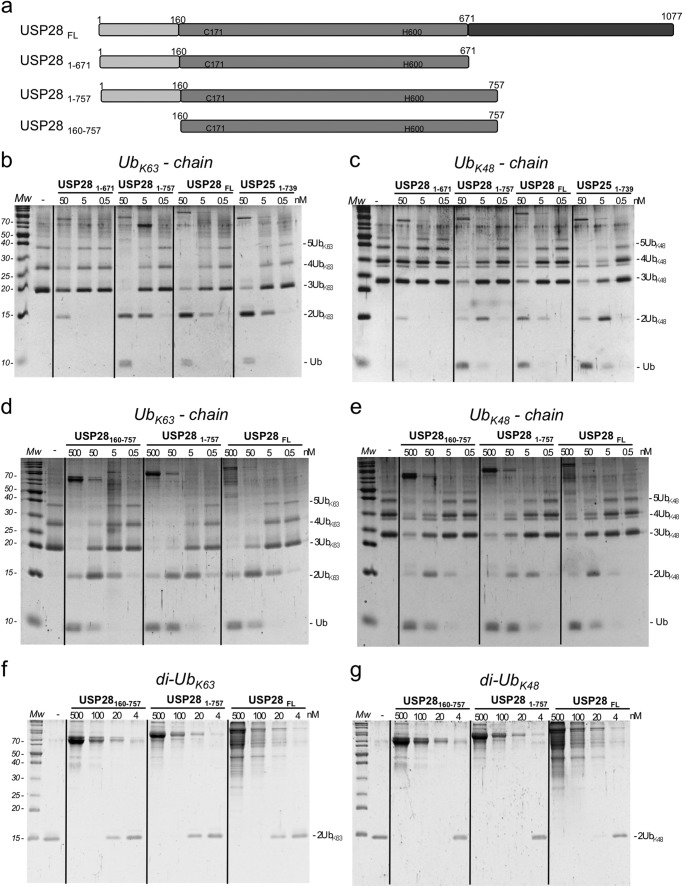
Deubiquitinating activity of USP28 on Lys48 and Lys63 ubiquitin substrates. a, cartoon representation of the different constructs of USP28 used in the analysis. b, end point activities on Lys63-linked ubiquitin chains of three different dilutions of indicated USP28 constructs after a 30-min reaction. c, end point activities on Lys48-linked ubiquitin chains of three different dilutions of USP28 constructs after a 30-min reaction. d, end point activities on Lys63-linked ubiquitin chains of four different dilutions of indicated USP28 constructs after a 30-min reaction. e, end point activities on Lys48-linked ubiquitin chains of four different dilutions of indicated USP28 constructs after a 30-min reaction. f, end point activities on Lys63 diubiquitin substrate of four different dilutions of indicated USP28 constructs after a 30-min reaction. g, end point activities on Lys48 diubiquitin substrate of four different dilutions of the indicated USP28 constructs after a 30-min reaction. Mw, molecular mass markers.
FIGURE 4.
FIGURE 4.
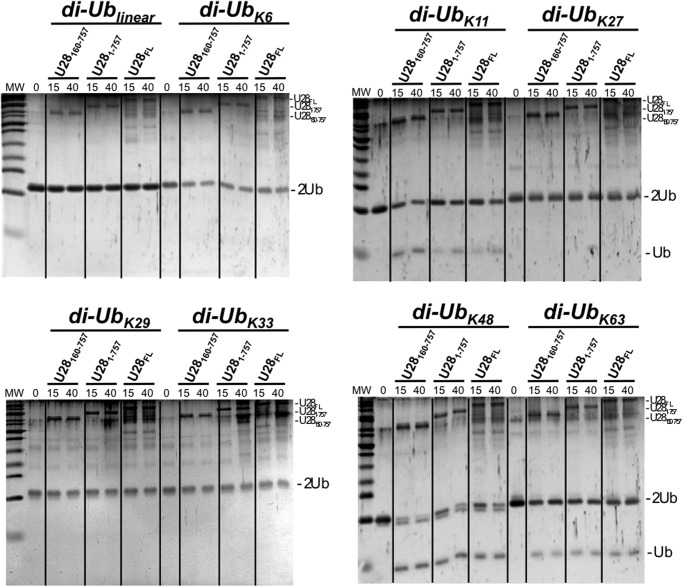
Diubiquitin linkage preference for USP28 constructs. USP28160–757, USP281-757, and USP28FL constructs were incubated with diubiquitin substrates of all linkage types (linear, Lys6, Lys11, Lys27, Lys29, Lys33, Lys48, and Lys63) for the indicated times and resolved in an SDS-PAGE stained with SYPRO-Ruby. All USP28 constructs were used at a fixed concentration (approximately 150 nm). MW, molecular mass markers.
FIGURE 5.
FIGURE 5.
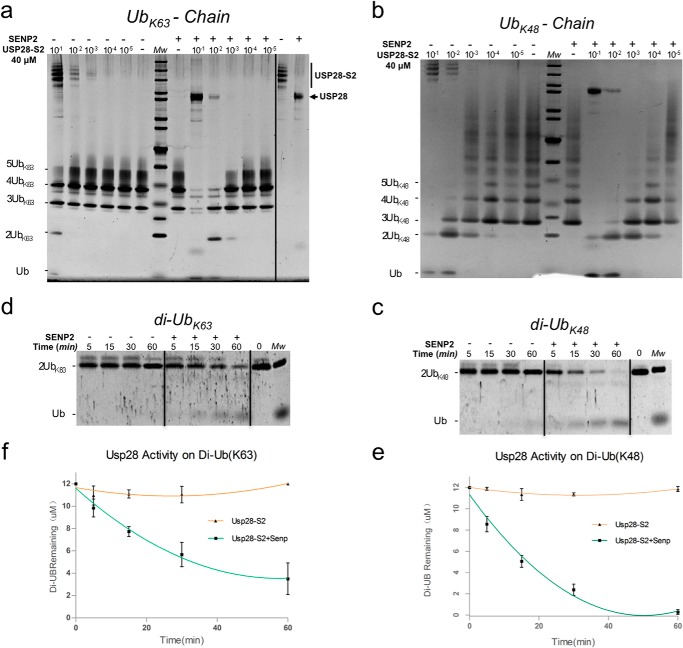
Inhibition of the deubiquitinating activity of USP28 by SUMO conjugation. a, end point deubiquitinating activity comparison on Lys48-linked ubiquitin chains using different dilutions of SUMO conjugated to the USP281–757 construct, before and after SENP2 treatment. b, end point deubiquitinating activity comparison on Lys63-linked ubiquitin chains using different dilutions of SUMO conjugated to the USP281–757 construct, before and after SENP2 treatment. c, time course reaction of deubiquitinating activity on Lys48 diubiquitin substrate using the SUMO-conjugated USP281–757 construct, before and after SENP2 treatment. d, time course reaction of deubiquitinating activity on Lys63 diubiquitin substrate using the SUMO-conjugated USP281–757 construct, before and after SENP2 treatment. e, graphic representation of the deubiquitination reaction shown in c. f, graphic representation of the deubiquitination reaction shown in d. The reactions were run in triplicate.
FIGURE 6.
FIGURE 6.
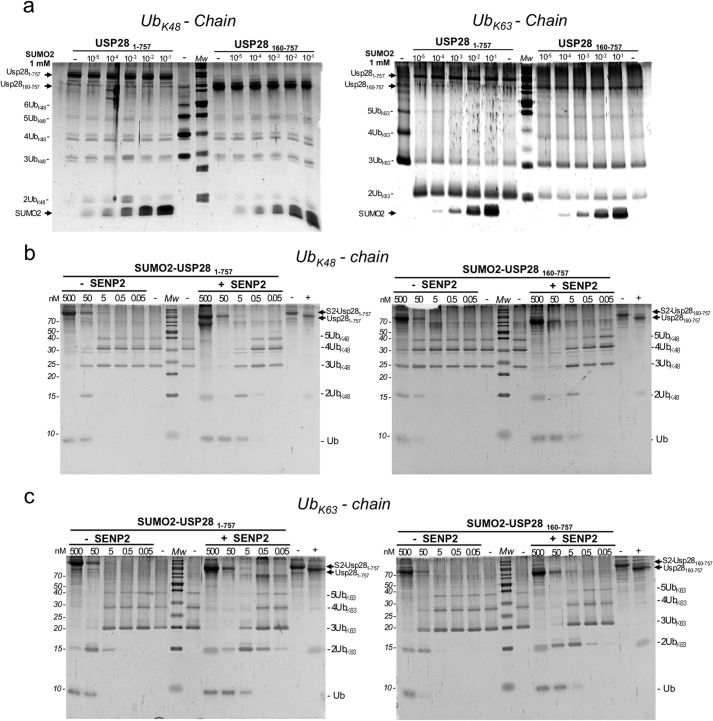
Noncovalent competitive analysis of SUMO2 and covalent SUMO2 fusion proteins analysis on the deubiquitinating activity of USP28. a, end point analysis of the deubiquitinating activity of the USP281–757 and USP28160–757 constructs on Lys48-linked (left panel) and K-63-linked (right panel) ubiquitin chains in the presence of increasing concentrations of SUMO2. b, end point deubiquitinating activity comparison on Lys48-linked ubiquitin chains using different dilutions of SUMO2-USP281–757 (left panel) and SUMO2-USP28160–757 (right panel) fusion constructs, before and after SENP2 treatment. Cleavage of the fusion protein is shown in the last two lanes of the gel. c, end point deubiquitinating activity comparison on Lys63-linked ubiquitin chains using different dilutions of SUMO2-USP281–757 (left panel) and SUMO2-USP28160–757 (right panel) fusion constructs, before and after SENP2 treatment. Cleavage of the fusion protein is shown in the last two lanes of the gel.

References

    1. Kerscher O., Felberbaum R., Hochstrasser M. (2006) Modification of proteins by ubiquitin and ubiquitin-like proteins. Annu. Rev. Cell Dev. Biol. 22, 159–180 - PubMed
    1. Ciechanover A., Schwartz A. L. (1998) The ubiquitin-proteasome pathway: the complexity and myriad functions of proteins death. Proc. Natl. Acad. Sci. U.S.A. 95, 2727–2730 - PMC - PubMed
    1. Geiss-Friedlander R., Melchior F. (2007) Concepts in sumoylation: a decade on. Nat. Rev. Mol. Cell Biol. 8, 947–956 - PubMed
    1. Hochstrasser M. (2009) Origin and function of ubiquitin-like proteins. Nature 458, 422–429 - PMC - PubMed
    1. Pickart C. M. (2001) Mechanisms underlying ubiquitination. Annu. Rev. Biochem. 70, 503–533 - PubMed

Publication types