. 2014:3:235838.
doi: 10.4303/jdar/235838.

Effects of the abused inhalant toluene on the mesolimbic dopamine system

Affiliations

Effects of the abused inhalant toluene on the mesolimbic dopamine system

John J Woodward et al. J Drug Alcohol Res. 2014.

Abstract

Toluene is a representative member of a class of inhaled solvents that are voluntarily used by adolescents and adults for their euphorigenic effects. Research into the mechanisms of action of inhaled solvents has lagged behind that of other drugs of abuse despite mounting evidence that these compounds exert profound neurobehavioral and neurotoxicological effects. Results from studies carried out by the authors and others suggest that the neural effects of inhalants arise from their interaction with a discrete set of ion channels that regulate brain activity. Of particular interest is how these interactions allow toluene and other solvents to engage portions of an addiction neurocircuitry that includes midbrain and cortical structures. In this review, we focus on the current state of knowledge regarding toluene's action on midbrain dopamine neurons, a key brain region involved in the initial assessment of natural and drug-induced rewards. Findings from recent studies in the authors' laboratory show that brief exposures of adolescent rats to toluene vapor induce profound changes in markers of glutamatergic plasticity in VTA DA neurons. These changes are restricted to VTA DA neurons that project to limbic structures and are prevented by transient activation of the medial prefrontal cortex prior to toluene exposure. Together, these data provide the first evidence linking the voluntary inhalation of solvents to changes in reward -sensitive dopamine neurons.


Figures

Figure 1
Figure 1
Trends in drug prevalence and funding from the National Institute of Drug Abuse (NIDA). Graph depicts relationship between 30 day prevalence of drug use by class and the number of R01s currently funded by NIDA for that drug class. Data for volatile solvents are indicated by a gold encircled triangle. Prevalence data are from Johnston et al (2013). Funding data obtained from NIH Project Reporter for fiscal year 2013. Keywords: marijuana – marijuana, cannabis, THC, cannabidiol; inhalants – inhalant, volatile solvent, alkyl nitrite, nitrous oxide; cocaine – cocaine, crack; amphetamine – amphetamine, Adderall; methamphetamine; heroin; tranquilizers – benzodiazepine, Xanax, valium, klonopin, tranquilizer; hallucinogen – hallucinogen, psilocybin, LSD, PCP, ketamine; MDMA – MDMA, ecstasy.
Figure 2
Figure 2
Identification of VTA neurons by immunohistochemistry. A) Examples of tyrosine hydroxylase (TH) positive (left) and negative (right) VTA neurons. Red indicates biocytin label in recorded neuron and green represents presence of TH; yellow indicates both. B) Proportion of TH+ recorded neurons from each retrobead labeled region. Blue is TH positive; red is TH negative. From Beckley at al. (2013).
Figure 3
Figure 3
Toluene vapor enhances the AMPA/NMDA ratio of mesoaccumbens DA neurons. Top panels show location of retrobead injections in NAC core (A) and shell (B) and examples of bead labeled neurons in VTA. Values are distance in mm from bregma. Middle panels show effects of toluene on AMPA/NMDA ratio of VTA DA neurons in NAC core (C, D) and shell (E). Panels F and G show representative traces from control and toluene exposed animals. Calibration bar; 20 pA, 10 ms. Symbol (*): indicates significant (p<0.05) difference in ratio between air and toluene exposed animals. From Beckley et al. [31].
Figure 4
Figure 4
Toluene vapor has no effect on AMPA/NMDA ratio in mesocortical DA neurons. A) Location of retrobead injections into medial prefrontal cortex and an example of bead labeled VTA DA neuron. Values are distance in mm from bregma. B) Graph shows lack of change in ratio between air and toluene exposed animals. C) Representative traces from PFC projecting VTA DA neuron. Calibration bar; 20 pA, 10 ms. From Beckley et al. [31].
Figure 5
Figure 5
Toluene exposure increases AMPA EPSC amplitude but not frequency and enhances AMPA current rectification. Top Panels: A) Averaged EPSCs from air-exposed (gray) and toluene-exposed (black) animals (calibration bar 5 pA, 5 ms) and examples of spontaneous AMPA EPSCs (calibration bar 25 pA, 500 msec). B) Cumulative probably chart of AMPA EPSC amplitude (± SEM) from air and toluene (5750 ppm) exposed animals. Inset shows mean (± SEM) amplitude of AMPA EPSCs from air and toluene exposed animals. C) Cumulative probability chart of AMPA EPSC inter-event interval (± SEM). Inset shows mean (± SEM) for air and toluene exposed animals. Symbols (***), indicates significant (p<0.001; Mixed Anova) amplitude × treatment interaction; (*), value significantly (p<0.05; t-test) different from control. Bottom Panels: A) Current-voltage relationship for evoked AMPA EPSCs from air and toluene exposed animals. B) Representative examples of AMPA EPSCs evoked from air (left) and toluene (right) exposed animals. Downward traces were obtained at −70 mV and upward traces are at +40 mV. Note blunted outward current amplitude in toluene treated neuron. Calibration bar 25 pA, 5 msec. C) Summary of effect of toluene vapor exposure on rectification index of evoked AMPA EPSCs. Symbols (***), indicates significant (p<0.001; mixed Anova, Bonferroni multiple comparison test) difference between current at +40 mV between toluene treated and air treated animals; (*), value significantly (p<0.05; t-test) different from control. From Beckley et al. [31].
Figure 6
Figure 6
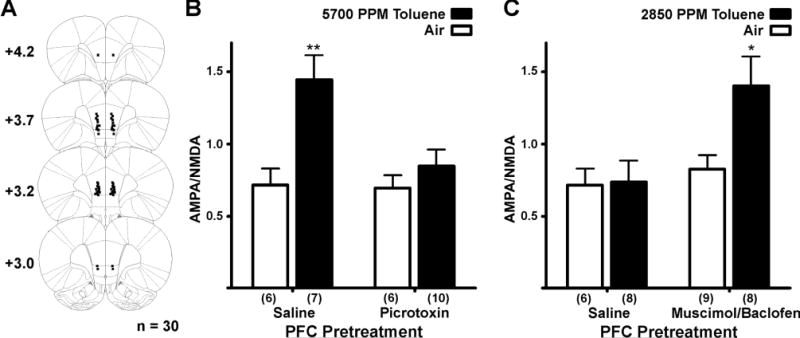
PFC output regulates toluene’s effect on AMPA/NMDA ratio in mesoaccumbens core DA neurons. A) Placement of microinjection cannula in the medial prefrontal cortex. Values are distance (mm) from bregma. B) Intra-PFC injection of picrotoxin blocks the toluene induced increase in AMPA/NMDA ratio in mesoaccumbens VTA DA neurons. C) Intra-PFC injection of muscimol/baclofen allows a previously inactive dose of toluene vapor to enhance AMPA/NMDA ratio of mesoaccumbens VTA DA neurons. Symbols (**), value significantly (p<0.01; two-way Anova, Bonferroni post-hoc test) different from all other groups; (*) value significantly (p<0.05; two-way Anova, Bonferroni post-hoc test) different from all other groups. From Beckley et al. [31].

References

    1. Balster RL. The Pharmacology of Inhalants. In: Ries RK, Fiellin DA, Miller SA, Saitz R, editors. Principles of Addiction Medicine. 4. Philadelphia: Wolters Kluwer/Lippincott Williams & Wilkins; 2009. pp. 241–250.
    1. Balster RL. Neural basis of inhalant abuse. Drug Alcohol Depend. 1998;51:207–214. - PubMed
    1. Johnston LD, O’Malley PM, Bachman JG, Schulenberg JE. Monitoring the Future National Results on Adolescent Drug Use: Overview of Key Findings, 2012. Institute for Social Research; Ann Arbor, MI: 2013. p. 83. University of Michigan.
    1. Filley CM, Halliday W, Kleinschmidt-DeMasters BK. The effects of toluene on the central nervous system. J Neuropathol Exp Neurol. 2004;63:1–12. - PubMed
    1. Bowen SE, Batis JC, Paez-Martinez N, Cruz SL. The last decade of solvent research in animal models of abuse: mechanistic and behavioral studies. Neurotoxicol Teratol. 2006;28:636–647. - PubMed

LinkOut - more resources