Safety of nonoperative management after acute diverticulitis
- PMID: 25360428
- PMCID: PMC4213937
- DOI: 10.3393/ac.2014.30.5.216
Safety of nonoperative management after acute diverticulitis
Abstract
Purpose: The role of surgery in the management of diverticular disease after an episode of acute diverticulitis (AD) managed in a conservative form is evolving. Age, number of episodes of AD, type of episode, and symptoms after the episodes are factors related to the need for elective surgery. The aim of this study is to evaluate the safety of conservative management and the risk factors for emergency surgery after a first episode of AD managed without surgery.
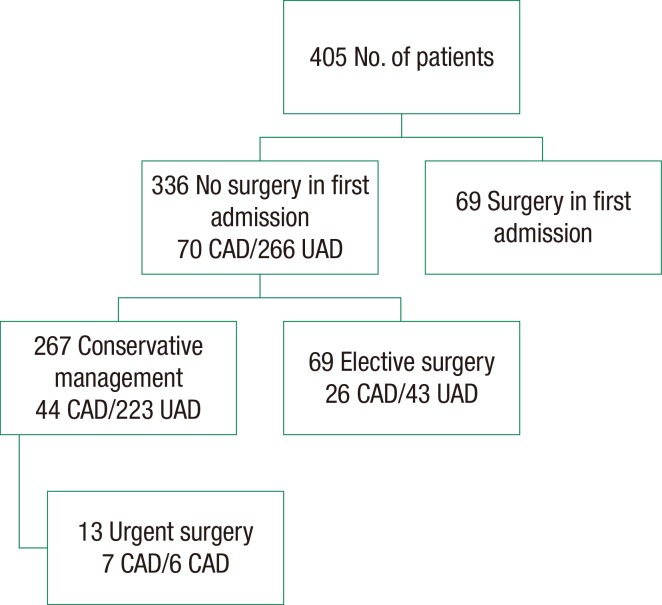
Methods: We retrospectively evaluated 405 patients diagnosed as having had a first episode of AD. Sixty-nine patients underwent emergency surgery on the first admission, and 69 patients had an elective operation in the follow-up (group A). The remaining 267 patients were managed initially without surgery (group B). Thirteen of these 267 patients needed a further urgent surgical procedure. Factors involved in the decision of elective surgery and the probability of emergency surgery after the first episode of AD managed without surgery were evaluated in relation to demographic factors, risk factors, presence of recurrences, and type of the first episode.
Results: Patients, mean age was 62.7 years, 71 were aged less than 51, and 151 were males. The mean follow-up for patients with nonoperative management was 91.2 months. An elective operation was performed in 69 patients. Compared to patients in group B, those in group A more frequently had a first episode of complicated acute diverticulitis (CAD) (37.1% vs. 16.4%; P = 0.000) and were more likely to be smokers (46.3% vs. 19.3%; P = 0.000) and to suffer more than one episode of AD (42% vs. 26.9%; P = 0.027). Nonoperative management was chosen for 267 patients, but 13 patients needed an emergency operation later. In the multivariate analysis, we found a significant relation between the presence of CAD in the first episode and the need for emergency surgery. There were no differences in surgical mortality between the patients in the two groups, but patients treated with elective surgery had a higher rate of stoma than patients treated non-operatively (7.2% vs. 1.4%; P = 0.028); this difference was not observed in the subgroup of patients with CAD (15.3% vs. 6.8%; P = 0.458).
Conclusion: After an episode of AD, nonoperative management is safe because fewer than 5% of patients will need an emergent procedure in a subsequent attack of AD. A first episode of CAD is the only risk factor for emergency surgery in patients managed conservatively.
Keywords: Acute diverticulitis surgery; Colonic diverticulitis; Complicated acute diverticulitis.
Conflict of interest statement
No potential conflict of interest relevant to this article was reported.
Figures
Similar articles
-
Diverticular Abscess Managed With Long-term Definitive Nonoperative Intent Is Safe.Dis Colon Rectum. 2016 Jul;59(7):648-55. doi: 10.1097/DCR.0000000000000624. Dis Colon Rectum. 2016. PMID: 27270517
-
Long-term evolution of acute colonic diverticulitis after successful medical treatment.World J Surg. 2015 Jan;39(1):266-74. doi: 10.1007/s00268-014-2773-y. World J Surg. 2015. PMID: 25189456
-
Medically Treated Diverticular Abscess Associated With High Risk of Recurrence and Disease Complications.Dis Colon Rectum. 2016 Mar;59(3):208-15. doi: 10.1097/DCR.0000000000000533. Dis Colon Rectum. 2016. PMID: 26855395
-
Is the outpatient management of acute diverticulitis safe and effective? A systematic review and meta-analysis.Tech Coloproctol. 2019 Feb;23(2):87-100. doi: 10.1007/s10151-018-1919-6. Epub 2019 Jan 25. Tech Coloproctol. 2019. PMID: 30684110
-
Elective surgery after acute diverticulitis.Br J Surg. 2005 Feb;92(2):133-42. doi: 10.1002/bjs.4873. Br J Surg. 2005. PMID: 15685694 Review.
Cited by
-
Nonoperative management of acute complicated diverticulitis.Ann Coloproctol. 2014 Oct;30(5):206. doi: 10.3393/ac.2014.30.5.206. Ann Coloproctol. 2014. PMID: 25360424 Free PMC article. No abstract available.
-
20-Year Trends in the Management of Diverticulitis Across New York State: an Analysis of 265,724 Patients.J Gastrointest Surg. 2017 Jan;21(1):78-84. doi: 10.1007/s11605-016-3205-0. Epub 2016 Jul 25. J Gastrointest Surg. 2017. PMID: 27456012
References
-
- Floch MH, Bina I. The natural history of diverticulitis: fact and theory. J Clin Gastroenterol. 2004;38(5 Suppl 1):S2–S7. - PubMed
-
- Boles RS, Jr, Jordan SM. The clinical significance of diverticulosis. Gastroenterology. 1958;35:579–582. - PubMed
-
- Ambrosetti P, Grossholz M, Becker C, Terrier F, Morel P. Computed tomography in acute left colonic diverticulitis. Br J Surg. 1997;84:532–534. - PubMed
-
- Eglinton T, Nguyen T, Raniga S, Dixon L, Dobbs B, Frizelle FA. Patterns of recurrence in patients with acute diverticulitis. Br J Surg. 2010;97:952–957. - PubMed
-
- Dharmarajan S, Hunt SR, Birnbaum EH, Fleshman JW, Mutch MG. The efficacy of nonoperative management of acute complicated diverticulitis. Dis Colon Rectum. 2011;54:663–671. - PubMed
LinkOut - more resources
Full Text Sources
Other Literature Sources
Miscellaneous