


An analysis of the binding characteristics of a panel of recently selected ICAM-1 binding Plasmodium falciparum patient isolates
- PMID: 25360558
- PMCID: PMC4216080
- DOI: 10.1371/journal.pone.0111518
An analysis of the binding characteristics of a panel of recently selected ICAM-1 binding Plasmodium falciparum patient isolates
Erratum in
-
Correction: An Analysis of the Binding Characteristics of a Panel of Recently Selected ICAM-1 Binding Plasmodium falciparum Patient Isolates.PLoS One. 2016 Feb 5;11(2):e0148836. doi: 10.1371/journal.pone.0148836. eCollection 2016. PLoS One. 2016. PMID: 26849362 Free PMC article. No abstract available.
Abstract
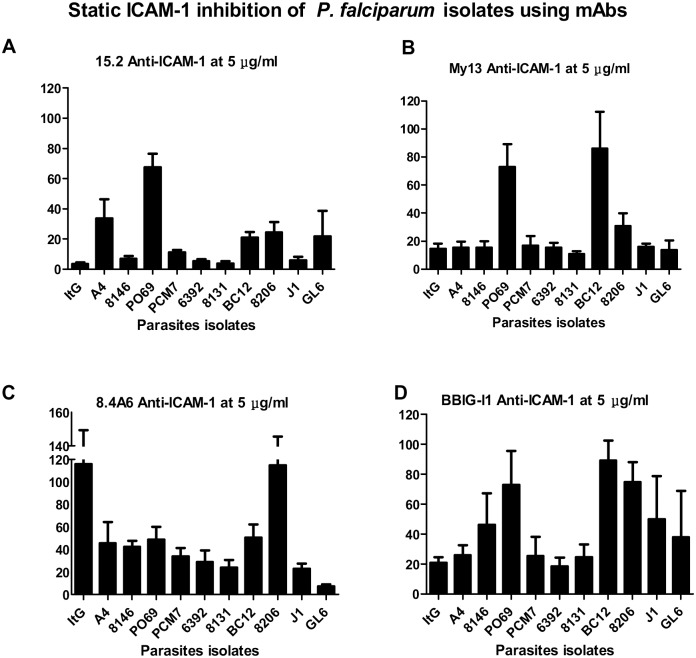
The basis of severe malaria pathogenesis in part includes sequestration of Plasmodium falciparum-infected erythrocytes (IE) from the peripheral circulation. This phenomenon is mediated by the interaction between several endothelial receptors and one of the main parasite-derived variant antigens (PfEMP1) expressed on the surface of the infected erythrocyte membrane. One of the commonly used host receptors is ICAM-1, and it has been suggested that ICAM-1 has a role in cerebral malaria pathology, although the evidence to support this is not conclusive. The current study examined the cytoadherence patterns of lab-adapted patient isolates after selecting on ICAM-1. We investigated the binding phenotypes using variant ICAM-1 proteins including ICAM-1Ref, ICAM-1Kilifi, ICAM-1S22/A, ICAM-1L42/A and ICAM-1L44/A using static assays. The study also examined ICAM-1 blocking by four anti-ICAM-1 monoclonal antibodies (mAb) under static conditions. We also characterised the binding phenotypes using Human Dermal Microvascular Endothelial Cells (HDMEC) under flow conditions. The results show that different isolates have variant-specific binding phenotypes under both static and flow conditions, extending our previous observations that this variation might be due to variable contact residues on ICAM-1 being used by different parasite PfEMP1 variants.
Conflict of interest statement
Figures


References
-
- WHO (2013) The World Malaria Report. Geneva: World Health Organization.
-
- Miller LH, Baruch DI, Marsh K, Doumbo OK (2002) The pathogenic basis of malaria. Nature 415: 673–679. - PubMed
-
- Baruch DI, Pasloske BL, Singh HB, Bi X, Ma XC, et al. (1995) Cloning the P. falciparum gene encoding PfEMP1, a malarial variant antigen and adherence receptor on the surface of parasitized human erythrocytes. Cell 82: 77–87. - PubMed
Publication types
MeSH terms
Substances
Grants and funding
LinkOut - more resources
Full Text Sources
Other Literature Sources
Miscellaneous
