


Multiple species of Trichosporon produce biofilms highly resistant to triazoles and amphotericin B
- PMID: 25360765
- PMCID: PMC4215839
- DOI: 10.1371/journal.pone.0109553
Multiple species of Trichosporon produce biofilms highly resistant to triazoles and amphotericin B
Abstract
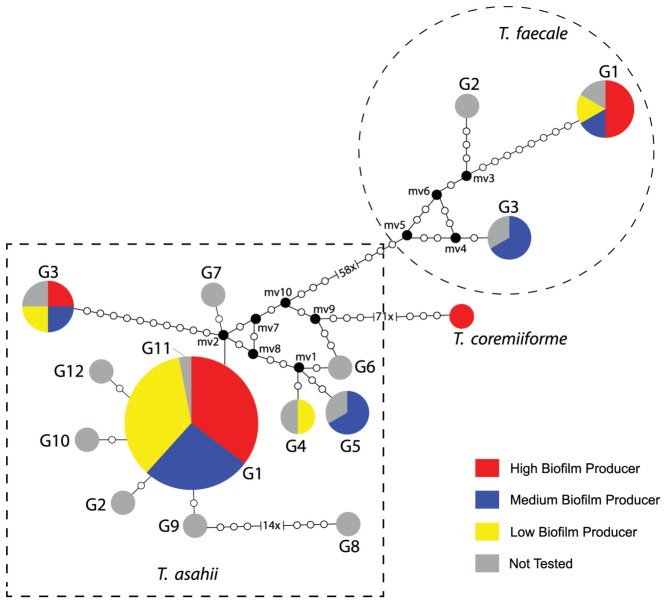
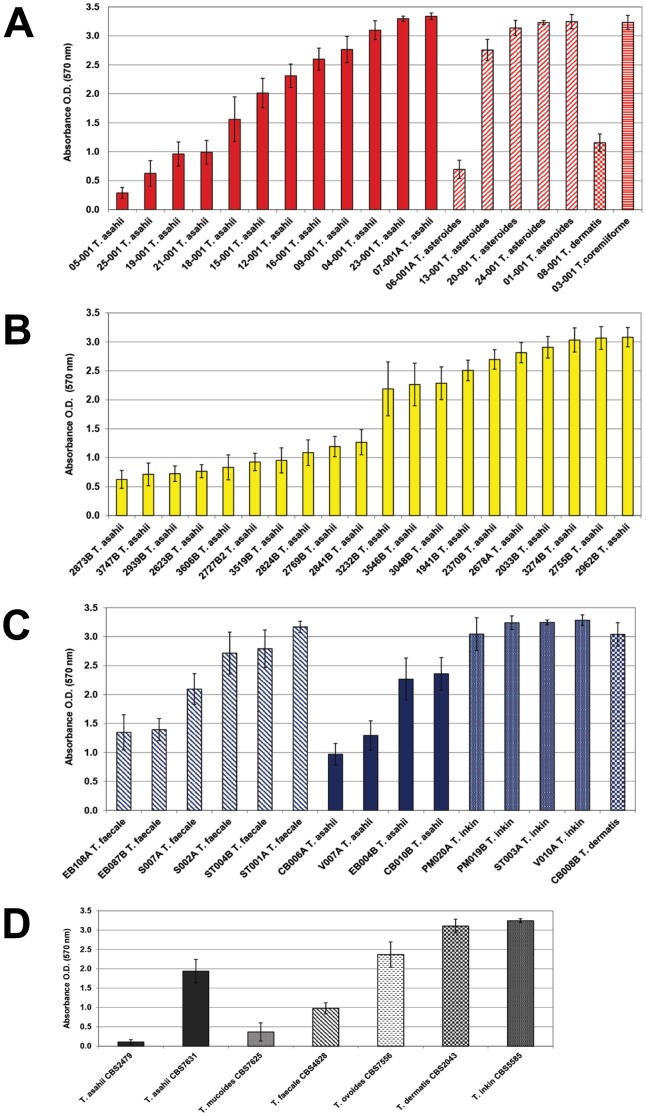
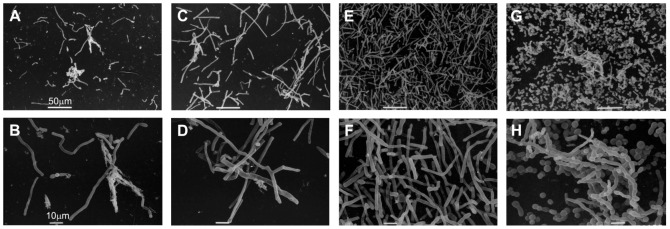
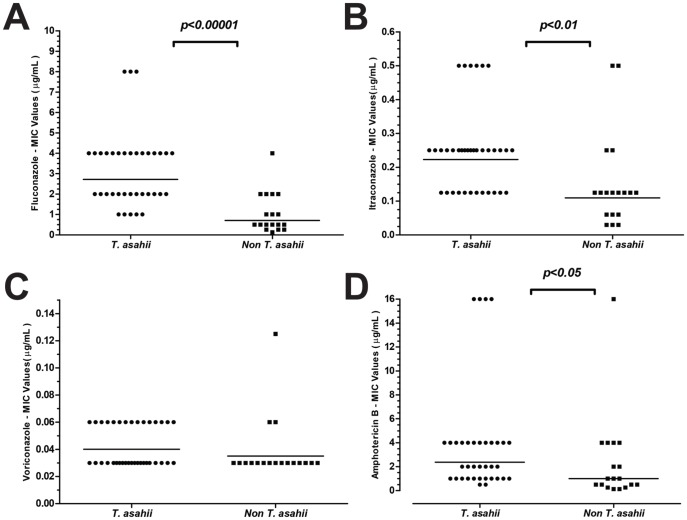
Invasive infections caused by Trichosporon spp. have increased considerably in recent years, especially in neutropenic and critically ill patients using catheters and antibiotics. The genus presents limited sensitivity to different antifungal agents, but triazoles are the first choice for treatment. Here, we investigated the biofilm production and antifungal susceptibility to triazoles and amphotericin B of 54 Trichosporon spp. isolates obtained from blood samples (19), urine (20) and superficial mycosis (15). All isolates and 7 reference strains were identified by sequence analysis and phylogenetic inferences of the IGS1 region of the rDNA. Biofilms were grown on 96-well plates and quantitation was performed using crystal violet staining, complemented with Scanning Electron Microscopy (SEM). Susceptibility tests for fluconazole, itraconazole, voriconazole and amphotericin B were processed using the microdilution broth method (CLSI) for planktonic cells and XTT reduction assay for biofilm-forming cells. Our results showed that T. asahii was the most frequent species identified (66.7%), followed by T. faecale (11.1%), T. asteroides (9.3%), T. inkin (7.4%), T. dermatis (3.7%) and one T. coremiiforme (1.8%). We identified 4 genotypes within T. asahii isolates (G1, G3, G4 and G5) and 2 genotypes within T. faecale (G1 and G3). All species exhibited high adhesion and biofilm formation capabilities, mainly T. inkin, T. asteroides and T. faecale. Microscopy images of high biofilm-producing isolates showed that T. asahii presented mainly hyphae and arthroconidia, whereas T. asteroides exhibited mainly short arthroconidia and few filaments. Voriconazole exhibited the best in vitro activity against all species tested. Biofilm-forming cells of isolates and reference strains were highly resistant to all antifungals tested. We concluded that levels of biofilm formation by Trichosporon spp. were similar or even greater than those described for the Candida genus. Biofilm-forming cells were at least 1,000 times more resistant to antifungals than planktonic cells, especially to voriconazole.
Conflict of interest statement
Figures
References
-
- Magalhaes AR, Mondino SS, Silva M, Nishikawa MM (2008) Morphological and biochemical characterization of the aetiological agents of white piedra . Mem Inst Oswaldo Cruz 103: 786–790. - PubMed
-
- Pfaller MA, Diekema DJ, Rinaldi MG, Barnes R, Hu B, et al. (2005) Results from the ARTEMIS DISK Global Antifungal Surveillance Study: a 6.5-year analysis of susceptibilities of Candida and other yeast species to fluconazole and voriconazole by standardized disk diffusion testing. J Clin Microbiol 43: 5848–5859. - PMC - PubMed
-
- Pfaller MA, Diekema DJ, Gibbs DL, Newell VA, Meis JF, et al. (2007) Results from the ARTEMIS DISK Global Antifungal Surveillance study, 1997 to 2005: an 8.5-year analysis of susceptibilities of Candida species and other yeast species to fluconazole and voriconazole determined by CLSI standardized disk diffusion testing. J Clin Microbiol 45: 1735–1745. - PMC - PubMed
-
- Pfaller MA, Diekema DJ, Gibbs DL, Newell VA, Bijie H, et al. (2009) Results from the ARTEMIS DISK Global Antifungal Surveillance Study, 1997 to 2007: 10.5-year analysis of susceptibilities of noncandidal yeast species to fluconazole and voriconazole determined by CLSI standardized disk diffusion testing. Journal of Clinical Microbiology 47: 117–123. - PMC - PubMed
Publication types
MeSH terms
Substances
LinkOut - more resources
Full Text Sources
Other Literature Sources
Miscellaneous
