. 2014 Oct 30;19(11):17649-62.
doi: 10.3390/molecules191117649.

β-sitosterol protects against carbon tetrachloride hepatotoxicity but not gentamicin nephrotoxicity in rats via the induction of mitochondrial glutathione redox cycling

Affiliations

β-sitosterol protects against carbon tetrachloride hepatotoxicity but not gentamicin nephrotoxicity in rats via the induction of mitochondrial glutathione redox cycling

Hoi-Shan Wong et al. Molecules. .

Abstract

Previous findings have demonstrated that β-sitosterol (BSS), an active component of Cistanches Herba, protected against oxidant injury in H9c2 cardiomyocytes and in rat hearts by enhancing mitochondrial glutathione redox cycling, possibly through the intermediacy of mitochondrial reactive oxygen species production. We therefore hypothesized that BSS pretreatment can also confer tissue protection against oxidant injury in other vital organs such as liver and kidney of rats. In this study, the effects of BSS pretreatment on rat models of carbon tetrachloride (CCl4) hepatotoxicity and gentamicin nephrotoxicity were investigated. The findings showed that BSS pretreatment protected against CCl4-induced hepatotoxicity, but not gentamicin nephrotoxicity in rats. The hepatoprotection afforded by BSS was associated with the improvement in mitochondrial glutathione redox status, presumably through the glutathione reductase-mediated enhancement in mitochondrial glutathione redox cycling. The hepatoprotection afforded by BSS was also accompanied by the improved mitochondrial functional ability in rat livers. The inability of BSS to protect against gentamicin nephrotoxicity was likely due to the relatively low bioavailability of BSS in rat kidneys. BSS may serve as potential mitohormetic agent for the prevention of oxidative stress-induced injury in livers.


Conflict of interest statement

The authors declare no conflict of interest

Figures
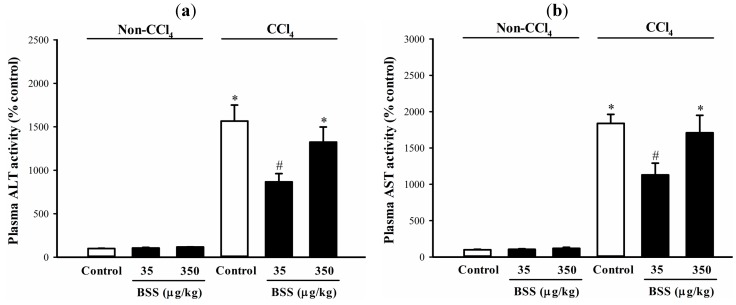
Figure 1
Figure 1
Effects of BSS on plasma ALT and AST activities in control and CCl4-intoxicated female rats. Plasma (a) ALT and (b) AST activity were measured as described in Materials and methods. Data were expressed in percent control with respect to the non-CCl4 control (plasma ALT activity = 41.2 ± 7.6 mU/L; plasma AST activity = 73.3 ± 11.8 mU/L). Values given are means ± SEM, with n = 7.
Figure 2
Figure 2
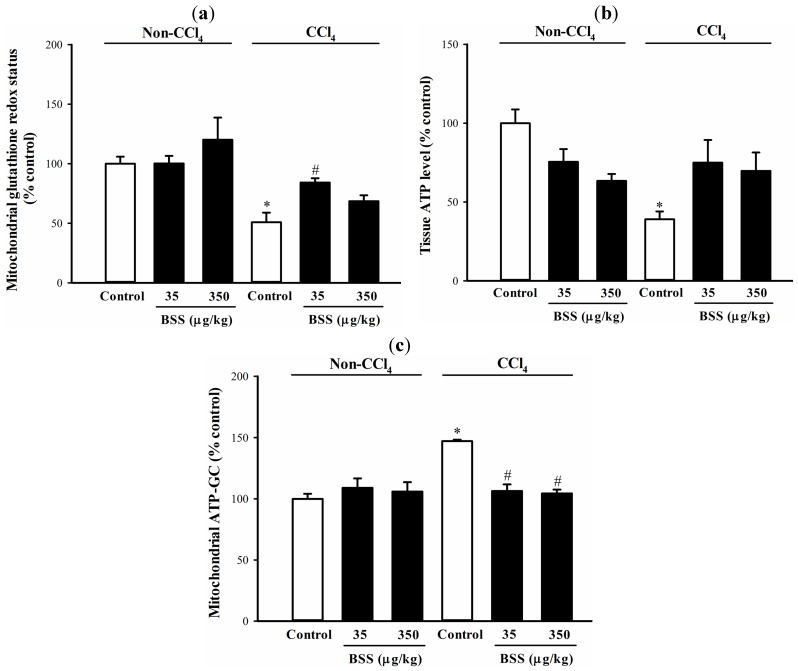
Effects of BSS on control and CCl4-intoxicated female rat livers. Data were expressed in percent control with respect to the non-CCl4 control ((a) mitochondrial GSH/GSSG ratio = 9.6 ± 0.3; (b) tissue ATP level = 10.2 ± 0.3 nmol/mg protein; (c) ATP-GC value = 999.8 ± 65.7 AU). Values given are means ± SEM, with n = 7.
Figure 3
Figure 3
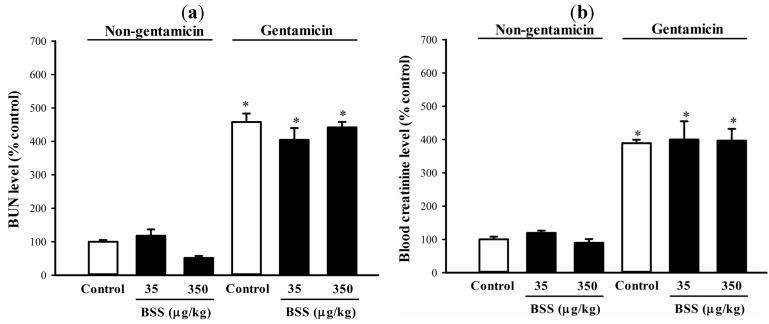
Effects of BSS on BUN and blood creatinine level in control and gentamicin-challenged rats. (a) BUN and (b) blood creatinine level were measured as described in Materials and methods. Data were expressed in percent control with respect to the non-gentamicin control (BUN level = 187.2 ± 16.2 mg/L; blood creatinine level = 4.5 ± 0.3 mg/L). Values given are means ± SEM, with n = 7.
Figure 4
Figure 4
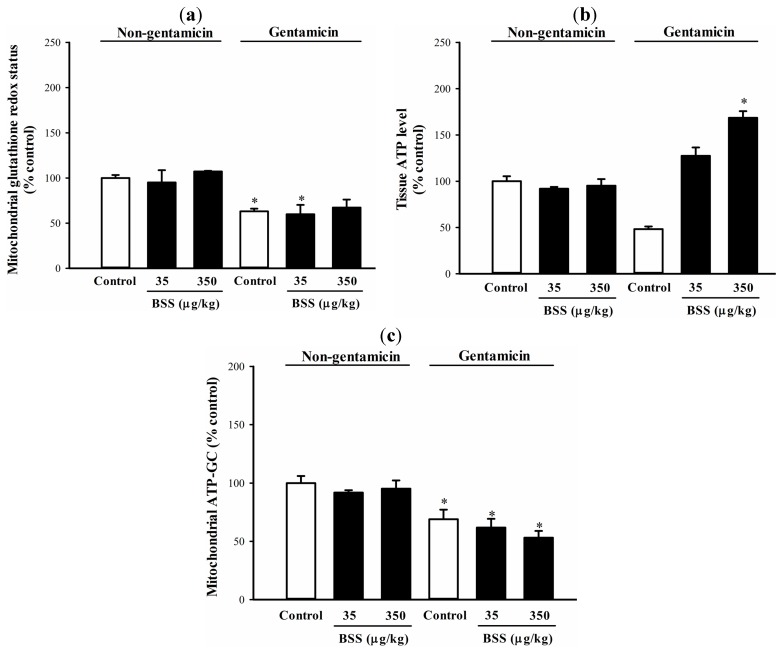
Effects of BSS on control and gentamicin-challenged rat kidneys. (a) Mitochondrial glutathione redox status, (b) tissue ATP level and (c) mitochondrial ATP-GC were examined as described in Materials and methods. Data were expressed in percent control with respect to non-gentamicin control (mitochondrial GSH/GSSG ratio = 13.9 ± 1.6; tissue ATP level = 0.9 ± 0.1 nmol/mg protein; ATP-GC value = 997.8 ± 14.4 AU). Values given are means ± SEM, with n = 7.

References

    1. Cesaratto L., Vascotto C., Calligaris S., Tell G.L. The importance of redox state in liver damage. Ann. Hepatol. 2004;3:86–92. - PubMed
    1. Tanikawa K., Torimura T. Studies on oxidative stress in liver diseases: Important future trends in liver research. Med. Mol. Morphol. 2006;39:22–27. doi: 10.1007/s00795-006-0313-z. - DOI - PubMed
    1. Li G., Chen Y., Hu H., Liu L., Hu X., Wang J., Shi W., Yin D. Association between age-related decline of kidney function and plasma malondialdehyde. Rejuvenation Res. 2012;15:257–264. doi: 10.1089/rej.2011.1259. - DOI - PMC - PubMed
    1. Small D.M., Coombes J.S., Bennett N., Johnson D.W., Gobe G.C. Oxidative stress, anti-oxidant therapies and chronic kidney disease. Nephrology. 2012;17:311–321. doi: 10.1111/j.1440-1797.2012.01572.x. - DOI - PubMed
    1. Molina M.F., Sanchez-Reus I., Iqlesias I., Benedi J. Quercetin, a flavonoid antioxidant, prevents and protects against ethanol-induced oxidative stress in mouse liver. Biol. Pharm. Bull. 2003;26:1398–1402. doi: 10.1248/bpb.26.1398. - DOI - PubMed

MeSH terms

LinkOut - more resources