


ArrayExpress update--simplifying data submissions
- PMID: 25361974
- PMCID: PMC4383899
- DOI: 10.1093/nar/gku1057
ArrayExpress update--simplifying data submissions
Abstract
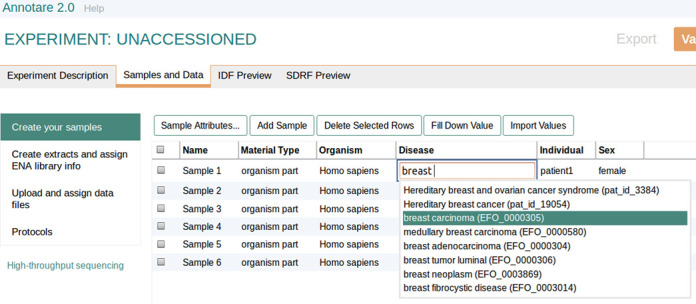
The ArrayExpress Archive of Functional Genomics Data (http://www.ebi.ac.uk/arrayexpress) is an international functional genomics database at the European Bioinformatics Institute (EMBL-EBI) recommended by most journals as a repository for data supporting peer-reviewed publications. It contains data from over 7000 public sequencing and 42,000 array-based studies comprising over 1.5 million assays in total. The proportion of sequencing-based submissions has grown significantly over the last few years and has doubled in the last 18 months, whilst the rate of microarray submissions is growing slightly. All data in ArrayExpress are available in the MAGE-TAB format, which allows robust linking to data analysis and visualization tools and standardized analysis. The main development over the last two years has been the release of a new data submission tool Annotare, which has reduced the average submission time almost 3-fold. In the near future, Annotare will become the only submission route into ArrayExpress, alongside MAGE-TAB format-based pipelines. ArrayExpress is a stable and highly accessed resource. Our future tasks include automation of data flows and further integration with other EMBL-EBI resources for the representation of multi-omics data.
© The Author(s) 2014. Published by Oxford University Press on behalf of Nucleic Acids Research.
Figures
References
-
- Ioannidis J.P., Allison D.B., Ball C.A., Coulibaly I., Cui X., Culhane A.C., Falchi M., Furlanello C., Game L., Jurman G., et al. Repeatability of published microarray gene expression analyses. Nat. Genet. 2009;41:149–155. - PubMed
-
- Brazma A., Hingamp P., Quackenbush J., Sherlock G., Spellman P., Stoeckert C., Aach J., Ansorge W., Ball C.A., Causton H.C., et al. Minimum information about a microarray experiment (MIAME)-toward standards for microarray data. Nat. Genet. 2001;29:365–371. - PubMed
Publication types
MeSH terms
Grants and funding
LinkOut - more resources
Full Text Sources
Other Literature Sources
