


Early Treatment Response in Children and Adolescents Receiving CBT for Trauma
- PMID: 25362103
- PMCID: PMC4710179
- DOI: 10.1093/jpepsy/jsu096
Early Treatment Response in Children and Adolescents Receiving CBT for Trauma
Abstract
Objectives: To investigate the incidence and correlates of early treatment response among youth receiving cognitive behavioral therapy (CBT) for posttraumatic stress disorder (PTSD).
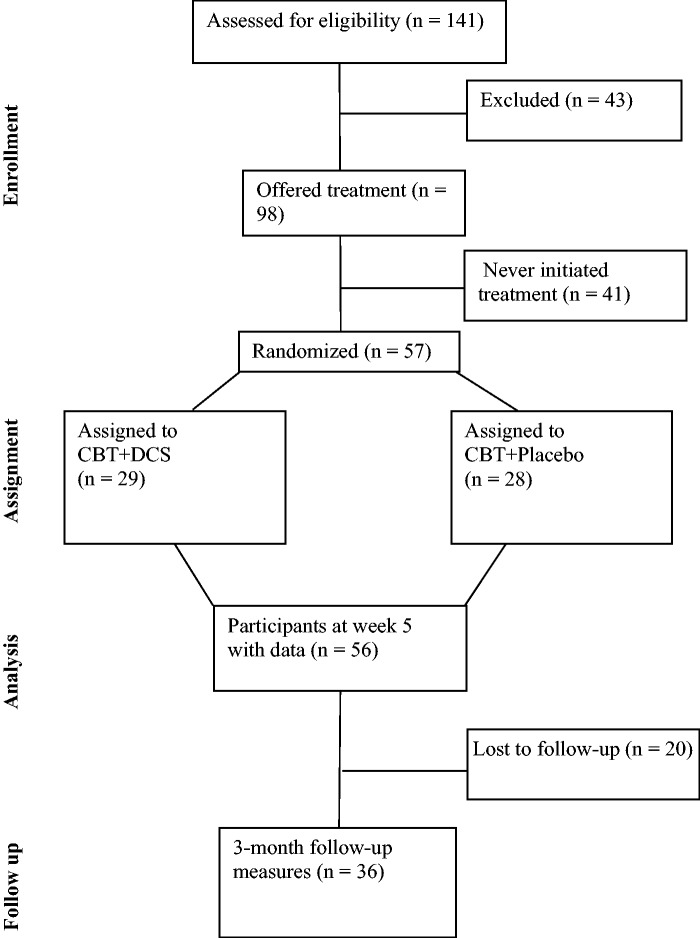
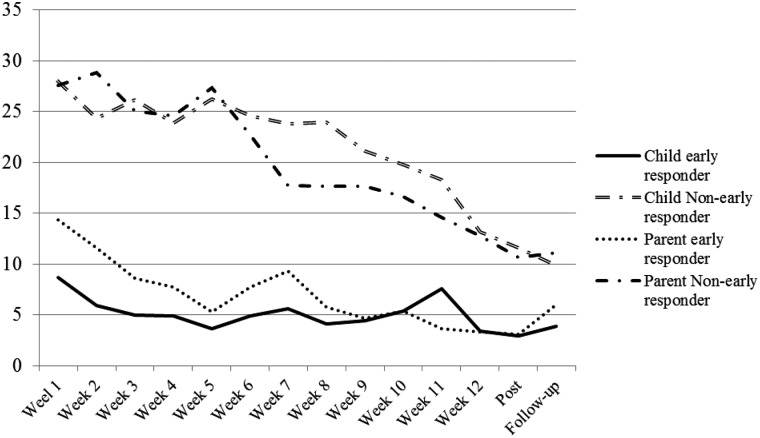
Methods: 56 youth who participated in a randomized controlled trial of CBT for PTSD and D-cycloserine were included. Youth with PTSD symptoms below clinical cutoff after Session 4 of a 12-session protocol were classified as early treatment responders (32% of parent reports, 44.6% of child reports). Pretreatment characteristics were examined in relation to responder status.
Results: Lower levels of pretreatment PTSD, depression, and anxiety symptoms and fewer trauma types were related to child- and parent-reported responder status (d = .57, d = .52, respectively). Early treatment response was maintained at follow-up.
Conclusions: Pretreatment symptoms levels and number of traumas may play an important role in predicting early treatment response. Correlates of early treatment response may provide avenues for identifying youth who could benefit from abbreviated protocols.
Keywords: PTSD; children and adolescents; cognitive behavior therapy; early treatment response.
© The Author 2014. Published by Oxford University Press on behalf of the Society of Pediatric Psychology. All rights reserved. For permissions, please e-mail: journals.permissions@oup.com.
Figures
References
-
- Allen B., Gharagozloo L., Johnson J. C. (2012). Clinician knowledge and utilization of empirically-supported treatments for maltreated children. Child Maltreatment, 17, 11–21. - PubMed
-
- Birmaher B., Khetarpal S., Brent D., Cully M., Balach L., Kaufman J., Neer S. M. (1997). The screen for child anxiety related emotional disorders (SCARED): Scale construction and psychometric characteristics. Journal of the American Academy of Child and Adolescent Psychiatry, 36, 545–553. - PubMed
-
- Carle A. C., Millsap R., Cole D. A. (2008). Measurement bias across gender on the Children's Depression Inventory. Educational & Psychological Measurement, 68, 281–303.
-
- Carrión V. G., Kletter H., Weems C. F., Berry R. R., Rettger J. P. (2013). Cue-centered treatment for youth exposed to interpersonal violence: A randomized controlled trial. Journal of Traumatic Stress, 26, 654–662. - PubMed
Publication types
MeSH terms
Grants and funding
LinkOut - more resources
Full Text Sources
Other Literature Sources
Medical
