. 2014 Jul 1;3(3):285-316.
doi: 10.3390/antibiotics3030285.

Evolution of Metallo-β-lactamases: Trends Revealed by Natural Diversity and in vitro Evolution

Affiliations

Evolution of Metallo-β-lactamases: Trends Revealed by Natural Diversity and in vitro Evolution

María-Rocío Meini et al. Antibiotics (Basel). .

Abstract

The production of β-lactamase enzymes is one of the most distributed resistance mechanisms towards β-lactam antibiotics. Metallo-β-lactamases constitute a worrisome group of these kinds of enzymes, since they present a broad spectrum profile, being able to hydrolyze not only penicillins, but also the latest generation of cephalosporins and carbapenems, which constitute at present the last resource antibiotics. The VIM, IMP, and NDM enzymes comprise the main groups of clinically relevant metallo-β-lactamases. Here we present an update of the features of the natural variants that have emerged and of the ones that have been engineered in the laboratory, in an effort to find sequence and structural determinants of substrate preferences. This knowledge is of upmost importance in novel drug design efforts. We also discuss the advances in knowledge achieved by means of in vitro directed evolution experiments, and the potential of this approach to predict natural evolution of metallo-β-lactamases.

Keywords: evolution; metallo-β-lactamases; resistance.


Figures
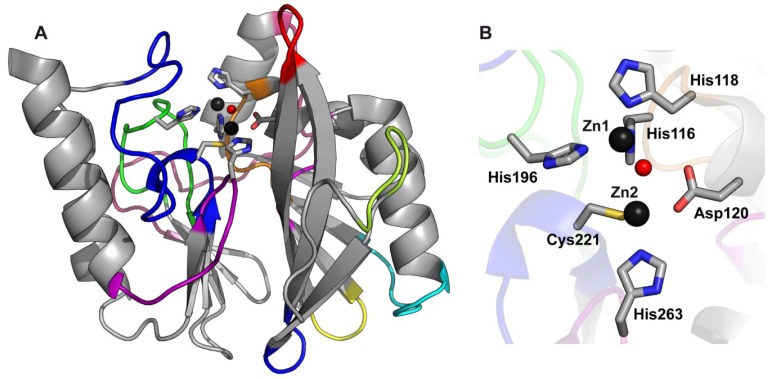
Figure 1
Figure 1
B1 MBLs conserved global fold and active site. (A) The crystallographic structure of VIM-2 (PDB 1KO3) is shown as an example of the conserved MBLs fold; (B) The active site of VIM-2 is shown as an example of B1 enzymes, consisting of two Zn(II) ions (dark gray spheres) bound by the indicated ligand residues (shown as sticks) and a bridging water/hydroxide molecule (red sphere).
Figure 2
Figure 2
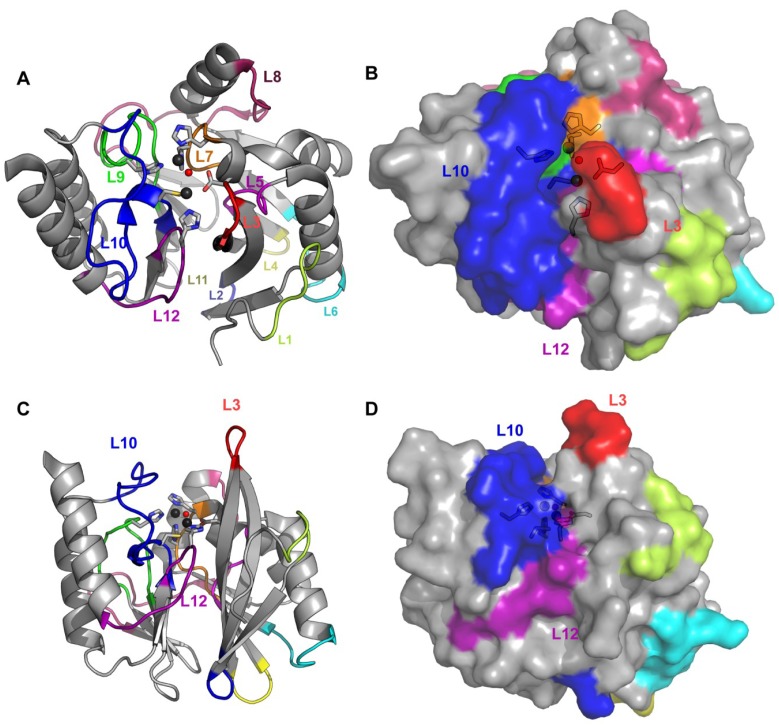
Loops and active site of B1 enzymes. (A) The loops, conserved in most of B1 enzymes, are marked in the crystallographic structure of VIM-2 (PDB 1KO3) in cartoon representation; (B) The same angle is shown as surface to distinguish the active site cavity; (C) and (D) Cartoon and surface representations viewed from another angle to show the active site walls formed by Loops L10 and L3 and the floor constituted by Loop-L12.
Figure 3
Figure 3
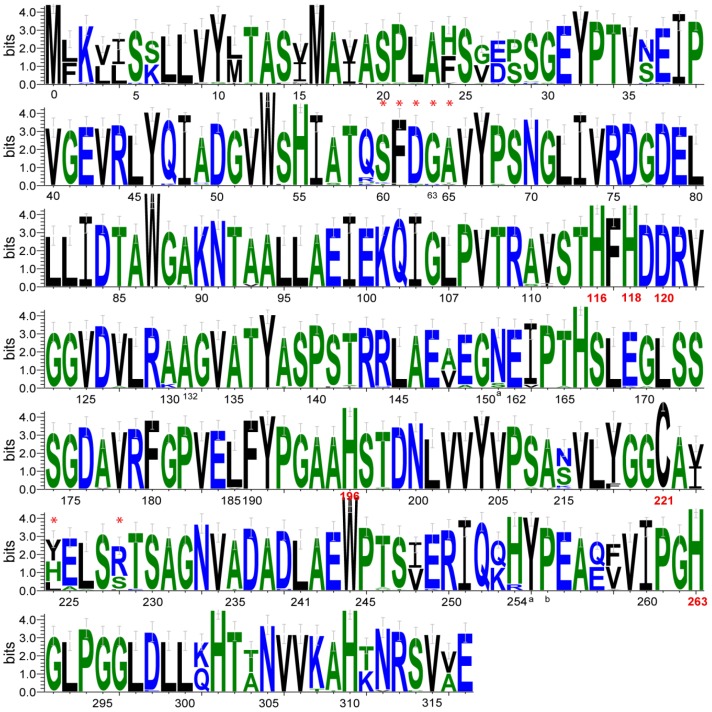
Logo representation of the alignment of the VIM variants. Logo was performed with WebLogo3 [69]. The compositional adjustment used was the typical amino acid usage pattern for proteins. Sequence is numbered according to the BBL scheme. The position of the amino acids that are Zn(II) ligands is highlighted in red. Positions discussed in the text are marked with an upper asterisk.
Figure 4
Figure 4
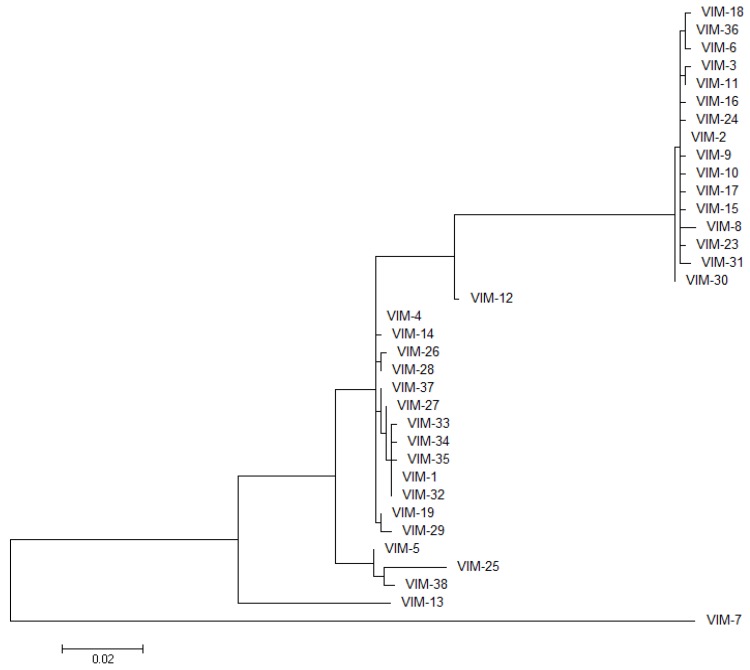
Molecular phylogenetic analysis of VIM variants. The evolutionary history was inferred by using the Maximum Likelihood method based on the Tamura-Nei model [70]. The tree with the highest log likelihood (−2610.7954) is drawn to scale, with branch lengths measured in the number of substitutions per site. The analysis involved 35 nucleotide sequences. Evolutionary analyses were conducted in MEGA6 [71].
Figure 5
Figure 5
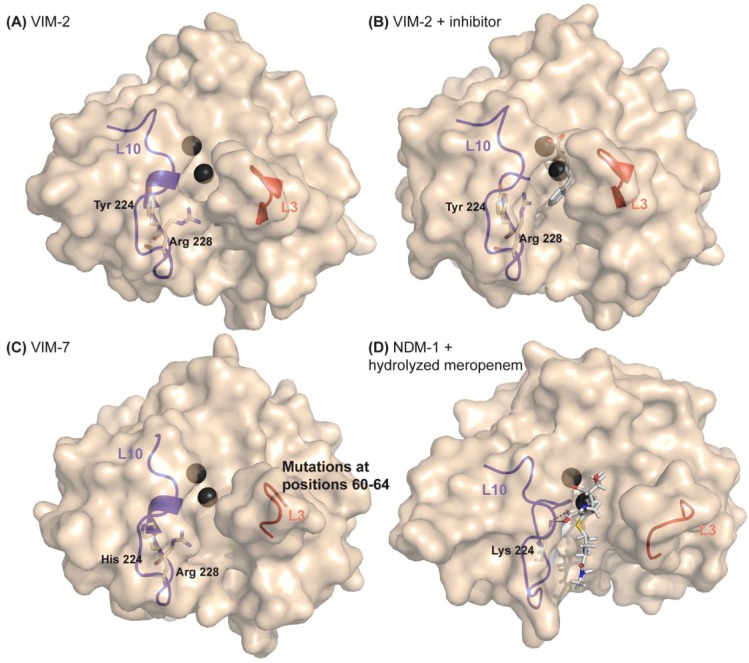
Structural features related to substrate preferences on the VIM variants family. (A) Crystallographic structure of VIM-2 (PDB 1K03); (B) Crystallographic structure of VIM-2 bound to a mercaptocarboxylate inhibitor (PDB 2YZ3); (C) Crystallographic structure of VIM-7 (PDB 2Y87); (D) Crystallographic structure of NDM-1 bound to hydrolyzed meropenem. The structures are represented as surface, Zn(II) ions are shown as dark grey spheres, Loop-L10 and Loop-L3 are shown as cartoon representations, residues at positions 224 and 228 are shown as sticks in VIMs structures. Lys224 is shown as stick in the NDM-1 structure, interacting with the C3-carboxylate of hydrolyzed meropenem. Arg228 has been proposed to act as a Lys224 equivalent on VIMs. Arg228 present different conformations in different VIM structures and is capable of adjusting its position to accommodate the inhibitor’s phenyl group, being stabilized by the interaction between the carbonyl group of Ala231 with the hydroxyl group of Tyr224. The binding cleft of VIM-2 is slightly narrower than that of VIM-7 due to Phe61 (Leu in VIM-7) and the different conformation of Arg228.
Figure 6
Figure 6
Kinetic parameters for VIM-1, VIM-2, VIM-4 and VIM-7 variants towards various β-lactam antibiotics. The data for VIM-1 and VIM-2 correspond to Docquier et al. [59] and the conditions employed for the reactions were 50 mM Hepes pH 7.5, 50 μM ZnCl2, and 20 μg/mL BSA, 30 °C. The data for VIM-4 correspond to Lassaux et al. [60] and the conditions employed for the reactions were 15 mM Hepes pH 7.2, 50 µM ZnCl2 and 20 µg/mL BSA. The data for VIM-7 correspond to Samuelsen et al. [61] and the conditions employed for the reactions were 50 mM sodium cacodylate pH 7, 100 μM ZnCl2, and 0.1 mg/mL BSA, 25 °C.
Figure 7
Figure 7
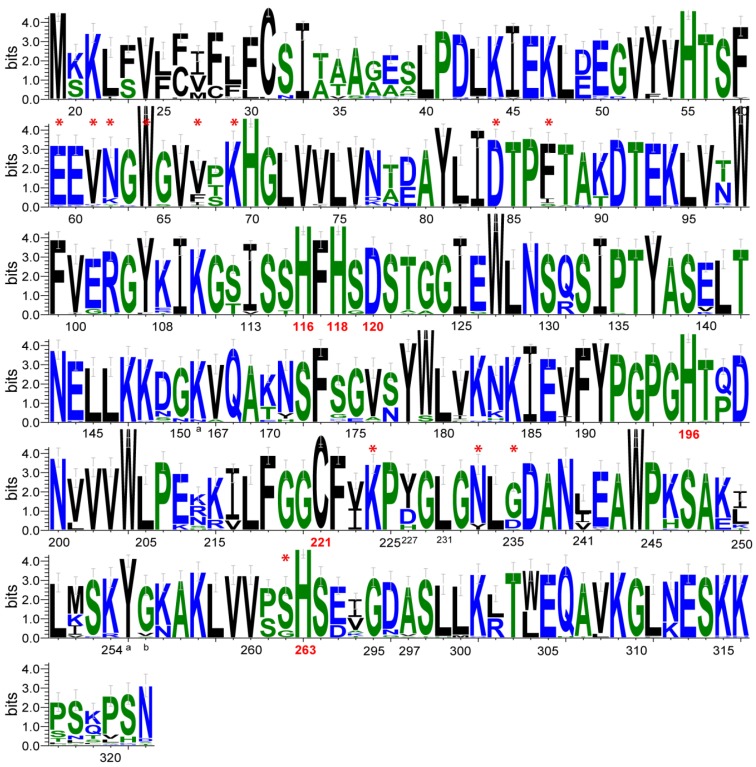
Logo representation of the alignment of the IMP variants. Logo was performed with WebLogo3 [69]. The compositional adjustment used was the typical amino acid usage pattern for proteins. Sequence is numbered according to the BBL scheme. The position of the amino acids that are Zn(II) ligands is highlighted in red. Positions discussed in the text are marked with an upper asterisk.
Figure 8
Figure 8
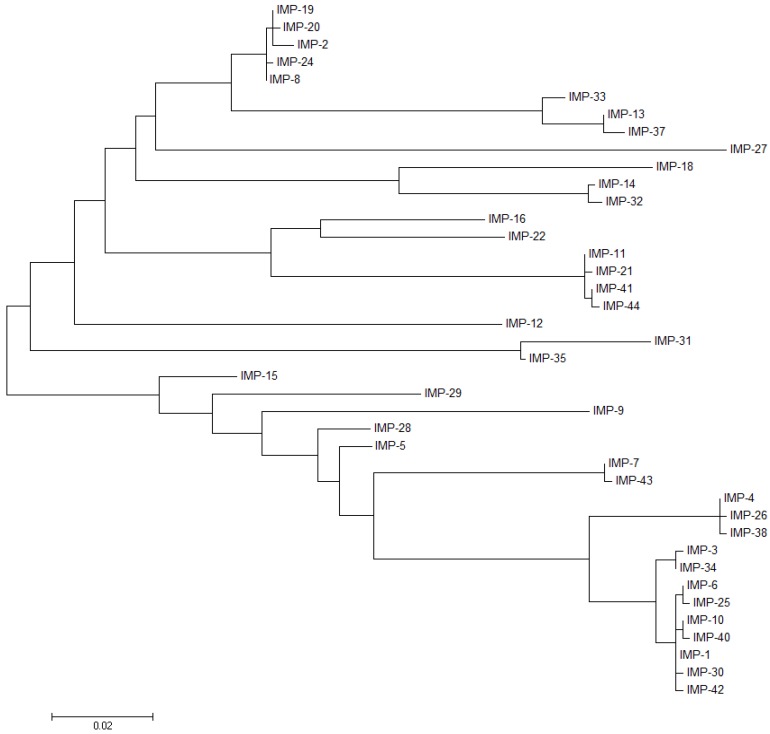
Molecular phylogenetic analysis of IMP variants. The evolutionary history was inferred by using the Maximum Likelihood method based on the Tamura-Nei model [70]. The tree with the highest log is drawn to scale, with branch lengths measured in the number of substitutions per site. The analysis involved 40 nucleotide sequences. There were a total of 738 positions in the final dataset. Evolutionary analyses were conducted in MEGA6 [71].
Figure 9
Figure 9
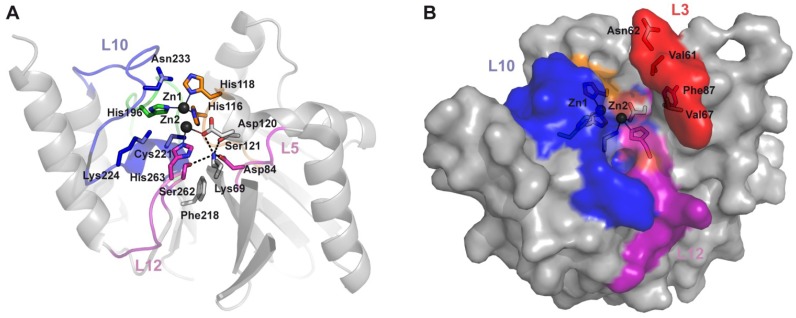
Structural features related to substrate preferences on the IMP variants family. (A) The active site residues are shown together with residues that accept variations but with substrate dependent effects on the randomization experiments performed by Palzkill et al. [44,73]. Since most of them are second shell residues, relevant hydrogen bond interactions are shown as dashed lines. Lys224 and Ser262 accept minimal variations. Zn(II) ions are represented as dark gray spheres; residues are showed as sticks; (B) Surface representation of IMP-1 structure (PDB 1DDK), showing the residues at Loop-L3 that accepted variations preserving hydrophobicity with some substrate dependence.
Figure 10
Figure 10
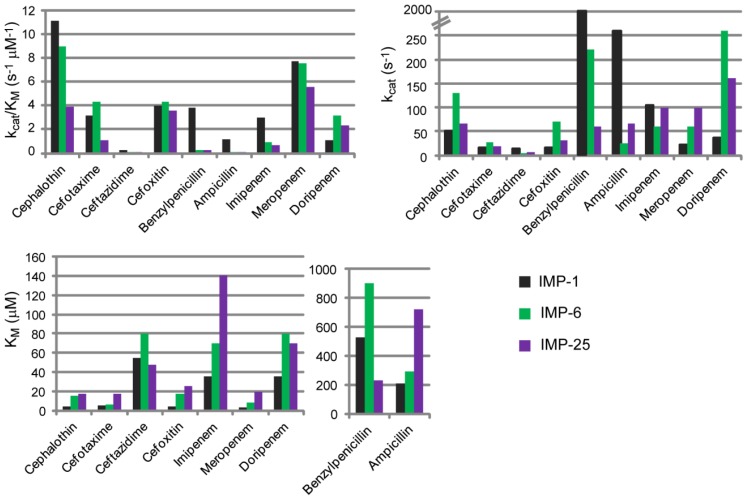
Kinetic parameters for IMP-1, IMP-6 and IMP-25 variants towards various β-lactam antibiotics. The data correspond to Liu et al. [83], the conditions employed for the reactions were Buffer MOPS pH 7, 100 µM ZnSO4, 10 µg/mL BSA, 30 °C.
Figure 11
Figure 11
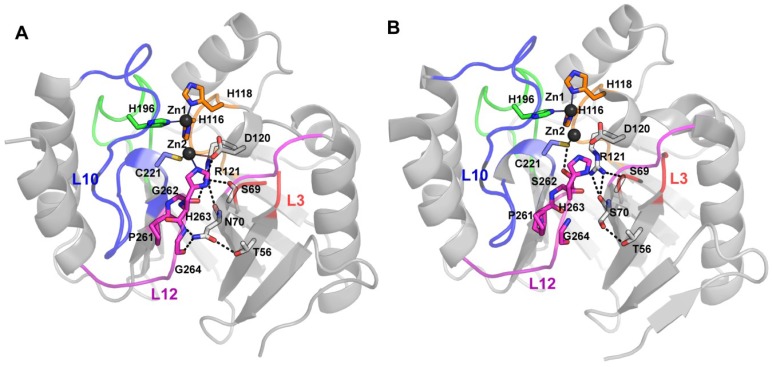
Hydrogen bond rearrangements in the vicinity of the active of the BcII evolved mutant. (A) BcII structure (PDB 1BC2); (B) BcII evolved mutant structure (PDB 3FCZ). The residues implicated in the hydrogen bond network that is affected by mutations N70S and G262S in the evolved mutant are shown together with the active site residues. The mutation G262S gives rise to a new interaction between side chains of Cys221 and Ser262 that affects the position of the Zn(II) ion at the Zn2 site. Interactions involving Asn70 side chain that connect Loop-12 and Loop-L3 are lost when this position is mutated to Ser. Residues are shown as sticks, relevant hydrogen bond interactions are shown as dashed lines and Zn(II) ions are shown as dark gray spheres.
Figure 12
Figure 12
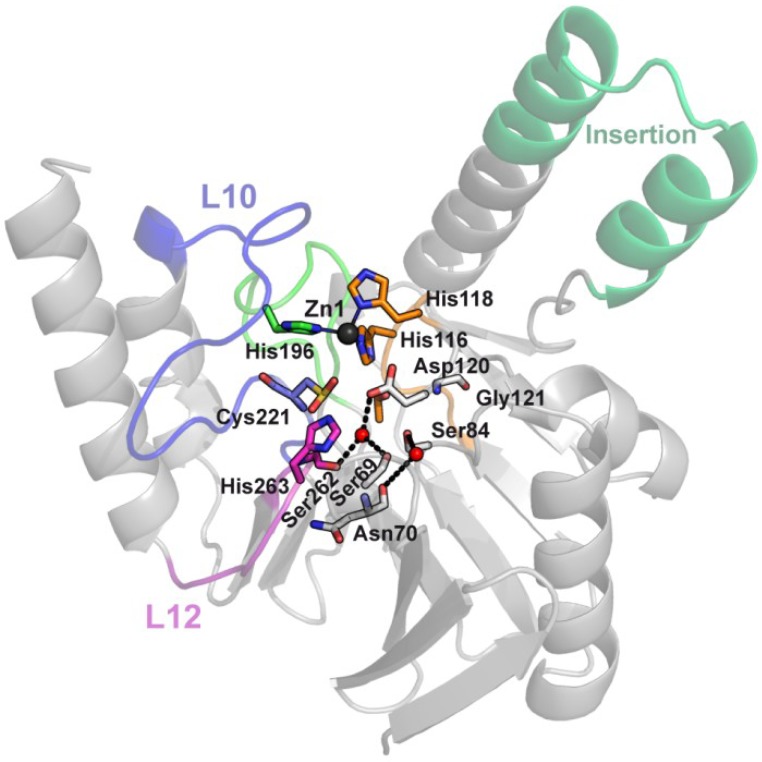
SPM-1, a B1 enzyme with unique structural and second sphere features. SPM-1 crystallographic structure (PDB 2FHX) shows how a central insertion accommodates in an extended α-helix, instead of the L8 loop found in the other B1 enzymes. Two atypical second sphere residues in SPM-1, S84, and G121, which replace the conserved D84/R121 couple, disrupt a B1 conserved second sphere network. Residues are shown as sticks, Zn(II) ions as dark gray spheres and water molecules as red spheres.

References

    1. Fisher J.F., Meroueh S.O., Mobashery S. Bacterial resistance to beta-lactam antibiotics: Compelling opportunism, compelling opportunity. Chem. Rev. 2005;105:395–424. doi: 10.1021/cr030102i. - DOI - PubMed
    1. Llarrull L.I., Testero S.A., Fisher J.F., Mobashery S. The future of the β-lactams. Curr. Opin. Microbiol. 2010;13:551–557. doi: 10.1016/j.mib.2010.09.008. - DOI - PMC - PubMed
    1. Bebrone C. Metallo-beta-lactamases (classification, activity, genetic organization, structure, zinc coordination) and their superfamily. Biochem. Pharmacol. 2007;74:1686–1701. doi: 10.1016/j.bcp.2007.05.021. - DOI - PubMed
    1. Paterson D.L., Bonomo R.A. Extended-spectrum beta-lactamases: A clinical update. Clin. Microbiol. Rev. 2005;18:657–686. doi: 10.1128/CMR.18.4.657-686.2005. - DOI - PMC - PubMed
    1. Nordmann P., Naas T., Poirel L. Global Spread of Carbapenemase-producing Enterobacteriaceae. Emerg. Infect. Dis. 2011;17:1791–1798. doi: 10.3201/eid1710.110655. - DOI - PMC - PubMed

LinkOut - more resources