


Neurovascular events after subarachnoid hemorrhage: focusing on subcellular organelles
- PMID: 25366597
- PMCID: PMC4373344
- DOI: 10.1007/978-3-319-04981-6_7
Neurovascular events after subarachnoid hemorrhage: focusing on subcellular organelles
Abstract
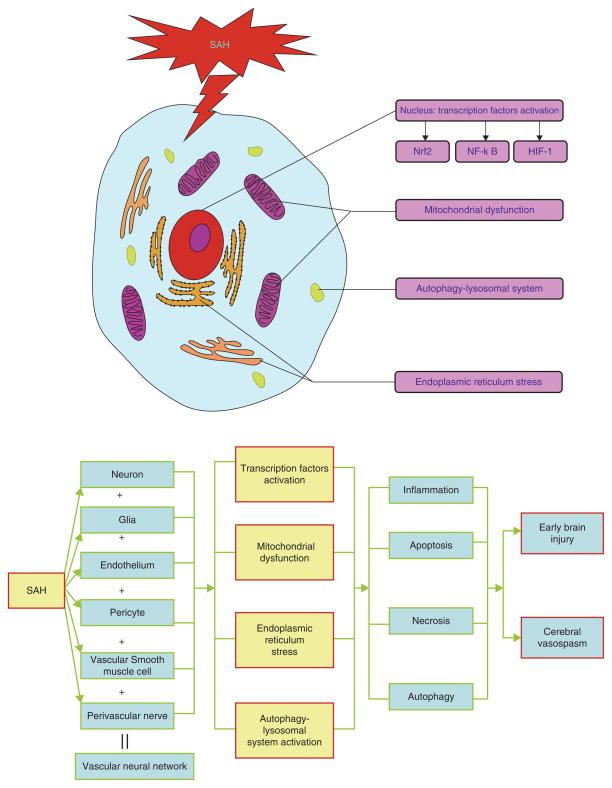
Subarachnoid hemorrhage (SAH) is a devastating condition with high morbidity and mortality rates due to the lack of effective therapy. Early brain injury (EBI) and cerebral vasospasm (CVS) are the two most important pathophysiological mechanisms for brain injury and poor outcomes for patients with SAH. CVS has traditionally been considered the sole cause of delayed ischemic neurological deficits after SAH. However, the failure of antivasospastic therapy in patients with SAH supported changing the research target from CVS to other mechanisms. Currently, more attention has been focused on global brain injury within 3 days after ictus, designated as EBI. The dysfunction of subcellular organelles, such as endoplasmic reticulum stress, mitochondrial failure, and autophagy-lysosomal system activation, has developed during EBI and delayed brain injury after SAH. To our knowledge, there is a lack of review articles addressing the direction of organelle dysfunction after SAH. In this review, we discuss the roles of organelle dysfunction in the pathogenesis of SAH and present the opportunity to develop novel therapeutic strategies of SAH via modulating the functions of organelles.
Conflict of interest statement
Figures
References
-
- Alaraj A, Charbel FT, Amin-Hanjani S. Peri-operative measures for treatment and prevention of cerebral vasospasm following subarachnoid hemorrhage. Neurol Res. 2009;31:651–659. - PubMed
-
- Baird L, Dinkova-Kostova AT. The cytoprotective role of the Keap1-Nrf2 pathway. Arch Toxicol. 2011;85:241–272. - PubMed
-
- Bramlett HM. Importance of sex in the pathophysiology and treatment of acute CNS repair. Transl Stroke Res. 2013;4:379–380. - PubMed
-
- Caner B, Hou J, Altay O, Fuj M, 2nd, Zhang JH. Transition of research focus from vasospasm to early brain injury after sub-arachnoid hemorrhage. J Neurochem. 2012;123(Suppl 2):12–21. - PubMed
Publication types
MeSH terms
Grants and funding
LinkOut - more resources
Full Text Sources
Other Literature Sources