. 2014 Nov 3:11:151.
doi: 10.1186/1743-0003-11-151.

Autonomous exoskeleton reduces metabolic cost of human walking

Affiliations

Autonomous exoskeleton reduces metabolic cost of human walking

Luke M Mooney et al. J Neuroeng Rehabil. .

Abstract

Background: Passive exoskeletons that assist with human locomotion are often lightweight and compact, but are unable to provide net mechanical power to the exoskeletal wearer. In contrast, powered exoskeletons often provide biologically appropriate levels of mechanical power, but the size and mass of their actuator/power source designs often lead to heavy and unwieldy devices. In this study, we extend the design and evaluation of a lightweight and powerful autonomous exoskeleton evaluated for loaded walking in (J Neuroeng Rehab 11:80, 2014) to the case of unloaded walking conditions.

Findings: The metabolic energy consumption of seven study participants (85 ± 12 kg body mass) was measured while walking on a level treadmill at 1.4 m/s. Testing conditions included not wearing the exoskeleton and wearing the exoskeleton, in both powered and unpowered modes. When averaged across the gait cycle, the autonomous exoskeleton applied a mean positive mechanical power of 26 ± 1 W (13 W per ankle) with 2.12 kg of added exoskeletal foot-shank mass (1.06 kg per leg). Use of the leg exoskeleton significantly reduced the metabolic cost of walking by 35 ± 13 W, which was an improvement of 10 ± 3% (p = 0.023) relative to the control condition of not wearing the exoskeleton.

Conclusions: The results of this study highlight the advantages of developing lightweight and powerful exoskeletons that can comfortably assist the body during walking.


Figures
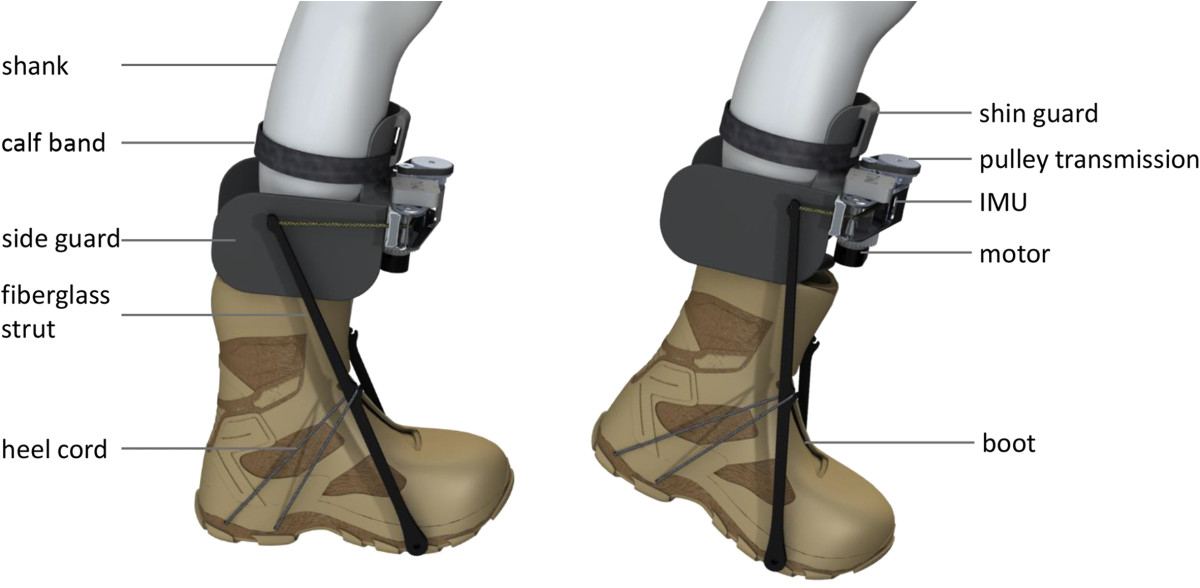
Figure 1
Figure 1
Autonomous leg exoskeleton. The posterior protrusion of the device was reduced compared to the former exoskeleton [6] by using shorter struts and increasing the length of the heel cord. Further, side guards were added to eliminate strut rubbing against the calves during walking.
Figure 2
Figure 2
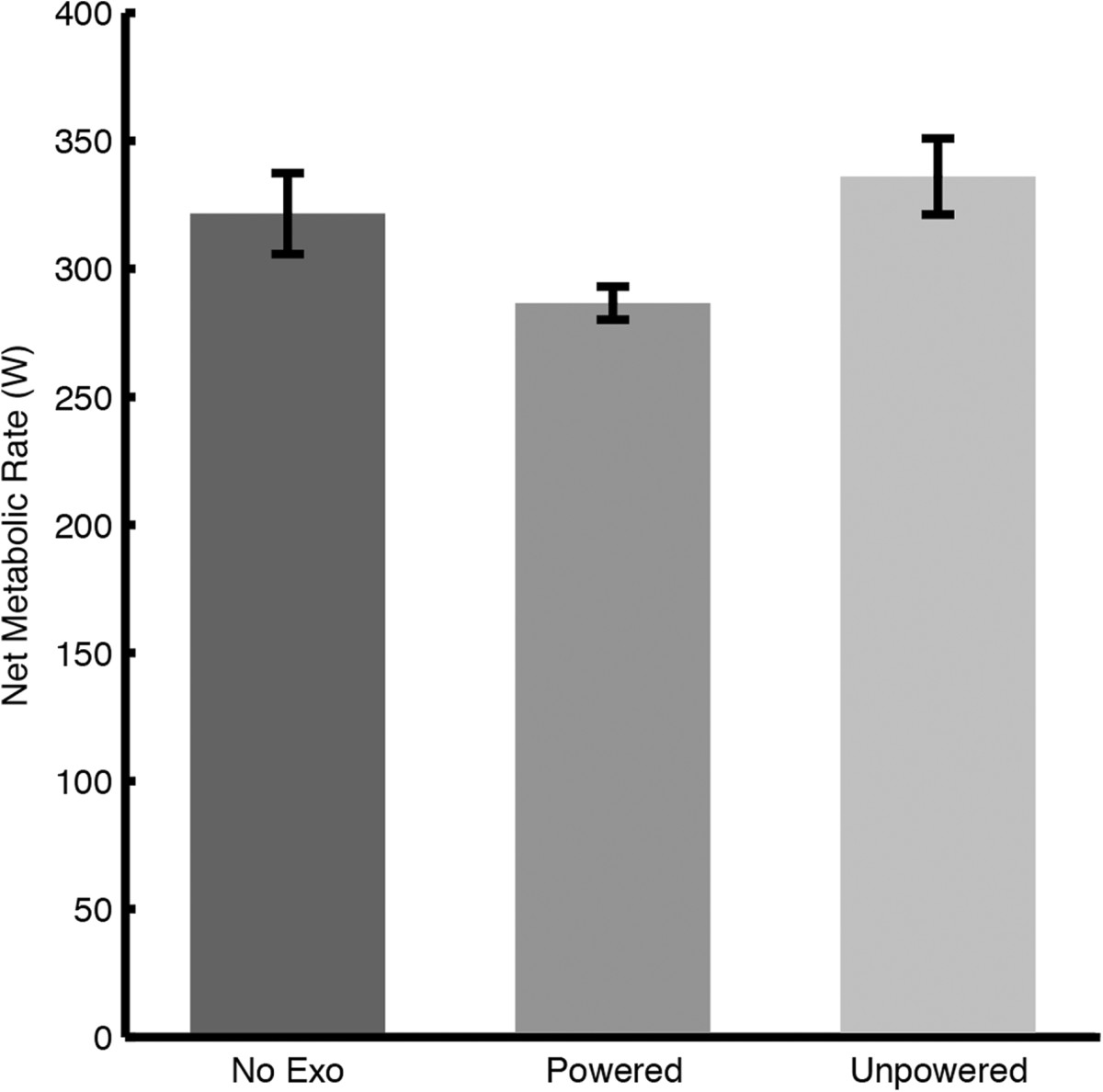
Metabolic comparison of walking trials. The net metabolic cost of walking is shown without the exoskeleton, with the powered exoskeleton, and with the unpowered exoskeleton. Standard error bars are shown for each experimental condition.
Figure 3
Figure 3
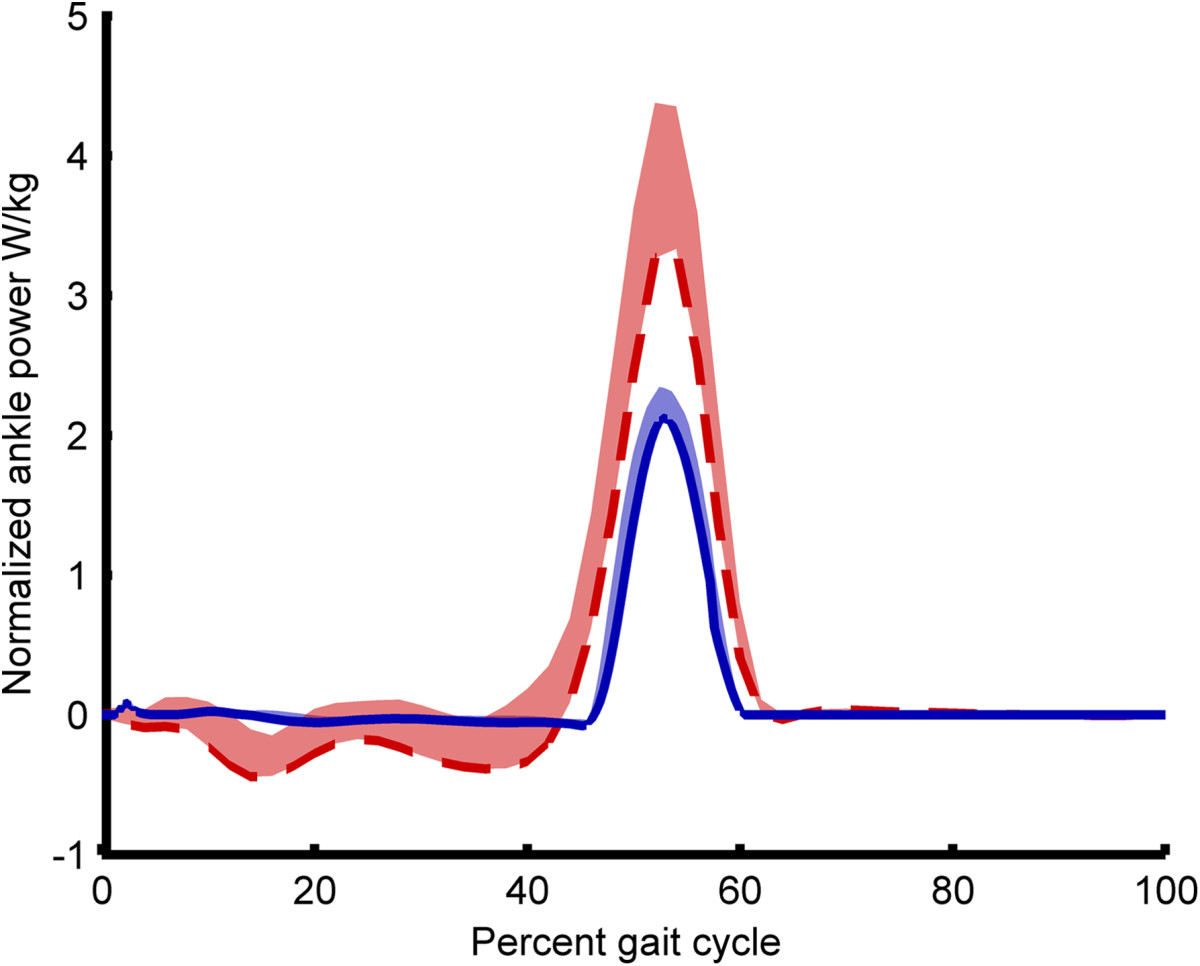
Exoskeletal mechanical power. Inter-subject mean exoskeletal ankle power provided by only the exoskeleton is shown (solid blue) throughout a single gait cycle. Power is normalized by body mass with standard deviation shown in translucent. For comparison, the mechanical power provided by only the biological ankle joint is shown (dashed red) for normal walking, acquired from a reference dataset [7].
Figure 4
Figure 4
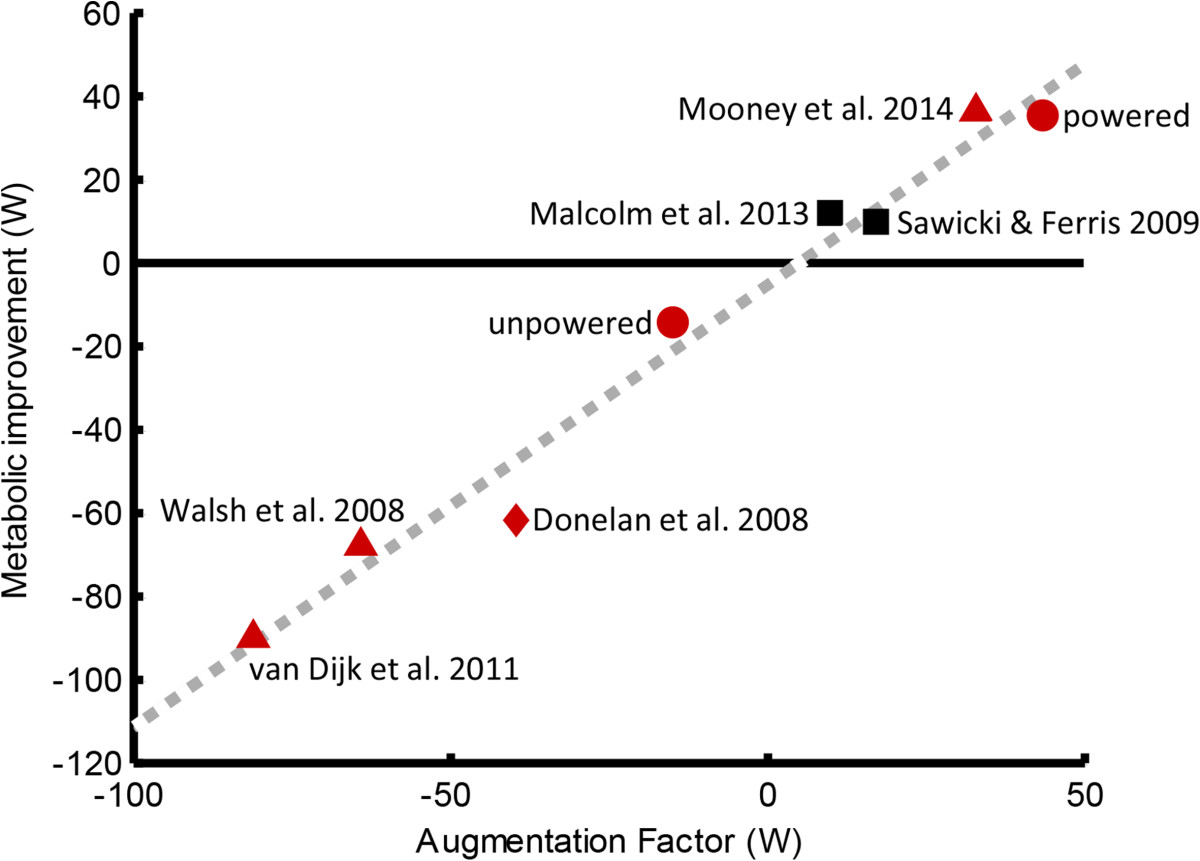
Augmentation Factor. The AF was calculated for six exoskeletal designs [, , –12] and one energy harvesting design [13]. Red triangle markers are previously published studies on autonomous exoskeletons, the red diamond is an energy harvesting device, black squares are previously published studies on tethered exoskeletons, and the two red circles are the exoskeletal design of the present study. The red circle with a positive AF (powered) denotes the present exoskeleton when powered on, and the red circle with a negative AF (unpowered) denotes the present exoskeleton when the device was powered off and thus delivered zero mechanical power. The equation estimated by linear regression is y = 1.1x – 5 with an R2 of 0.98.

References

    1. Yagn N. Apparatus for facilitating walking, running, and jumping. 1890.
    1. Zoss A, Kazerooni H, Chu A. Biomechanical design of the Berkeley lower extremity exoskeleton (BLEEX) IEEE/ASME Trans Mechatronics. 2006;11:128–138. doi: 10.1109/TMECH.2006.871087. - DOI
    1. Malcolm P, Derave W, Galle S, De Clercq D. A simple exoskeleton that assists plantarflexion can reduce the metabolic cost of human walking. PLoS One. 2013;8:e56137. doi: 10.1371/journal.pone.0056137. - DOI - PMC - PubMed
    1. Sawicki GS, Ferris DP. Mechanics and energetics of level walking with powered ankle exoskeletons. J Exp Biol. 2008;211(Pt 9):1402–1413. doi: 10.1242/jeb.009241. - DOI - PubMed
    1. Ferris DP, Czerniecki JM, Hannaford B. An ankle-foot orthosis powered by artificial pneumatic muscles. J Appl Biomech. 2005;21:189–197. - PMC - PubMed

Publication types