. 2014 Nov;33(11):2018-24.
doi: 10.1377/hlthaff.2014.0538.

Specialty drug spending trends among Medicare and Medicare Advantage enrollees, 2007-11

Affiliations

Specialty drug spending trends among Medicare and Medicare Advantage enrollees, 2007-11

Erin Trish et al. Health Aff (Millwood). 2014 Nov.

Abstract

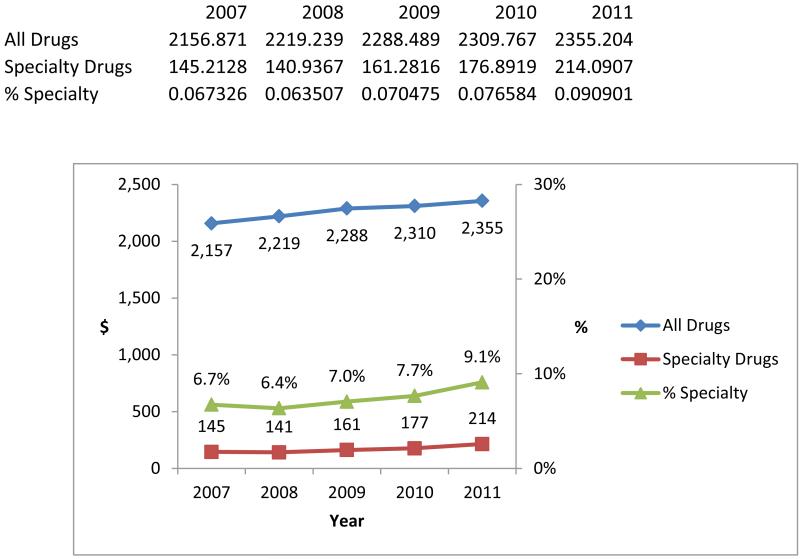
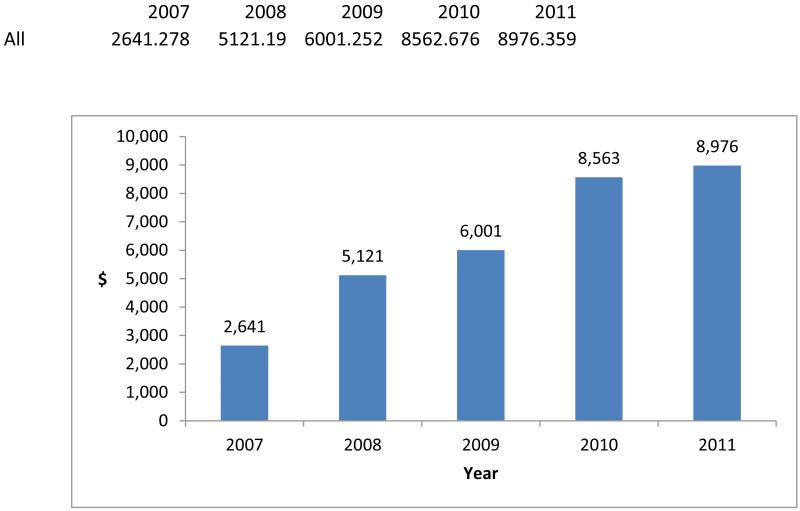
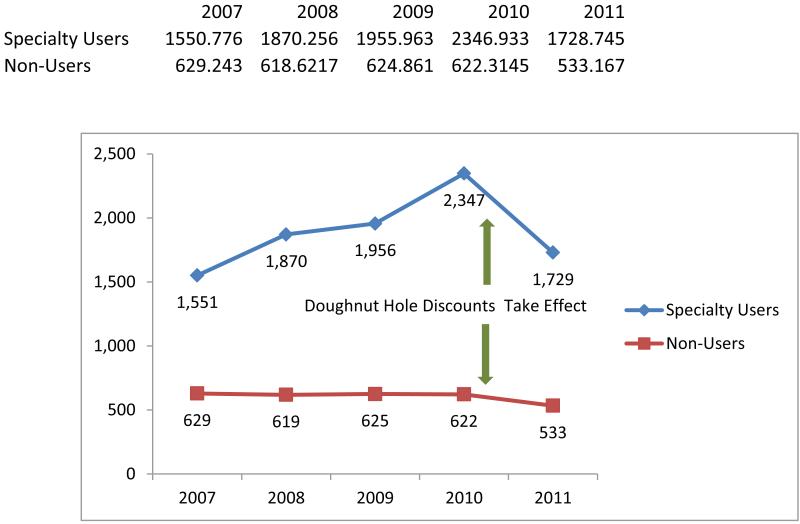
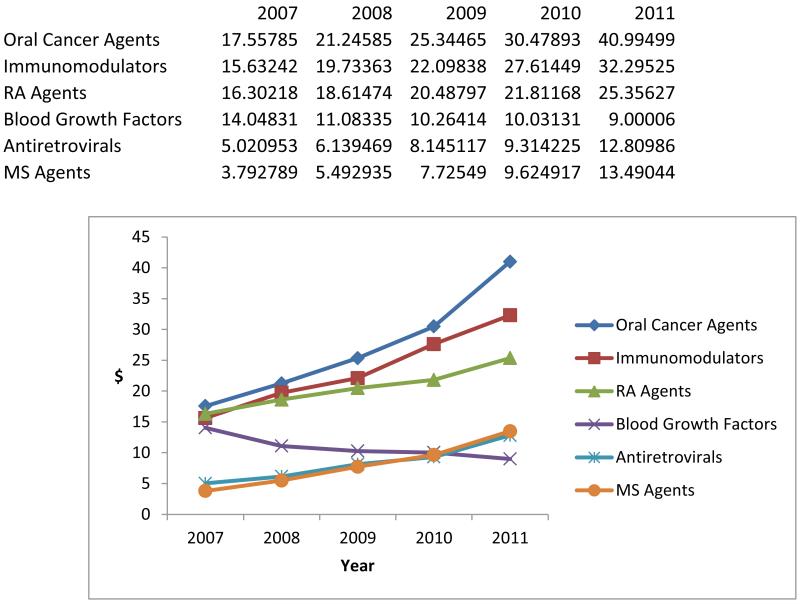
Specialty pharmaceuticals include most injectable and biologic agents used to treat complex conditions such as rheumatoid arthritis, multiple sclerosis, and cancer. We analyzed trends in specialty drug spending among Medicare beneficiaries ages sixty-five and older using 2007-11 pharmacy claims data from a 20 percent sample of Medicare beneficiaries. Annual specialty drug spending per beneficiary who used specialty drugs increased considerably during the study period, from $2,641 to $8,976. However, specialty drugs accounted for only 6.7 percent of total drug spending per beneficiary in 2007 and 9.1 percent in 2011. Moreover, in 2011 cost-sharing reductions under the Affordable Care Act significantly reduced specialty drug users' out-of-pocket burden, which decreased 26 percent from 2010. Oral cancer agents accounted for a significant proportion of the increase in specialty drug spending among the study population. This suggests that the migration of specialty drug coverage from Medicare's Part B medical benefit to the Part D pharmacy benefit because of new treatment options may play an important role in specialty pharmacy trends. This shift is likely to continue as pharmaceutical innovations enable more specialty therapeutics to be self-administered and to be covered under the pharmacy instead of the medical benefit.

Keywords: Health Economics; Health Spending; Medicare; Pharmaceuticals.


Figures

Exhibit 1 (figure)
Exhibit 1 (figure). Annual Per Beneficiary Pharmacy Spending On Specialty And All Drugs Among Elderly Medicare Beneficiaries, 2007–11
Source/Notes: SOURCE Authors’ analysis of pharmacy claims from a 20 percent sample of Medicare beneficiaries ages sixty-five and older. NOTES Specialty drugs are defined in the text. The sample includes elderly beneficiaries enrolled in stand-alone prescription drug plans or in Medicare Advantage plans that had prescription drug coverage, whether or not they received a low-income subsidy. The red and blue lines depict spending (reported in nominal amounts—that is, not adjusted for inflation) and relate to the left-hand y axis. The green line depicts the percentage of total drug expenditures spent on specialty drugs for each year and relates to the right-hand y axis.
Exhibit 2 (figure)
Exhibit 2 (figure). Annual Specialty Pharmacy Spending Per Elderly Medicare Specialty Drug User, 2007–11
Source/Notes: SOURCE Authors’ analysis of pharmacy claims from a 20 percent sample of Medicare beneficiaries ages sixty-five and older. NOTES Specialty drugs are defined in the text. The sample includes elderly beneficiaries who had a specialty drug claim and who were enrolled in stand-alone prescription drug plans or in Medicare Advantage plans that had prescription drug coverage, whether or not they received a low-income subsidy. All amounts are reported in nominal dollars (that is, not adjusted for inflation).
Exhibit 3 (figure)
Exhibit 3 (figure). Annual Per Beneficiary Out-of-Pocket Pharmacy Spending Among Specialty Drug Users And Nonusers, 2007–11
Source/Notes: SOURCE Authors’ analysis of pharmacy claims from a 20 percent sample of Medicare beneficiaries ages sixty-five and older. NOTES Specialty drugs are defined in the text. The sample includes elderly beneficiaries enrolled in stand-alone prescription drug plans or in Medicare Advantage plans that had prescription drug coverage. Beneficiaries who received a low-income subsidy are excluded. All amounts are reported in nominal dollars (that is, not adjusted for inflation).
Exhibit 4 (figure)
Exhibit 4 (figure). Relative Contribution Of Major Specialty Drug Classes To Annual Specialty Pharmacy Spending Per Beneficiary, 2007–11
Source/Notes: SOURCE Authors’ analysis of pharmacy claims from a 20 percent sample of Medicare beneficiaries ages sixty-five and older. NOTES Specialty drugs ardefined in the text. Drug classes are defined by linking National Drug Codes to drug classes via a crosswalk from the IMS Health drug database. The sample includes elderly beneficiaries enrolled in standalone prescription drug plans or in Medicare Advantage plans that had prescription drug coverage, whether or not they received a low-income subsidy. Immunomodulators are biologic drugs that are used to treat a number of inflammatory conditions, such as inflammatory bowel disease, Crohn’s disease, ulcerative colitis, and other immunebased diseases. RA is rheumatoid arthritis. MS is multiple sclerosis. All amounts are reported in nominal dollars (that is, not adjusted for inflation).

References

    1. IMS Institute for Healthcare Informatics . Medicine use and shifting costs of healthcare: a review of the use of medicines in the United States in 2013 [Internet] IMS; Parsippany (NJ): Apr, 2014. [cited 2014 Sep 25]. Available from: http://www.imshealth.com/cds/imshealth/Global/Content/Corporate/IMS%20He....
    1. Thomas K. Prices soaring for specialty drugs, researchers find. New York Times. 2014 Apr 15;
    1. Editorial Board Why $1,000 a pill? Our view. USA Today. 2014 Jul 16;
    1. Wyden R, Grassley CE. Letter to Dr. John C. Martin [Internet] Senate Committee on Finance; Washington (DC): Jul 11, 2014. [cited 2014 Sep 25]. Available from: http://www.finance.senate.gov/imo/media/doc/Wyden-Grassley%20Document%20....
    1. Kliff S. Each of these hepatitis C pills cost $1,000. That’s actually a great deal. Vox [serial on the Internet] [updated 2014 Jul 16; cited 2014 Sep 25]. Available from: http://www.vox.com/2014/7/16/5902271/hepatitis-c-drug-sovaldi-price.

Publication types

MeSH terms

LinkOut - more resources