. 2014 Dec;7(12):1335-40.
doi: 10.1242/dmm.017368. Epub 2014 Oct 31.

Huntingtin is required for ER-to-Golgi transport and for secretory vesicle fusion at the plasma membrane

Affiliations

Huntingtin is required for ER-to-Golgi transport and for secretory vesicle fusion at the plasma membrane

Hemma Brandstaetter et al. Dis Model Mech. 2014 Dec.

Abstract

Huntingtin is a large membrane-associated scaffolding protein that associates with endocytic and exocytic vesicles and modulates their trafficking along cytoskeletal tracks. Although the progression of Huntington's disease is linked to toxic accumulation of mutant huntingtin protein, loss of wild-type huntingtin function might also contribute to neuronal cell death, but its precise function is not well understood. Therefore, we investigated the molecular role of huntingtin in exocytosis and observed that huntingtin knockdown in HeLa cells causes a delay in endoplasmic reticulum (ER)-to-Golgi transport and a reduction in the number of cargo vesicles leaving the trans-Golgi network. In addition, we found that huntingtin is required for secretory vesicle fusion at the plasma membrane. Similar defects in the early exocytic pathway were observed in primary fibroblasts from homozygous Htt(140Q/140Q) knock-in mice, which have the expansion inserted into the mouse huntingtin gene so lack wild-type huntingtin expression. Interestingly, heterozygous fibroblasts from a Huntington's disease patient with a 180Q expansion displayed no obvious defects in the early secretory pathway. Thus, our results highlight the requirement for wild-type huntingtin at distinct steps along the secretory pathway.

Keywords: ER; Exocytosis; Golgi; Huntingtin; Vesicle fusion.


Figures

Fig. 1.
Fig. 1.
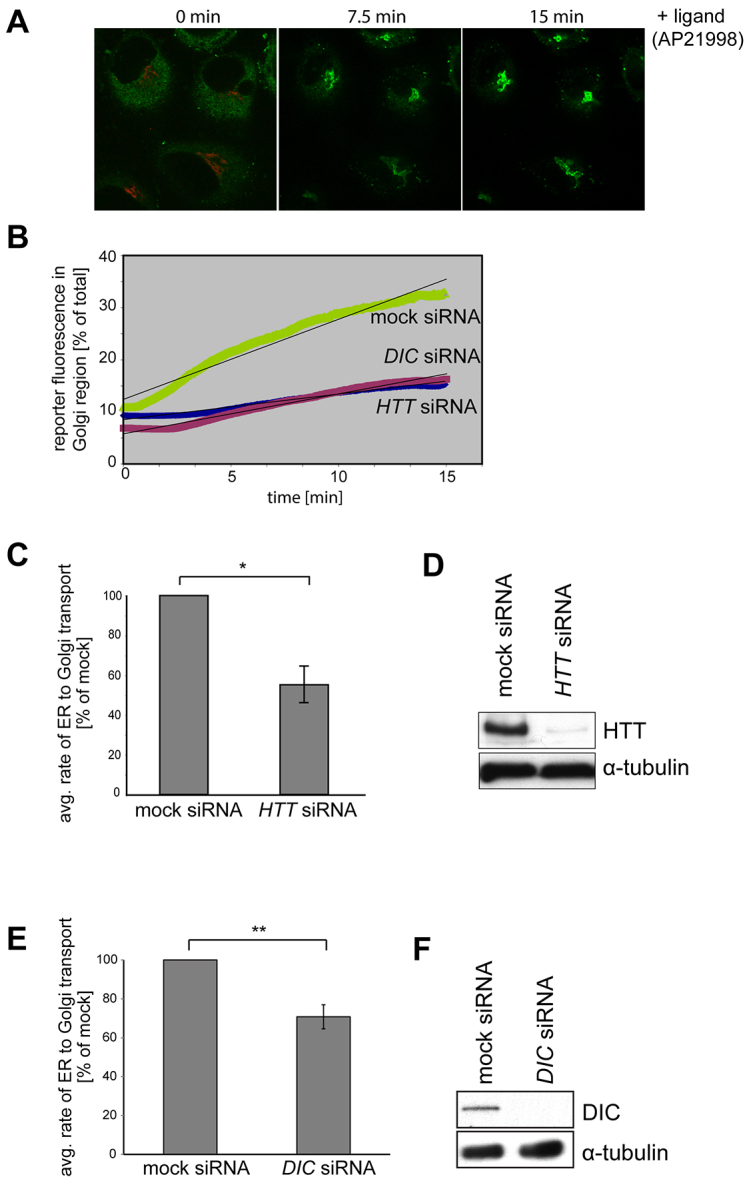
Depletion of huntingtin and its binding partner dynein intermediate chain (DIC) reduces the rate of ER-to-Golgi transport. (A) To follow transport of the GFP reporter from the ER to Golgi, HeLa C1 cells stably expressing the GFP-hGH reporter construct (green) and transiently transfected with GalT-mRFP (red) to mark the Golgi were fixed at the indicated times after AP21998 ligand addition and processed for immunofluorescence microscopy. (B) To analyse the rate of reporter movement from ER to Golgi, HeLa C1 cells that were either mock-treated or treated with HTT or DIC siRNA were imaged by live-cell spinning-disk microscopy after ligand addition. Volocity imaging software was used to calculate the rate of accumulation of GFP reporter in the Golgi region over time in these cells. (C) Graph depicting the average rate of ER-to-Golgi reporter transport in huntingtin-depleted cells as a percentage of mock. Huntingtin depletion resulted in a ~45% decrease in ER-to-Golgi transfer rate compared with control. 59 cells from three independent knockdown experiments were analysed using the unpaired Student’s t-test. Values are means ± s.e.m. (D) Representative immunoblot using antibodies against huntingtin and α-tubulin as a loading control demonstrates huntingtin protein depletion. (E) Depletion of the huntingtin binding partner DIC results in a ~30% decrease in ER-to-Golgi transfer compared with control. 93 cells from five independent knockdown experiments were analysed. (F) Representative immunoblot using antibodies against DIC and α-tubulin as a loading control demonstrates DIC protein depletion. *P≤0.05; **P≤0.01.
Fig. 2.
Fig. 2.
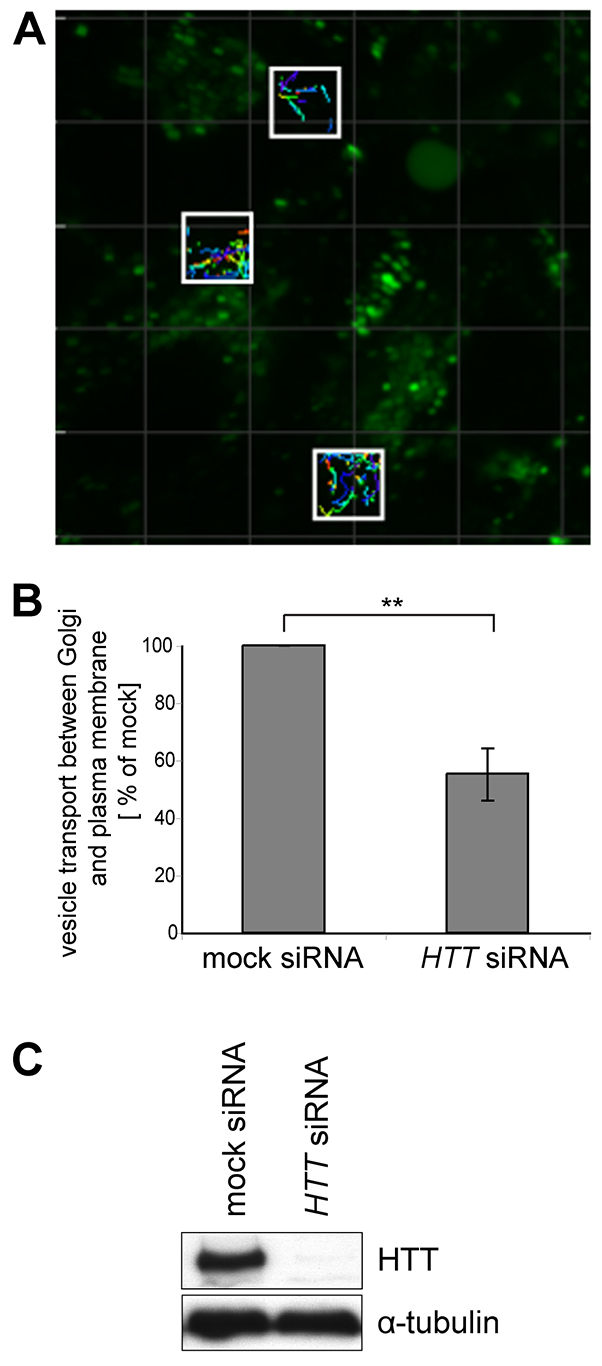
Huntingtin depletion leads to a reduction in the number of vesicles travelling between the Golgi and plasma membrane. (A) In HeLa C1 cells treated with HTT siRNA, live-cell spinning-disk microscopy was used to capture continuous 1-minute movies at defined intervals between 25 and 59 minutes after ligand addition. The total number of vesicles travelling through ten 6×6-μm areas (white boxes) between the Golgi complex and the plasma membrane was quantified over the course of 18 one-minute movies using Imaris vesicle-tracking software. (B) Analysis of 1800 regions of >630 cells from five independent knockdown experiments indicates that huntingtin depletion results in reduced numbers of secretory vesicles leaving the Golgi when compared with mock-treated cells. (C) Representative immunoblot demonstrating huntingtin protein knockdown in HeLa C1 cells. **P≤0.01.
Fig. 3.
Fig. 3.
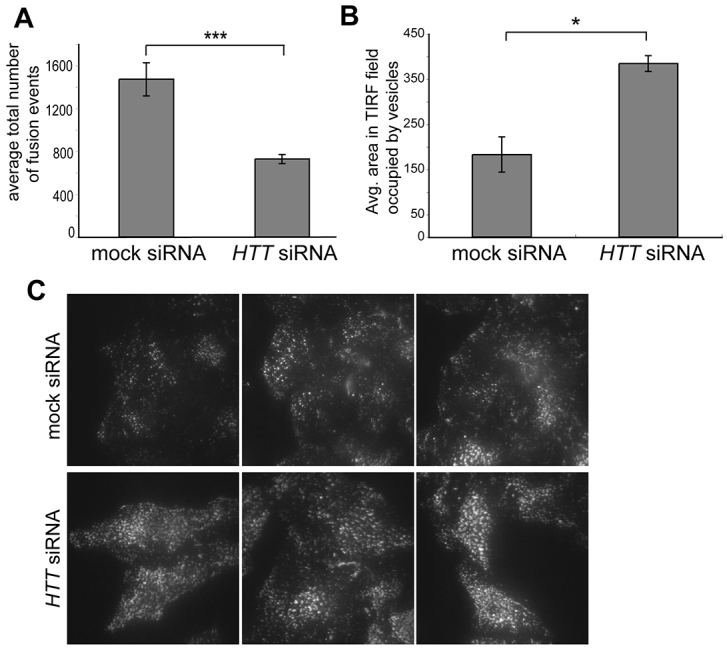
Huntingtin loss reduces the number of vesicle fusion events and increases the number of docked vesicles at the plasma membrane. (A) Vesicle fusion events in mock or huntingtin-depleted HeLa C1 cells were monitored by live-cell TIRF microscopy at 5-minute intervals between 25 and 59 minutes after ligand addition. Huntingtin depletion causes a significant decrease of 50% in average number of vesicle fusion events at the plasma membrane. 170 cells from four independent knockdown experiments performed in duplicate or triplicate were analysed using the Student’s t-test; values are means ± s.e.m. (B) In mock or huntingtin-depleted HeLa C1 cells, the total area in the TIRF field occupied by fluorescent vesicles in single-plane images taken at specific intervals between 25 and 60 minutes after AP21998 ligand addition was calculated using Volocity analysis software. Huntingtin knockdown results in a significant increase in the area occupied by docked vesicles as compared with mock. 170 cells from four independent knockdown experiments (as used in the TIRF fusion assay) were analysed using the Student’s t-test; values are means ± s.e.m. (C) Vesicles in the TIRF field at the base of mock and huntingtin-depleted cells. *P≤0.05; ***P≤0.001.
Fig. 4.
Fig. 4.
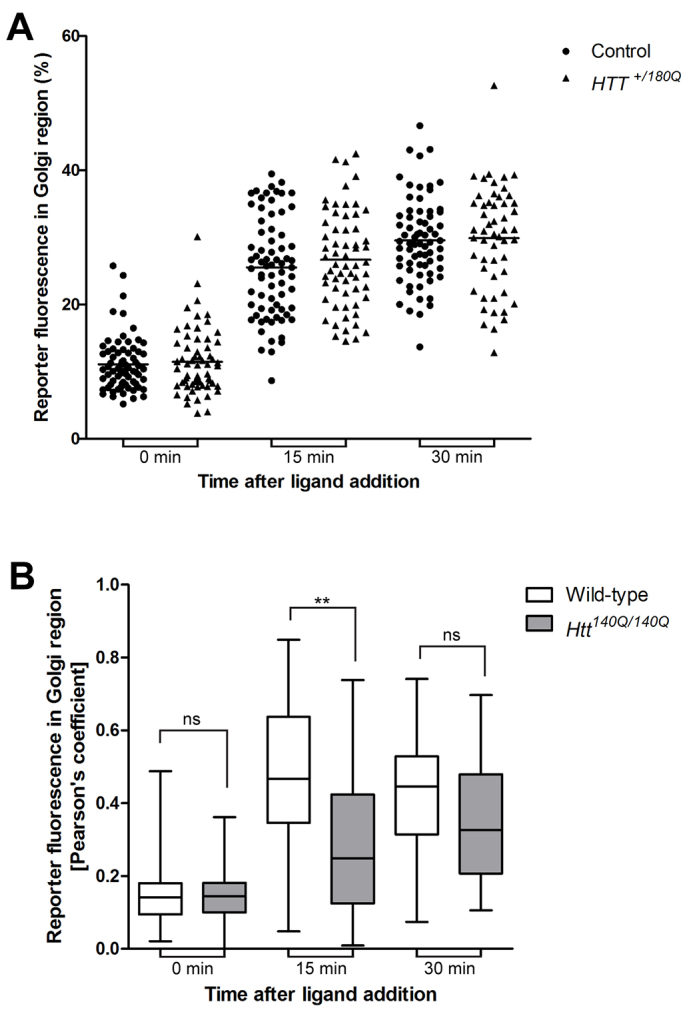
ER-to-Golgi transport of a fluorescent reporter is reduced in homozygous Htt140Q/140Q KI MEFs but not in heterozygous patient fibroblasts with a 180Q expansion. (A) Human fibroblasts from a healthy control and a patient with juvenile-onset HD (HTT+/180Q) were transiently transfected with the GFP-hGH reporter construct. Cells were untreated or treated with the ligand AP21998 for 0, 15 and 30 minutes, fixed and stained with antibodies to GFP and the Golgi protein GM130. The amount of fluorescent reporter present in the Golgi region was quantified in confocal images using Volocity image-analysis software in >350 cells from four independent experiments and is illustrated as a scatter plot with the line representing the mean. There was no significant difference in reporter movement from the ER to Golgi in HD patient fibroblasts compared with control. (B) Mouse embryonic fibroblasts (MEFs) were isolated from wild-type and Htt140Q/140Q knock-in mice at E17/18 and transiently transfected with the GFP-hGH reporter construct. At 0, 15 and 30 minutes after AP21998 ligand addition, GFP and GM130 colocalisation images were analysed by calculating the Pearson’s coefficient using Volocity image-analysis software. Compared with wild-type MEFs, significantly less cargo accumulated in the Golgi of homozygous Htt140Q/140Q knock-in MEFs in >120 cells in four independent experiments and is illustrated as a box-and-whisker plot. The box represents the median, 25th and 75th percentiles and whiskers represent the maximum and minimum. A one-way ANOVA followed by a post-hoc Bonferroni multiple comparison test was conducted as a statistical test. **P≤0.01. ns, not significant.

References

    1. Arribat Y., Bonneaud N., Talmat-Amar Y., Layalle S., Parmentier M. L., Maschat F. (2013). A huntingtin peptide inhibits polyQ-huntingtin associated defects. PLoS ONE 8, e68775. - PMC - PubMed
    1. Bond L. M., Peden A. A., Kendrick-Jones J., Sellers J. R., Buss F. (2011). Myosin VI and its binding partner optineurin are involved in secretory vesicle fusion at the plasma membrane. Mol. Biol. Cell 22, 54–65. - PMC - PubMed
    1. Borrell-Pagès M., Zala D., Humbert S., Saudou F. (2006). Huntington’s disease: from huntingtin function and dysfunction to therapeutic strategies. Cell. Mol. Life Sci. 63, 2642–2660. - PMC - PubMed
    1. Caviston J. P., Holzbaur E. L. (2009). Huntingtin as an essential integrator of intracellular vesicular trafficking. Trends Cell Biol. 19, 147–155. - PMC - PubMed
    1. Caviston J. P., Ross J. L., Antony S. M., Tokito M., Holzbaur E. L. (2007). Huntingtin facilitates dynein/dynactin-mediated vesicle transport. Proc. Natl. Acad. Sci. USA 104, 10045–10050. - PMC - PubMed

Publication types

MeSH terms

LinkOut - more resources