


Decreased polycystin 2 expression alters calcium-contraction coupling and changes β-adrenergic signaling pathways
- PMID: 25368166
- PMCID: PMC4246301
- DOI: 10.1073/pnas.1415933111
Decreased polycystin 2 expression alters calcium-contraction coupling and changes β-adrenergic signaling pathways
Abstract
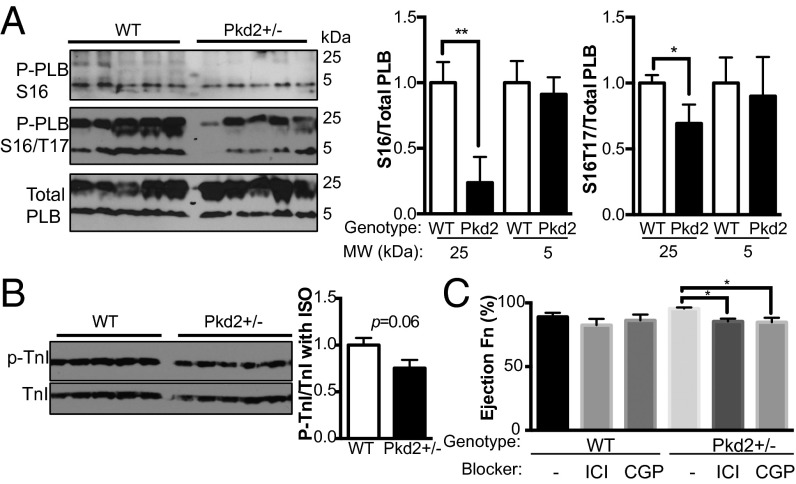
Cardiac disorders are the main cause of mortality in autosomal-dominant polycystic kidney disease (ADPKD). However, how mutated polycystins predispose patients with ADPKD to cardiac pathologies before development of renal dysfunction is unknown. We investigate the effect of decreased levels of polycystin 2 (PC2), a calcium channel that interacts with the ryanodine receptor, on myocardial function. We hypothesize that heterozygous PC2 mice (Pkd2(+/-)) undergo cardiac remodeling as a result of changes in calcium handling, separate from renal complications. We found that Pkd2(+/-) cardiomyocytes have altered calcium handling, independent of desensitized calcium-contraction coupling. Paradoxically, in Pkd2(+/-) mice, protein kinase A (PKA) phosphorylation of phospholamban (PLB) was decreased, whereas PKA phosphorylation of troponin I was increased, explaining the decoupling between calcium signaling and contractility. In silico modeling supported this relationship. Echocardiography measurements showed that Pkd2(+/-) mice have increased left ventricular ejection fraction after stimulation with isoproterenol (ISO), a β-adrenergic receptor (βAR) agonist. Blockers of βAR-1 and βAR-2 inhibited the ISO response in Pkd2(+/-) mice, suggesting that the dephosphorylated state of PLB is primarily by βAR-2 signaling. Importantly, the Pkd2(+/-) mice were normotensive and had no evidence of renal cysts. Our results showed that decreased PC2 levels shifted the βAR pathway balance and changed expression of calcium handling proteins, which resulted in altered cardiac contractility. We propose that PC2 levels in the heart may directly contribute to cardiac remodeling in patients with ADPKD in the absence of renal dysfunction.
Keywords: calcium signaling; excitation contraction coupling; β-adrenergic receptor blocker.
Conflict of interest statement
The authors declare no conflict of interest.
Figures


References
-
- Schrier RW. Renal volume, renin-angiotensin-aldosterone system, hypertension, and left ventricular hypertrophy in patients with autosomal dominant polycystic kidney disease. J Am Soc Nephrol. 2009;20(9):1888–1893. - PubMed
-
- Bardají A, et al. Cardiac involvement in autosomal-dominant polycystic kidney disease: a hypertensive heart disease. Clin Nephrol. 2001;56(3):211–220. - PubMed
Publication types
MeSH terms
Substances
Grants and funding
LinkOut - more resources
Full Text Sources
Other Literature Sources
Molecular Biology Databases
Miscellaneous
