The effects of intravenous dexmedetomidine on spinal anesthesia: comparision of different dose of dexmedetomidine
- PMID: 25368783
- PMCID: PMC4216787
- DOI: 10.4097/kjae.2014.67.4.252
The effects of intravenous dexmedetomidine on spinal anesthesia: comparision of different dose of dexmedetomidine
Abstract
Background: In this prospective, randomized, double-blind, placebo-controlled trial, we tried to find out appropriate amounts of single-dose dexmedetomidine to prolong the duration of spinal anesthesia in a clinical setting.
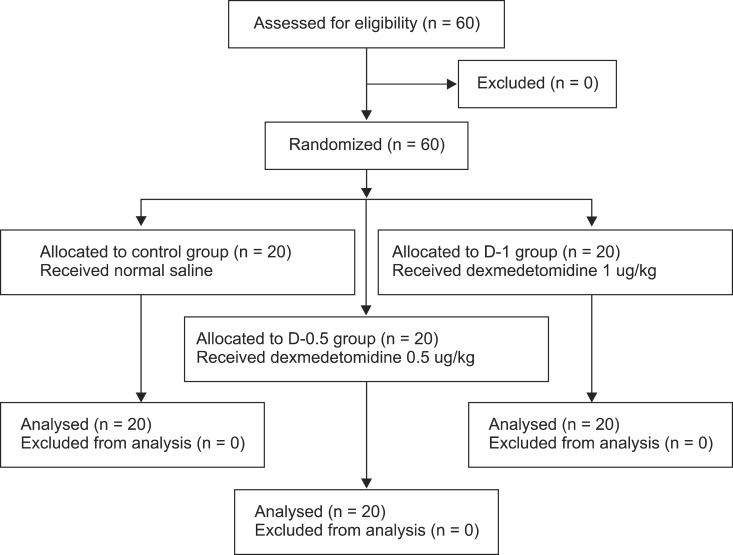
Methods: Sixty patients who were scheduled for unilateral lower limb surgery under spinal anesthesia were randomized into three groups receiving normal saline (control group, n = 20) or 0.5 or 1.0 ug/kg dexmedetomidine (D-0.5 group, n = 20; D-1, n = 20) intravenously prior to spinal anesthesia with 12 mg of bupivacaine. The two-dermatome pinprick sensory regression time, duration of the motor block, Ramsay sedation score (RSS), and side effects of dexmedetomidine were assessed.
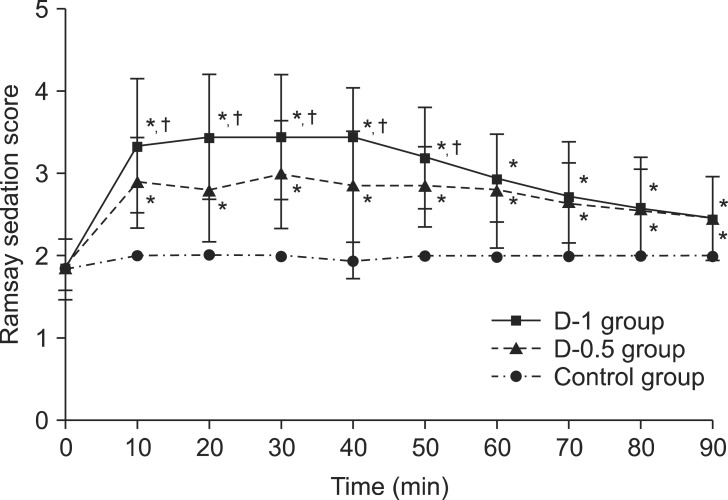
Results: The two-dermatome pinprick sensory regression time (57.6 ± 23.2 vs 86.5 ± 24.3 vs 92.5 ± 30.7, P = 0.0002) and duration of the motor block (98.8 ± 34.1 vs 132.9 ± 43.4 vs 130.4 ± 50.4, P = 0.0261) were significantly increased in the D-0.5 and D-1 groups than in the control group. The RSS were significantly higher in the D-0.5 and D-1 groups than in the control group. However, there were no patients with oxygen desaturation in dexmedetomidine groups. The incidences of hypotension and bradycardia showed no differences among the three groups.
Conclusions: Both 0.5 and 1.0 ug/kg of dexmedetomidine administered as isolated boluses in the absence of maintenance infusions prolonged the duration of spinal anesthesia.
Keywords: Bupivacaine; Dexmedetomidine; Spinal anesthesia.
Figures
References
-
- Kamibayashi T, Maze M. Clinical uses of alpha 2-adrenergic agonists. Anesthesiology. 2000;93:1345–1349. - PubMed
-
- Fragen RJ, Fitzgerald PC. Effect of dexmedetomidine on the minimum alveolar concentration (MAC) of sevoflurane in adult age 55-70 years. J Clin Anesth. 1999;11:466–470. - PubMed
-
- Guo TZ, Jiang JY, Buttermann AE, Maze M. Dexmedetomidine injection into the locus ceruleus produces antinociception. Anesthesiology. 1996;84:873–881. - PubMed
-
- Jorm CM, Stamford JA. Actions of the hypnotic anaesthetic, dexmedetomidine, on noradrenaline release and cell firing in rat locus ceruleus slices. Br J Anaesth. 1993;71:447–449. - PubMed
-
- Jung SH, Lee SK, Lim KJ, Park EY, Kang MH, Lee JM, et al. The effects of single-dose intravenous dexmedetomidine on hyperbaric bupivacaine spinal anesthesia. J Anesth. 2013;27:380–384. - PubMed
LinkOut - more resources
Full Text Sources
Other Literature Sources