


Lombards on the move--an integrative study of the migration period cemetery at Szólád, Hungary
- PMID: 25369022
- PMCID: PMC4219681
- DOI: 10.1371/journal.pone.0110793
Lombards on the move--an integrative study of the migration period cemetery at Szólád, Hungary
Abstract
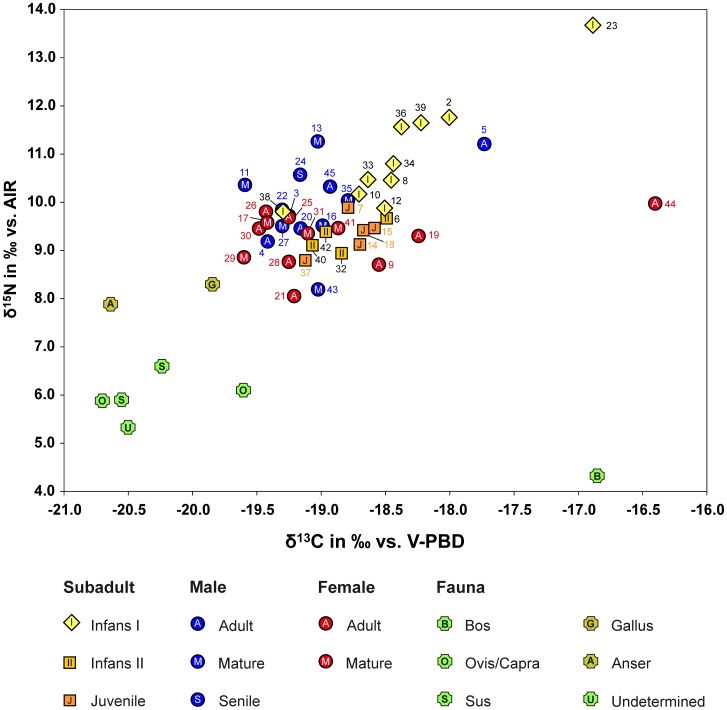
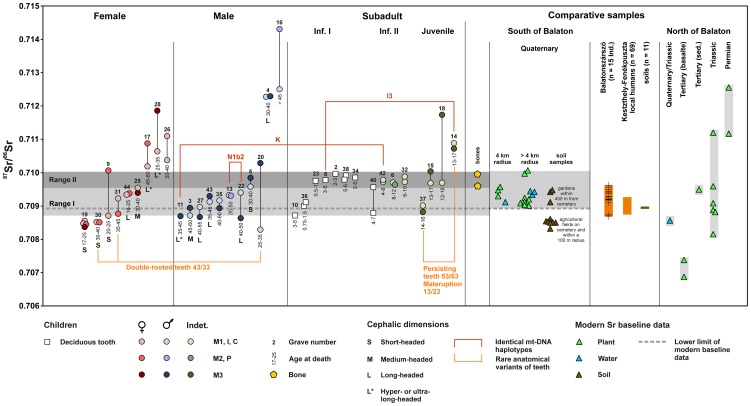
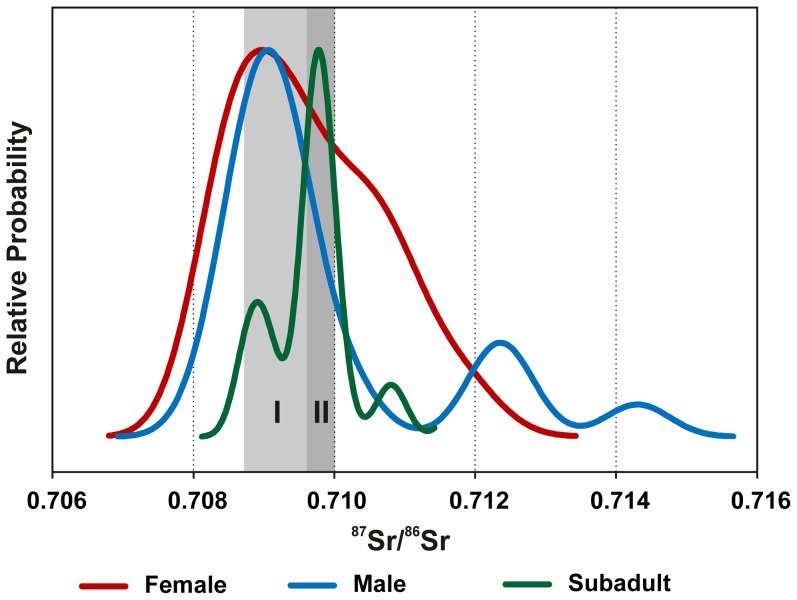
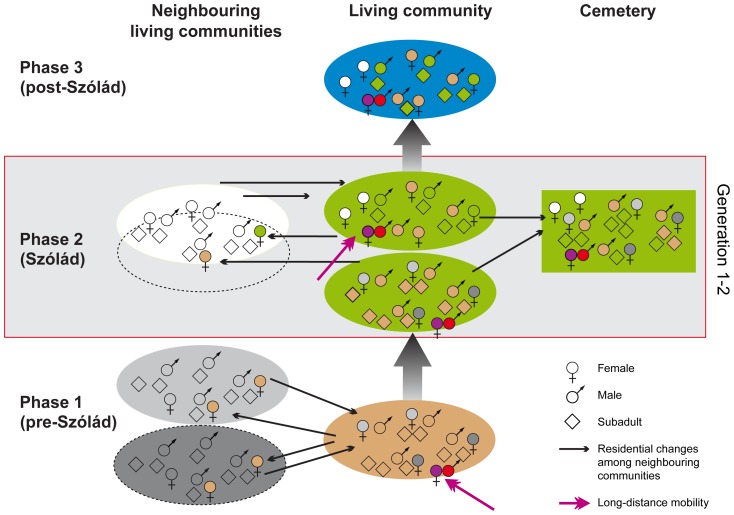
In 2005 to 2007 45 skeletons of adults and subadults were excavated at the Lombard period cemetery at Szólád (6th century A.D.), Hungary. Embedded into the well-recorded historical context, the article presents the results obtained by an integrative investigation including anthropological, molecular genetic and isotopic (δ(15)N, δ(13)C, (87)Sr/(86)Sr) analyses. Skeletal stress markers as well as traces of interpersonal violence were found to occur frequently. The mitochondrial DNA profiles revealed a heterogeneous spectrum of lineages that belong to the haplogroups H, U, J, HV, T2, I, and K, which are common in present-day Europe and in the Near East, while N1a and N1b are today quite rare. Evidence of possible direct maternal kinship was identified in only three pairs of individuals. According to enamel strontium isotope ratios, at least 31% of the individuals died at a location other than their birthplace and/or had moved during childhood. Based on the peculiar 87 Sr/86 Sr ratio distribution between females, males, and subadults in comparison to local vegetation and soil samples, we propose a three-phase model of group movement. An initial patrilocal group with narrower male but wider female Sr isotope distribution settled at Szólád, whilst the majority of subadults represented in the cemetery yielded a distinct Sr isotope signature. Owing to the virtual absence of Szólád-born adults in the cemetery, we may conclude that the settlement was abandoned after approx. one generation. Population heterogeneity is furthermore supported by the carbon and nitrogen isotope data. They indicate that a group of high-ranking men had access to larger shares of animal-derived food whilst a few individuals consumed remarkable amounts of millet. The inferred dynamics of the burial community are in agreement with hypotheses of a highly mobile lifestyle during the Migration Period and a short-term occupation of Pannonia by Lombard settlers as conveyed by written sources.
Conflict of interest statement
Figures
References
-
- Jarnut J (1982) Geschichte der Langobarden. Stuttgart, Berlin, Köln, Mainz: Kohlhammer.
-
- Johne KP (2008) Die Langobarden in den Schriftquellen bis zu den Markomannenkriegen. In: Bemmann J, Schmauder M, editors. Kulturwandel in Mitteleuropa Langobarden – Awaren – Slawen. Akten der Internationalen Tagung in Bonn vom 25. bis 28. Februar 2008. Frankfurt a. M., Bonn: Habelt. pp. 43–50.
-
- Voss HU (2008) Parum – Putensen – Pavia? Anmerkungen zur Archäologie der Langobarden an der Niederelbe. In: Bemmann J, Schmauder M, editors. Kulturwandel in Mitteleuropa Langobarden – Awaren – Slawen. Akten der Internationalen Tagung in Bonn vom 25. bis 28. Februar 2008. Frankfurt a. M., Bonn: Habelt. pp. 51–78.
-
- Geary PJ (2002) The myth of nations. The medieval origins of Europe. Princeton: Princeton University Press.
-
- Pohl W (2008) Migration und Ethnogenesen der Langobarden aus Sicht der Schriftquellen. In: Bemmann J, Schmauder M, editors. Kulturwandel in Mitteleuropa Langobarden – Awaren – Slawen. Akten der Internationalen Tagung in Bonn vom 25. bis 28. Februar 2008. Frankfurt a. M., Bonn: Habelt. pp. 1–12.
Publication types
MeSH terms
Substances
Associated data
- Actions
- Actions
- Actions
- Actions
- Actions
- Actions
- Actions
- Actions
- Actions
- Actions
- Actions
- Actions
- Actions
- Actions
- Actions
- Actions
- Actions
- Actions
- Actions
- Actions
- Actions
- Actions
- Actions
- Actions
- Actions
- Actions
- Actions
- Actions
- Actions
- Actions
- Actions
- Actions
- Actions
- Actions
LinkOut - more resources
Full Text Sources
Other Literature Sources
Research Materials
