. 2015 Feb;23(2):270-7.
doi: 10.1038/mt.2014.209. Epub 2014 Nov 5.

PTEN depletion decreases disease severity and modestly prolongs survival in a mouse model of spinal muscular atrophy

Affiliations

PTEN depletion decreases disease severity and modestly prolongs survival in a mouse model of spinal muscular atrophy

Daniel Little et al. Mol Ther. 2015 Feb.

Abstract

Spinal muscular atrophy (SMA) is the second most common genetic cause of death in childhood. However, no effective treatment is available to halt disease progression. SMA is caused by mutations in the survival motor neuron 1 (SMN1) gene. We previously reported that PTEN depletion leads to an increase in survival of SMN-deficient motor neurons. Here, we aimed to establish the impact of PTEN modulation in an SMA mouse model in vivo. Initial experiments using intramuscular delivery of adeno-associated vector serotype 6 (AAV6) expressing shRNA against PTEN in an established mouse model of severe SMA (SMNΔ7) demonstrated the ability to ameliorate the severity of neuromuscular junction pathology. Subsequently, we developed self-complementary AAV9 expressing siPTEN (scAAV9-siPTEN) to allow evaluation of the effect of systemic suppression of PTEN on the disease course of SMA in vivo. Treatment with a single injection of scAAV9-siPTEN at postnatal day 1 resulted in a modest threefold extension of the lifespan of SMNΔ7 mice, increasing mean survival to 30 days, compared to 10 days in untreated mice. Our data revealed that systemic PTEN depletion is an important disease modifier in SMNΔ7 mice, and therapies aimed at lowering PTEN expression may therefore offer a potential therapeutic strategy for SMA.


Figures
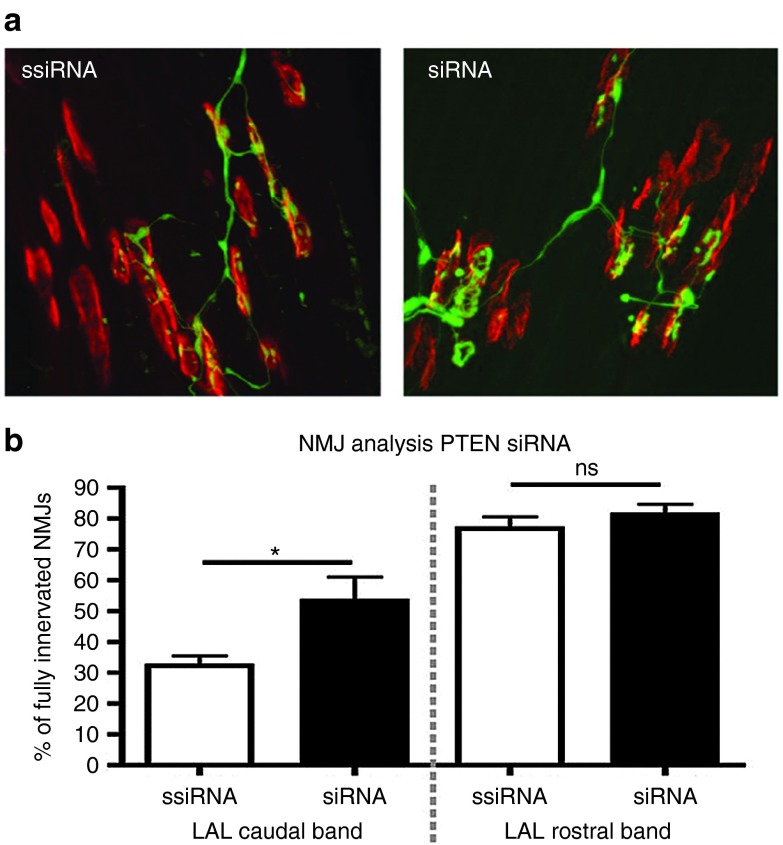
Figure 1
Figure 1
scAAV6-mediated knockdown of PTEN ameliorates neuromuscular junction (NMJ) pathology in SMA mice. (a) Representative confocal micrographs showing widespread NMJ pathology in the caudal band of the levator auris longus muscle (LAL) in SMNΔ7 mice at postnatal day 10 that received intramuscular injection of scrambled siPTEN (AAV6-ssiPTEN) at postnatal day 1 (left panel) and reduced pathology in mice that received intramuscular injection of siPTEN (AAV6-siPTEN). Antibodies against neurofilament proteins were used to label motor axon collaterals (green), and tetramethylrhodamine-conjugated α-bungarotoxin was used to label acetylcholine receptors at the motor endplate (red). More motor endplates appeared to be innervated by overlying motor nerve terminals in the AAV6-siPTEN–treated muscle. (b) Bar chart showing the extent of NMJ denervation (mean ± SEM) in the affected caudal band, and unaffected rostral band, of the LAL muscle in treated (siRNA) and untreated (ssiRNA) mice. This analysis revealed significantly more innervated NMJs in the caudal band of treated mice (*P < 0.05, n = 4 mice per group, Student's t-test).
Figure 2
Figure 2
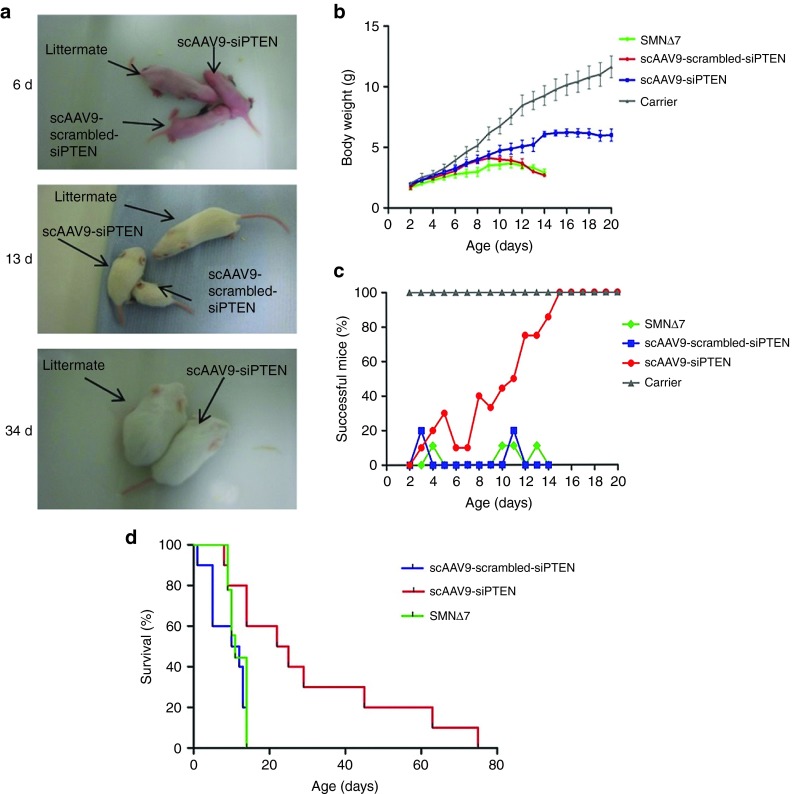
A single scAAV9-siPTEN injection improves weight gain and extends the lifespan of the SMNΔ7 mouse model of SMA. (a) Images showing the same SMNΔ7 pups at different ages as indicated; for reference, a gender-matched carrier littermate was included. The pups were injected at postnatal day 1 with either scAAV9-siPTEN or scAAV9-scrambled-siPTEN. (b) Body weight increase in SMNΔ7 mice injected with scAAV9-siPTEN or scAAV9-scrambled-siPTEN from postnatal days 2–20. Body weight of scAAV-siPTEN injected mice was significantly greater than that of scAAV9-scrambled-siPTEN mice from day 11 onward (P < 0.05 two-way ANOVA with Bonferroni post hoc test). Untreated and carrier groups were included as controls. (c) Percentage of mice able to complete the righting reflex test. Mice were placed on their backs and were deemed successful if they were able to reorientate within 30 seconds. scAAV9-siPTEN–injected mice improved gradually over the first 15 days, by which time all mice were able to complete the test. (d) Kaplan–Meier cumulative survival curves in the different experimental groups. scAAV9-siPTEN–treated mice lived significantly longer than scAAV9-scrambled-siPTEN or SMNΔ7 controls (P < 0.01).
Figure 3
Figure 3
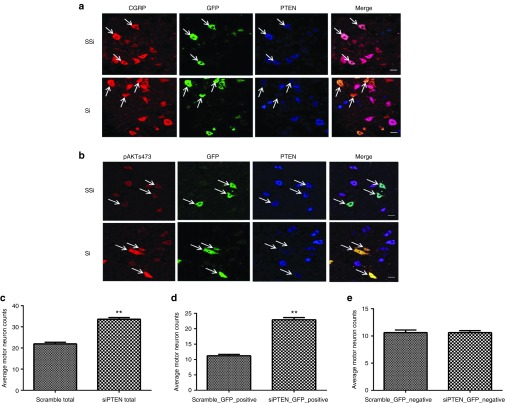
RNAi-mediated reduction in PTEN expression in SMNΔ7 transgenic mice after scAAV9-siPTEN gene transfer to motor neurons. Immunofluorescence showing a reduction in PTEN expression in scAAV9-siPTEN-transduced motor neurons as revealed by antibodies against PTEN (blue) (a,b), CGRP (red, a), and GFP (green, a,b) compared with scAAV9-ssiPTEN controls. (b) PTEN knockdown results in increased immunolabelling phosphorylated-AKT (red) in scAAV9-siPTEN-transduced motor neurons (green). Bar = 20 µm. scAAV-mediated PTEN knockdown improves motor neuron survival in SMNΔ7 mice. (c) Quantification of CGRP-positive cells in siPTEN or scrambled-siPTEN transduced lumbar spinal cord sections, showing the average number of motor neurons per section in 12 sections per animal. (d) GFP-positive CGRP neuron count. (e) GFP-negative CGRP neuron count. **P < 0.01; n = 3; Student's t-test.
Figure 4
Figure 4
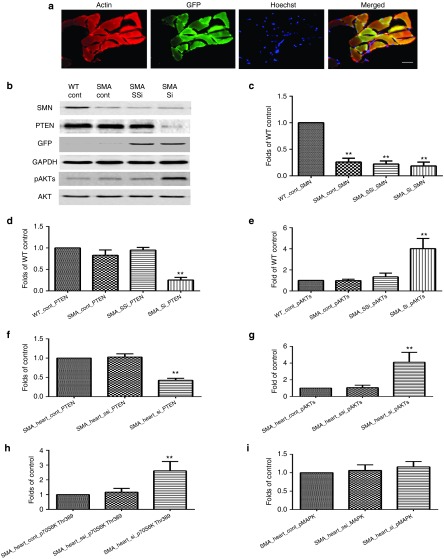
PTEN depletion in the heart and skeletal muscle following systemic delivery of scAAV9-siPTEN in P1 SMNΔ7 transgenic mice. (a) Immunofluorescence showing GFP expression in scAAV9-siPTEN-transduced heart cells (GFP, green), Hoechst labeled nuclei (blue), and actin (rhodamine phalloidin, red). Bar = 20 µm. (be) Western blotting in skeletal muscles. (fi) Western blotting analysis in heart muscles.

References

    1. Lefebvre S, Bürglen L, Reboullet S, Clermont O, Burlet P, Viollet L.et al. (1995Identification and characterization of a spinal muscular atrophy-determining gene Cell 80155–165. - PubMed
    1. Coovert DD, Le TT, McAndrew PE, Strasswimmer J, Crawford TO, Mendell JR.et al. (1997The survival motor neuron protein in spinal muscular atrophy Hum Mol Genet 61205–1214. - PubMed
    1. Burghes AH, Beattie CE. Spinal muscular atrophy: why do low levels of survival motor neuron protein make motor neurons sick. Nat Rev Neurosci. 2009;10:597–609. - PMC - PubMed
    1. Hamilton G, Gillingwater TH. Spinal muscular atrophy: going beyond the motor neuron. Trends Mol Med. 2013;19:40–50. - PubMed
    1. Jablonka S, Wiese S, Sendtner M. Axonal defects in mouse models of motoneuron disease. J Neurobiol. 2004;58:272–286. - PubMed

Publication types

MeSH terms

Substances