


Statin discontinuation in nursing home residents with advanced dementia
- PMID: 25369872
- PMCID: PMC4241149
- DOI: 10.1111/jgs.13105
Statin discontinuation in nursing home residents with advanced dementia
Abstract
Objectives: To describe patterns of, and factors associated with, statin use and discontinuation in nursing home (NH) residents progressing to advanced dementia and followed for at least 90 days.
Design: Retrospective inception cohort using a dataset linking 2007 to 2008 Minimum Data Set (MDS) to Medicare denominator and Part D files.
Setting: All NHs in five states (Minnesota, Massachusetts, Pennsylvania, California, Florida).
Participants: NH residents with dementia.
Measurements: Residents who developed advanced dementia were observed from baseline (date of progression to very severe cognitive impairment with eating problems) and followed for at least 90 days to statin discontinuation or death. Logistic regression was used to identify baseline factors associated with statin use. Cox proportional hazard regression was used to identify factors associated with time to statin discontinuation.
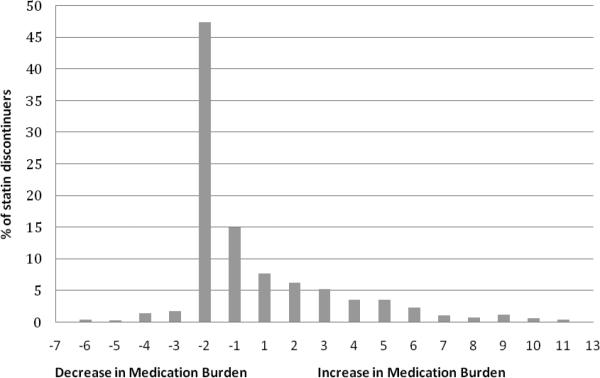
Results: Of 10,212 residents, 16.6% (n = 1,699) used statins. Greater odds of statin use were associated with having diabetes mellitus (adjusted odds ratio (AOR) = 1.24, 95% confidence interval (CI) = 1.09-1.40), stroke (AOR = 1.31, 95% CI = 1.16-1.48), and hypertension (AOR = 1.35, 95% CI = 1.18-1.54); hospice enrollment was associated with lower odds (AOR = 0.75, 95% CI = 0.64-0.89). In follow-up, 37.2% (n = 632) discontinued statins. Median time to discontinuation was 36 days (interquartile range 12-110 days). Shorter time to discontinuation was associated with hospitalization in past 30 days (adjusted hazard ratio (AHR) = 1.67, 95% CI = 1.40-1.99) and more daily medications (AHR = 1.02, 95% CI = 1.01-1.04). When statins were discontinued, 15.0% (n = 95) of residents stopped only statins, and 47.5% (n = 300) stopped at least one other medication.
Conclusion: Most NH residents who use statins at the time of progression to advanced dementia continue use in follow-up.
Keywords: dementia; pharmaceuticals; statins.
© 2014, Copyright the Authors Journal compilation © 2014, The American Geriatrics Society.
Figures
References
-
- Field M, Cassell C. Approaching death: Improving care at the end of life. National Academy Press; Washington DC: 1997. Institute of Medicine Report. - PubMed
-
- Holmes HM, Sachs GA, Shega JW, et al. Integrating palliative medicine into the care of persons with advanced dementia: Identifying appropriate medication use. J Am Geriatr Soc. 2008;56:1306–1311. - PubMed
-
- Luchins DJ, Hanrahan P. J Am Geriatr Soc. 1993;What Is Appropriate health care for end-stage dementia?41:25–30. - PubMed
-
- Vollrath AM, Sinclair C, Hallenbeck J. Discontinuing cardiovascular medications at the end of life: Lipid-lowering agents. J Pall Med. 2005;8:876–881. - PubMed
Publication types
MeSH terms
Substances
Grants and funding
LinkOut - more resources
Full Text Sources
Other Literature Sources
Medical
Research Materials
Miscellaneous
