


Effect of weight maintenance on symptoms of knee osteoarthritis in obese patients: a twelve-month randomized controlled trial
- PMID: 25370359
- PMCID: PMC4657487
- DOI: 10.1002/acr.22504
Effect of weight maintenance on symptoms of knee osteoarthritis in obese patients: a twelve-month randomized controlled trial
Abstract
Objective: To compare results of obese patients with knee osteoarthritis (OA) who, after an intensive weight loss regimen, received 1 year of either dietary support (D), a knee-exercise program (E), or "no attention" (C; control group).
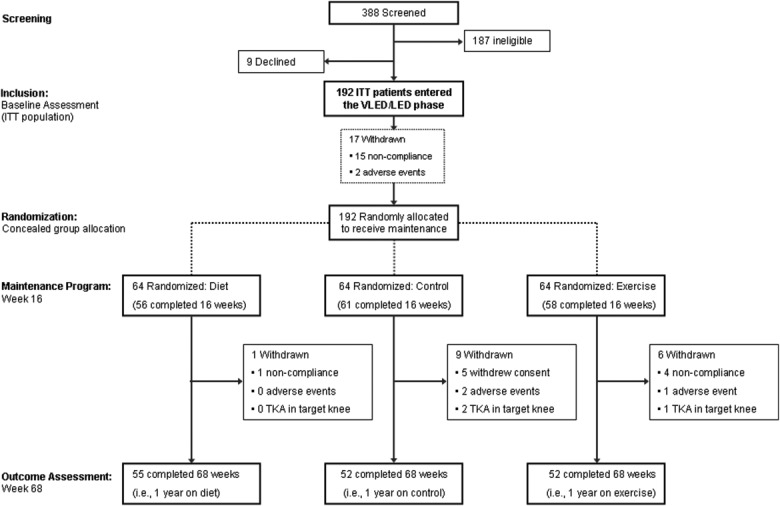
Methods: We conducted a randomized, 2-phase, parallel-group trial. A total of 192 obese participants with knee OA were enrolled; the mean age was 62.5 years and 81% were women with a mean entry weight of 103.2 kg. In phase 1, all participants were randomly assigned to 1 of 3 groups and began a dietary regimen of 400-810 and 1,250 kcal/day for 16 weeks (2 8-week phases) to achieve a major weight loss. Phase 2 consisted of 52 weeks' maintenance in either group D, E, or C. Outcomes were changes from randomization in pain on a 100-mm visual analog scale, weight, and response according to the Outcome Measures in Rheumatology-Osteoarthritis Research Society International criteria.
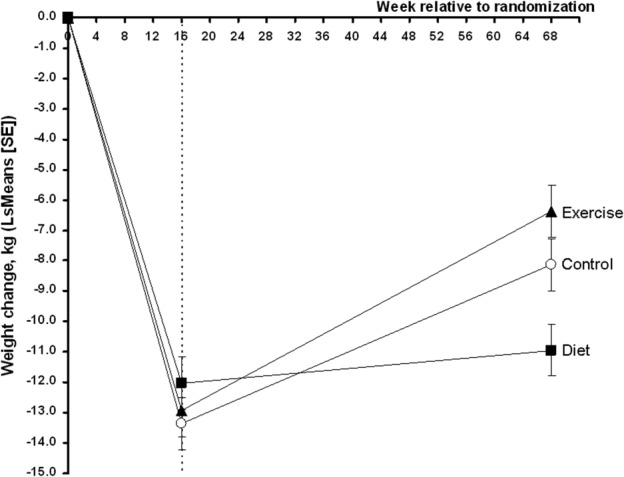
Results: Mean weight loss for phase 1 was 12.8 kg. After 1 year on maintenance therapy, the D group sustained a lower weight (11.0 kg, 95% confidence interval [95% CI] 9.0, 12.8 kg) than those in the E (6.2, 95% CI 4.4, 8.1 kg) and C (8.2, 95% CI 6.4, 10.1 kg) groups (P = 0.002 by analysis of covariance [ANCOVA]). Adherence was low in the E group. All groups had statistically significant pain reduction (D: 6.1; E: 5.6; and C: 5.5 mm) with no difference between groups (P = 0.98 by ANCOVA). In each group 32 (50%), 26 (41%), and 33 (52%) participants responded to treatment in the D, E, and C groups, respectively, with no statistically significant difference in the number of responders (P = 0.41).
Conclusion: A significant weight reduction with a 1-year maintenance program improves knee OA symptoms irrespective of maintenance program.
Trial registration: ClinicalTrials.gov NCT00655941.
© 2015, American College of Rheumatology.
Figures
References
-
- Lawrence RC, Helmick CG, Arnett FC, Deyo RA, Felson DT, Giannini EH, et al. Estimates of the prevalence of arthritis and selected musculoskeletal disorders in the United States. Arthritis Rheum. 1998;41:778–99. - PubMed
-
- World Health Organization. WHO Technical Report Series (919): the burden of musculoskeletal conditions at the start of the new millenium. 2003. URL: http://whqlibdoc.who.int/trs/WHO_TRS_919.pdf. - PubMed
-
- Felson DT. Clinical practice: osteoarthritis of the knee. N Engl J Med. 2006;354(8):841. - PubMed
-
- Blagojevic M, Jinks C, Jeffery A, Jordan KP. Risk factors for onset of osteoarthritis of the knee in older adults: a systematic review and meta-analysis. Osteoarthritis Cartilage. 2010;18:24–33. - PubMed
Publication types
MeSH terms
Associated data
LinkOut - more resources
Full Text Sources
Other Literature Sources
Medical
