


Artificial corneas versus donor corneas for repeat corneal transplants
- PMID: 25372407
- PMCID: PMC4270365
- DOI: 10.1002/14651858.CD009561.pub2
Artificial corneas versus donor corneas for repeat corneal transplants
Update in
-
Artificial corneas versus donor corneas for repeat corneal transplants.Cochrane Database Syst Rev. 2020 May 13;5(5):CD009561. doi: 10.1002/14651858.CD009561.pub3. Cochrane Database Syst Rev. 2020. PMID: 32408386 Free PMC article.
Abstract
Background: Individuals who have failed one or more full thickness penetrating keratoplasties (PKs) may be offered repeat corneal surgery using an artificial or donor cornea. An artificial or prosthetic cornea is known as a keratoprosthesis. Both donor and artificial corneal transplantations involve removal of the diseased and opaque recipient cornea (or the previously failed cornea) and replacement with another donor or prosthetic cornea.
Objectives: To assess the effectiveness of artificial versus donor corneas in individuals who have had one or more failed donor corneal transplantations.
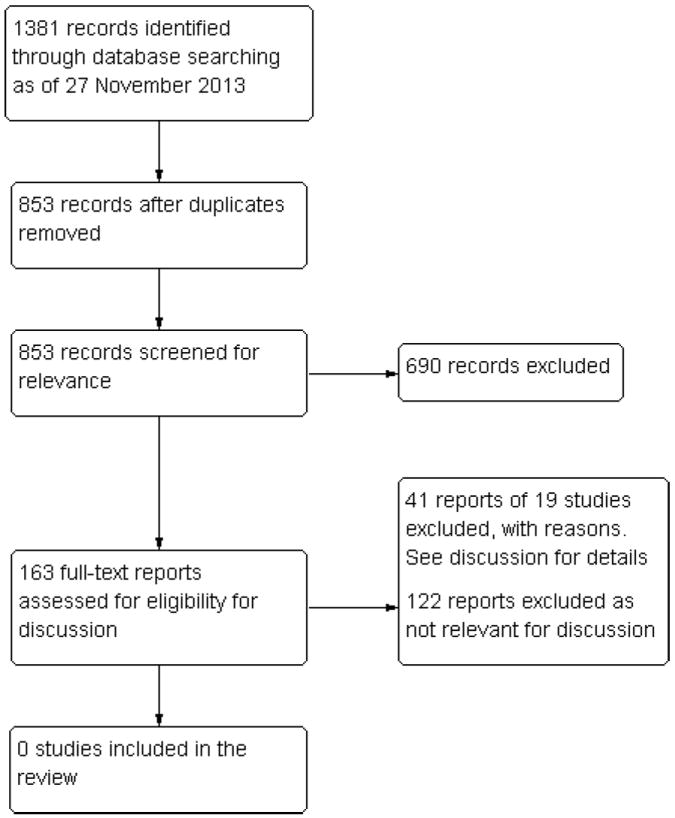
Search methods: We searched CENTRAL (which contains the Cochrane Eyes and Vision Group Trials Register) (2013, Issue 10), Ovid MEDLINE, Ovid MEDLINE In-Process and Other Non-Indexed Citations, Ovid MEDLINE Daily, Ovid OLDMEDLINE (January 1946 to November 2013), EMBASE (January 1980 to November 2013), Latin American and Caribbean Health Sciences Literature Database (LILACS) (January 1982 to November 2013), the metaRegister of Controlled Trials (mRCT) (www.controlled-trials.com), ClinicalTrials.gov (www.clinicaltrials.gov) and the World Health Organization (WHO) International Clinical Trials Registry Platform (ICTRP) (www.who.int/ictrp/search/en). We did not use any date or language restrictions in the electronic searches for trials. We last searched the electronic databases on 27 November 2013.
Selection criteria: Two review authors independently assessed reports from the electronic searches to identify randomized controlled trials (RCTs) or controlled clinical trials (CCTs). We resolved discrepancies by discussion or consultation with a third review author.
Data collection and analysis: For discussion purposes, we assessed findings from observational cohort studies and non-comparative case series. No data synthesis was performed.
Main results: We did not identify any RCTs or CCTs comparing artificial corneas with donor corneas for repeat corneal transplantations.
Authors' conclusions: The optimal management for those individuals who have failed a conventional corneal transplantation is not known. Currently, in some centers, artificial corneal devices routinely are recommended after just one graft failure, and in others, not until after multiple graft failures, or not at all. To date, there have been no controlled trials comparing the visual outcomes and complications of artificial corneal devices (particularly the Boston type 1 keratoprosthesis which is the most commonly implanted artificial corneal device) with repeat donor corneal transplantation, in order to guide surgeons and their patients. It is apparent that such a trial is needed and would offer significant benefit to an ever-increasing pool of people with visual disability due to corneal opacification, most of whom are still in productive stages of their lives.
Conflict of interest statement
None known.
Figures
References
References to studies excluded from this review
-
- Aldave AJ, Kamal KM, Vo RC, Yu F. The Boston type I keratoprosthesis: improving outcomes and expanding indications. Ophthalmology. 2009;116(4):640–51. - PubMed
-
- Aldave AJ, Sangwan VS, Basu S, Basak SK, Hovakimyan A, Gevorgyan O, et al. International results with the Boston type I keratoprosthesis. Ophthalmology. 2012;119(8):1530–8. - PubMed
-
- Goldman DR, Hubschman JP, Aldave AJ, Chiang A, Huang JS, Bourges JL, et al. Postoperative posterior segment complications in eyes treated with the Boston type I keratoprosthesis. Retina. 2013;33(3):532–41. - PubMed
-
- Kim MJ, Yu F, Aldave AJ. Microbial keratitis after Boston type I keratoprosthesis implantation: incidence, organisms, risk factors, and outcomes. Ophthalmology. 2013;120(11):2209–16. - PubMed
-
- Sejpal K, Yu F, Aldave AJ. The Boston keratoprosthesis in the management of corneal limbal stem cell deficiency. Cornea. 2011;30(11):1187–94. - PubMed
Additional references
-
- American Academy of Ophthalmology Cornea/External Disease Panel. Preferred Practice Pattern® Guidelines. [6 February 2014];Corneal edema and opacification. www.aao.org/ppp.
-
- The Australian Corneal Graft Registry. 1990 to 1992 report. Australian and New Zealand Journal of Ophthalmology. 1993;21(2 Suppl):1–48. - PubMed
-
- Ament JD, Stryjewski TP, Ciolino JB, Todani A, Chodosh J, Dohlman CH. Cost-effectiveness of the Boston keratoprosthesis. American Journal of Ophthalmology. 2010;149(2):221–8. - PubMed
-
- Bersudsky V, Blum-Hareuveni T, Rehany U, Rumelt S. The profile of repeated corneal transplantation. Ophthalmology. 2001;108(3):461–9. - PubMed
-
- Eye Bank Association of America. [3 February 2014];2013 Eye banking statistical report. www.restoresight.org/wp-content/uploads/2014/04/2013Statistical.Report-F....
References to other published versions of this review
Publication types
MeSH terms
Grants and funding
LinkOut - more resources
Full Text Sources
Other Literature Sources
Research Materials
Miscellaneous
