


Risk of malnutrition and zinc deficiency in community-living elderly men and women: the Tromsø Study
- PMID: 25373445
- PMCID: PMC10271854
- DOI: 10.1017/S1368980014002420
Risk of malnutrition and zinc deficiency in community-living elderly men and women: the Tromsø Study
Abstract
Objective: Elderly people may be at particular risk of Zn deficiency due to an increased prevalence of malnutrition. The aim of the present study was to evaluate the Zn status in community-living elderly people at risk of malnutrition.
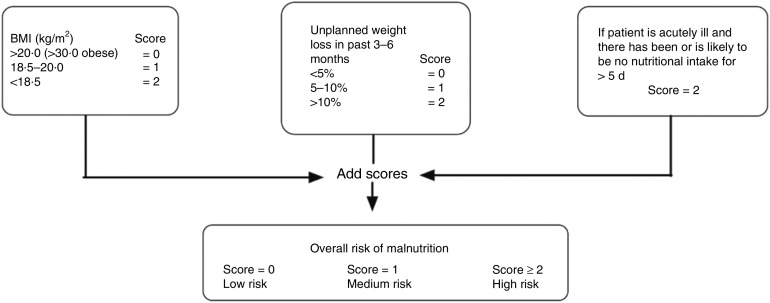
Design: Cross-sectional population-based survey. Individuals at risk of malnutrition were identified by the Malnutrition Universal Screening Tool. Zn status was assessed by measuring serum Zn. Logistic regression was performed to evaluate the association between the risk of malnutrition and Zn deficiency.
Setting: Municipality of Tromsø, Norway.
Subjects: Random sample of 743 men and 778 women aged 65-87 years.
Results: Zn deficiency was found in 10.1% of the participants, including 13.1% of the men and 7.3% of the women. Among the men and women at risk of malnutrition, 31.0% and 12.7%, respectively, had Zn deficiency. In a model adjusted for age, gender, serum albumin and smoking status, Zn deficiency was positively associated with the risk of malnutrition (OR=2.2; 95% CI 1.3, 3.6).
Conclusions: Overall, Zn deficiency was found in one out of ten community-living elderly people and was associated with the risk of malnutrition. Our results encourage the assessment of Zn status in elderly people at risk of malnutrition, with a special emphasis on elderly men.
Keywords: Elderly people; Malnutrition; Malnutrition Universal Screening Tool; Mental distress; Zinc deficiency.
Figures

References
-
- Kaplan LA, Pesce AJ & Kazmierczak SC (2003) Clinical Chemistry. Theory, Analysis, Correlation, 4th ed. St Louis, MO: Mosby.
-
- Tuerk MJ & Fazel N (2009) Zinc deficiency. Curr Opin Gastroenterol 25, 136–143. - PubMed
-
- McClain CJ, McClain M, Barve S et al. (2002) Trace metals and the elderly. Clin Geriatr Med 18, 801–818. - PubMed
-
- Marcellini F, Giuli C, Papa R et al. (2006) Zinc status, psychological and nutritional assessment in old people recruited in five European countries: Zincage study. Biogerontology 7, 339–345. - PubMed
Publication types
MeSH terms
Substances
LinkOut - more resources
Full Text Sources
Other Literature Sources
