


Subclass responses and their half-lives for antibodies against EBA175 and PfRh2 in naturally acquired immunity against Plasmodium falciparum malaria
- PMID: 25373511
- PMCID: PMC4232678
- DOI: 10.1186/1475-2875-13-425
Subclass responses and their half-lives for antibodies against EBA175 and PfRh2 in naturally acquired immunity against Plasmodium falciparum malaria
Abstract
Background: Plasmodium falciparum EBA175 and PfRh2 belong to two main families involved in parasite invasion, and both are potential vaccine candidates. Current knowledge is limited regarding which target antigens and subclasses of antibodies are actually important for protection, and how naturally acquired immunity is achieved.
Methods: Repeated blood samples were collected from individuals in Nigeria over a period of almost one year. ELISA was used to analyse subclasses of IgG responses.
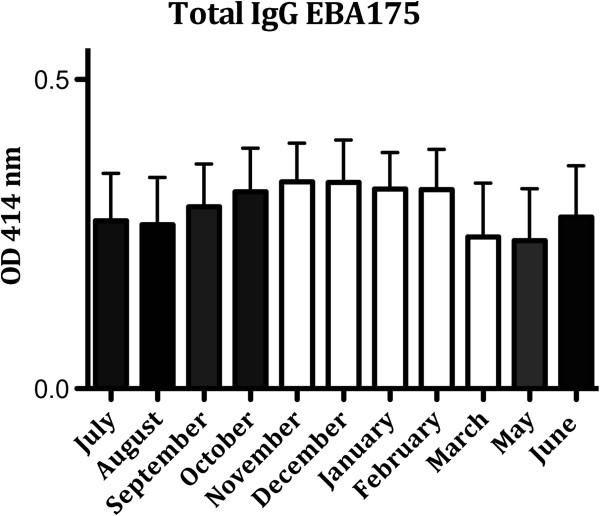
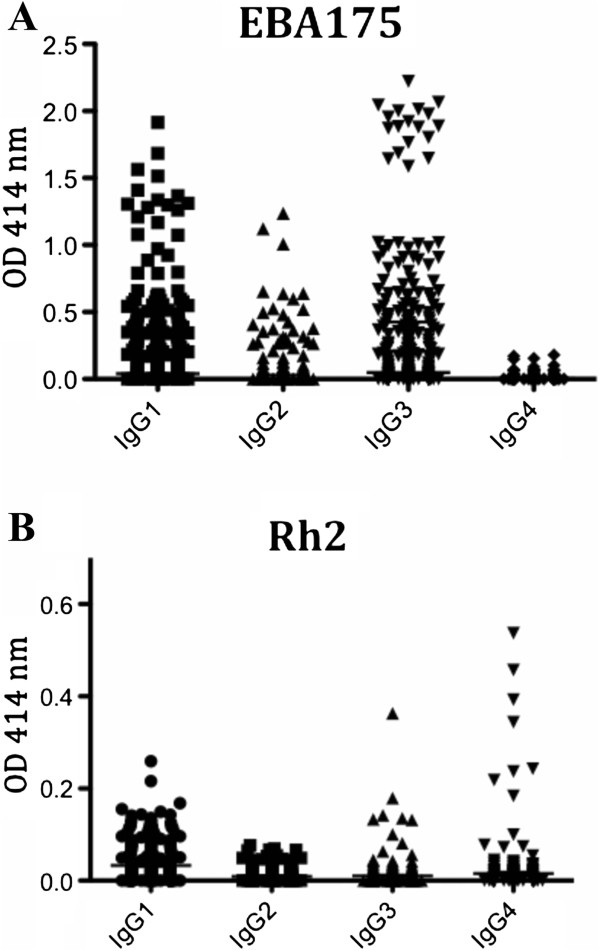
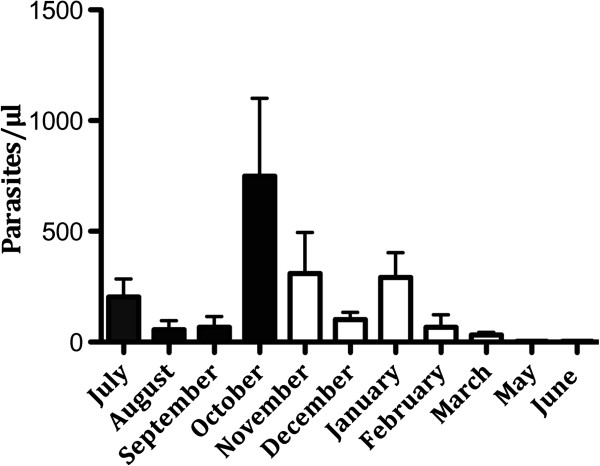
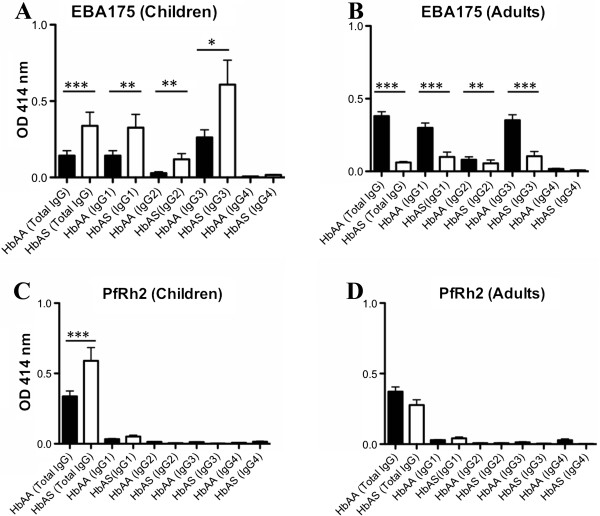
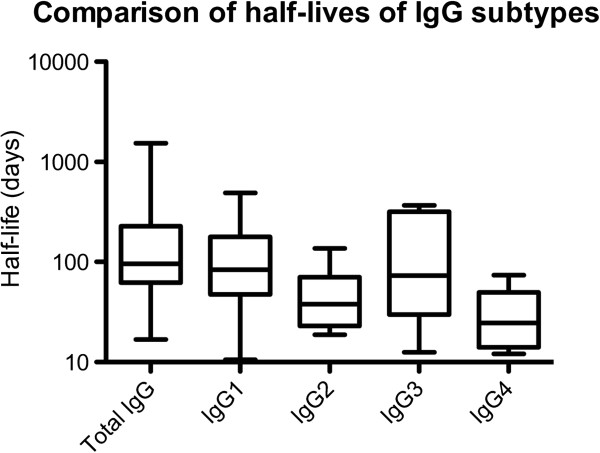
Results: For both EBA175 (region III-V) and (a fragment of) PfRh2, the dominant antibody responses consisted of IgG1 and IgG3 followed by IgG2, while for PfRh2 there was also a relatively prominent response for IgG4. High levels of IgG1, IgG2 and IgG3 for EBA175 and total IgG for PfRh2 correlated significantly with a lower parasitaemia during the study period. Children with HbAS had higher levels of some subclasses compared to children with HbAA, while in adults the pattern was the opposite. The half-lives of IgG2 and IgG4 against EBA175 were clearly shorter than those for IgG1 and IgG3.
Conclusion: EBA175 and PfRh2 are potential targets for protective antibodies since both correlated with lower parasitaemia. The shorter half-lives for IgG2 and IgG4 might explain why these subclasses are often considered less important in protection against malaria. Triggering the right subclass responses could be of critical importance in a successful vaccine. Further studies are needed to evaluate the role of haemoglobin polymorphisms and their malaria protective effects in this process.
Figures
References
-
- WHO . World Malaria Report 2010. Geneva: World Health Organization; 2010.
-
- Talisuna AO, Karema C, Ogutu B, Juma E, Logedi J, Nyandigisi A, Mulenga M, Mbacham WF, Roper C, Guerin PJ, D’Alessandro U, Snow RW. Mitigating the threat of artemisinin resistance in Africa: improvement of drug-resistance surveillance and response systems. Lancet Infect Dis. 2012;12:888–896. doi: 10.1016/S1473-3099(12)70241-4. - DOI - PMC - PubMed
Publication types
MeSH terms
Substances
LinkOut - more resources
Full Text Sources
Other Literature Sources
