


Comment
doi: 10.1016/j.devcel.2014.10.011.
Outside in: inversion of cell polarity controls epithelial lumen formation
Affiliations
- PMID: 25373773
- PMCID: PMC4373590
- DOI: 10.1016/j.devcel.2014.10.011
Item in Clipboard
Comment
Outside in: inversion of cell polarity controls epithelial lumen formation
Dev Cell.
.
Abstract
Establishment of cell polarity is important for epithelial lumen formation, and the molecular mechanisms directing this process are only partially understood. In this issue of Developmental Cell, Bryant et al. (2014) show that disassembly, membrane translocation, and reassembly of podocalyxin complexes controls epithelial cell polarization and lumen formation in 3D matrices.
Figures
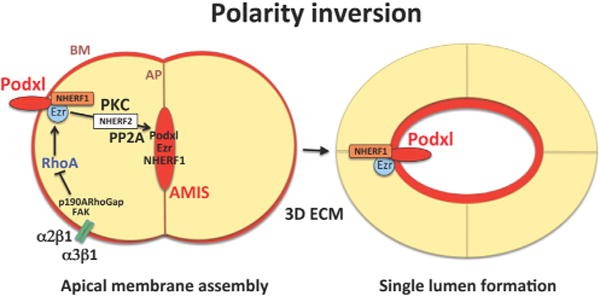
Podocalyxin (Podxl) and its interacting partners, NHERF1, NHERF2, and Ezrin (Ezr), control lumen formation via polarity inversion in 3D matrices. Integrin signaling through a2b1 and a3b1 leads to FAK and p190A RhoGap activation and RhoA inactivation. This signal, in conjunction with PKC activation, leads to disassembly of Podxl/NHERF1/Ezr complexes at the basal membrane (BM). Membrane translocation events lead to nascent assembly of pre-apical membrane surfaces called apical membrane initiating sites (AMIS), which then mature into apical membranes (AP) during lumen formation between multiple epithelial cells. Podxl associates with NHERF2 during vesicular trafficking, while Podxl/NHERF1/Ezr complexes reform during apical membrane assembly in a manner dependent on the protein phosphatase, PP2A.
Comment on
-
From cells to organs: building polarized tissue.Nat Rev Mol Cell Biol. 2008 Nov;9(11):887-901. doi: 10.1038/nrm2523. Nat Rev Mol Cell Biol. 2008. PMID: 18946477 Free PMC article. Review.
-
A molecular network for de novo generation of the apical surface and lumen.Nat Cell Biol. 2010 Nov;12(11):1035-45. doi: 10.1038/ncb2106. Epub 2010 Oct 3. Nat Cell Biol. 2010. PMID: 20890297 Free PMC article.
References
Publication types
MeSH terms
Grants and funding
LinkOut - more resources
Full Text Sources
Other Literature Sources
