. 2014 Nov 5;15(1):955.
doi: 10.1186/1471-2164-15-955.

Comparative transcriptomics reveals striking similarities between the bovine and feline isolates of Tritrichomonas foetus: consequences for in silico drug-target identification

Affiliations

Comparative transcriptomics reveals striking similarities between the bovine and feline isolates of Tritrichomonas foetus: consequences for in silico drug-target identification

Victoria Morin-Adeline et al. BMC Genomics. .

Abstract

Background: Few, if any, protozoan parasites are reported to exhibit extreme organ tropism like the flagellate Tritrichomonas foetus. In cattle, T. foetus infects the reproductive system causing abortion, whereas the infection in cats results in chronic large bowel diarrhoea. In the absence of a T. foetus genome, we utilized a de novo approach to assemble the transcriptome of the bovine and feline genotype to identify host-specific adaptations and virulence factors specific to each genotype. Furthermore, a subset of orthologs was used to characterize putative druggable targets and expose complications of in silico drug target mining in species with indefinite host-ranges.

Results: Illumina RNA-seq reads were assembled into two representative bovine and feline transcriptomes containing 42,363 and 36,559 contigs, respectively. Coding and non-coding regions of the genome libraries revealed striking similarities, with 24,620 shared homolog pairs reduced down to 7,547 coding orthologs between the two genotypes. The transcriptomes were near identical in functional category distribution; with no indication of selective pressure acting on orthologs despite differences in parasite origins/host. Orthologs formed a large proportion of highly expressed transcripts in both genotypes (bovine genotype: 76%, feline genotype: 56%). Mining the libraries for protease virulence factors revealed the cysteine proteases (CP) to be the most common. In total, 483 and 445 bovine and feline T. foetus transcripts were identified as putative proteases based on MEROPS database, with 9 hits to putative protease inhibitors. In bovine T. foetus, CP8 is the preferentially transcribed CP while in the feline genotype, transcription of CP7 showed higher abundance. In silico druggability analysis of the two genotypes revealed that when host sequences are taken into account, drug targets are genotype-specific.

Conclusion: Gene discovery analysis based on RNA-seq data analysis revealed prominent similarities between the bovine and feline T. foetus, suggesting recent adaptation to their respective host/niche. T. foetus represents a unique case of a mammalian protozoan expanding its parasitic grasp across distantly related host lineages. Consequences of the host-range for in silico drug targeting are exposed here, demonstrating that targets of the parasite in one host are not necessarily ideal for the same parasite in another host.


Figures
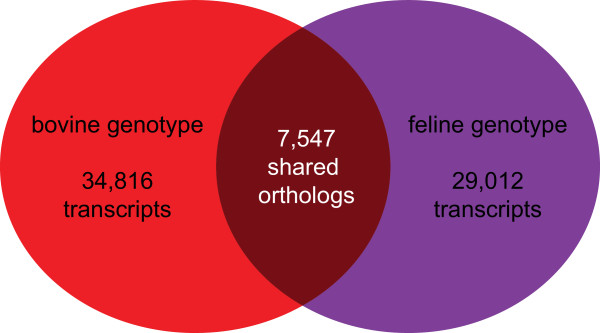
Figure 1
Figure 1
Distribution of shared transcripts between the bovine and feline T. foetus genotype. Venn diagram illustrating the shared bovine and feline transcriptome obtained by de novo assembly of Illumina RNA-seq sequenced data. A total of 7,547 transcripts were identified as true orthologs shared between the two genotypes.
Figure 2
Figure 2
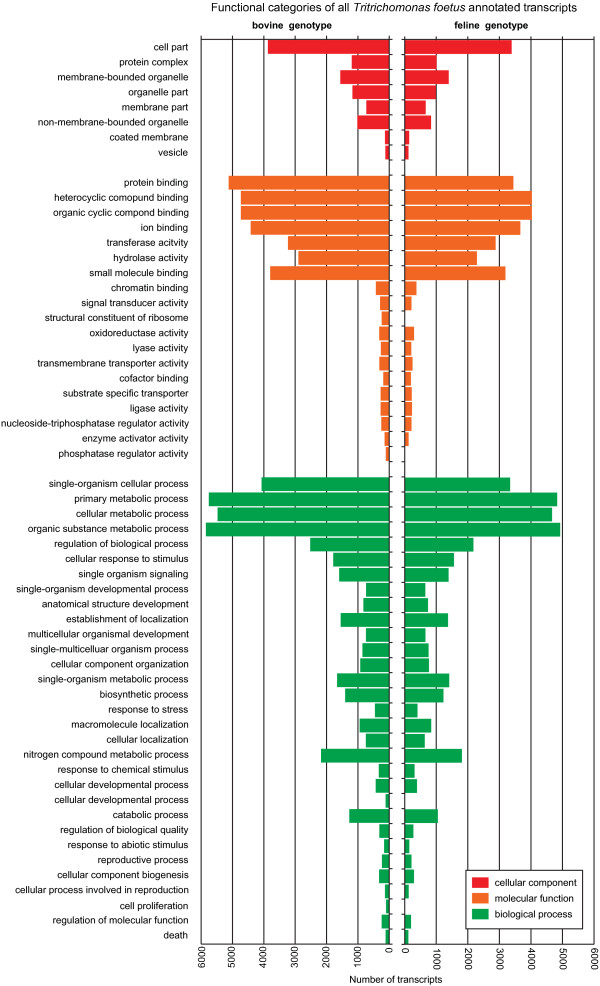
Top ranked GO categories of the bovine and feline Tritrichomonas foetus whole transcriptomes. Functional characterisation of the bovine (left) and feline (right) expressed genome based on Gene Ontology categories showing top ranked categories for cellular component, molecular function and biological process. Categories presented represent a minimum threshold filter value of 100 sequences.
Figure 3
Figure 3
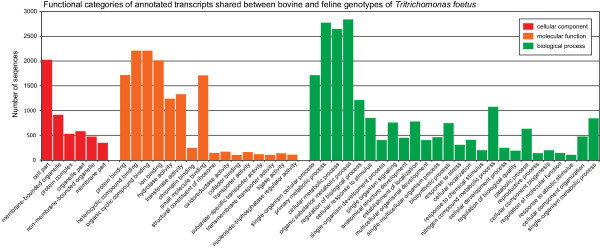
Representative functional annotation of shared orthologs between the bovine and feline T. foetus genotypes. Representative Gene Ontology functional categories of the bovine and feline shared orthologous gene pairs for cellular component, molecular function and biological process.
Figure 4
Figure 4
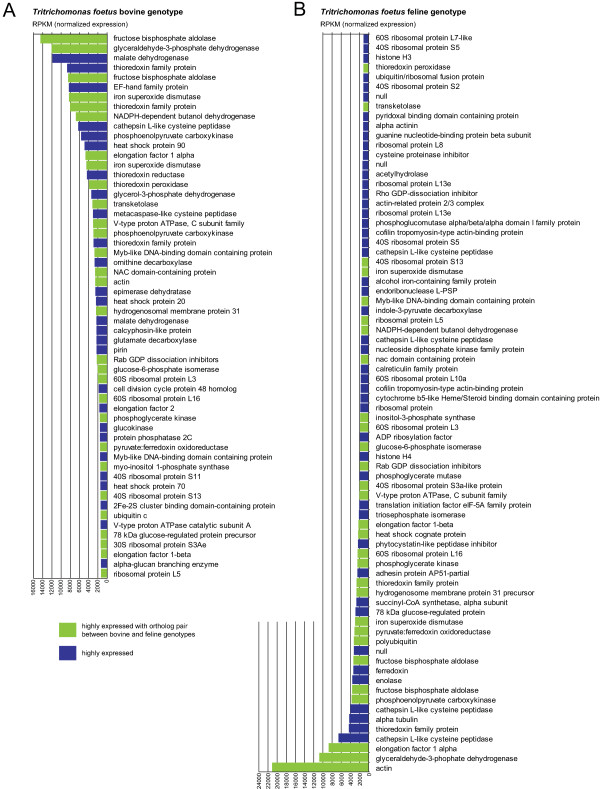
Annotation of the most highly expressed ortholog genes in the bovine and feline T. foetus.BlastX functional annotation of ortholog transcripts present within the top 100 highly expressed transcripts in the bovine (left, A) and feline (right, B) T. foetus genotypes after RPKM normalization of reads counts. The graphs show the 76 and 56 orthologous transcripts of the bovine and feline genotypes, respectively. Non-orthologous transcripts are not shown. Green bars represent the orthologs pairs that are highly expressed in both genotypes.
Figure 5
Figure 5
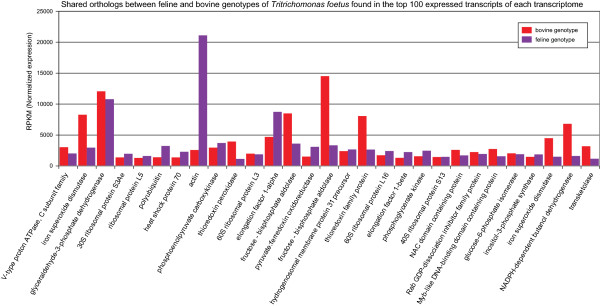
Normalized expression values of 29 highly expressed orthologous transcripts. Normalized read counts (RPKM) and BlastX annotation of 29 pairs of orthologous transcripts present within the top 100 highly expressed transcripts in the bovine and feline T. foetus genotypes.
Figure 6
Figure 6
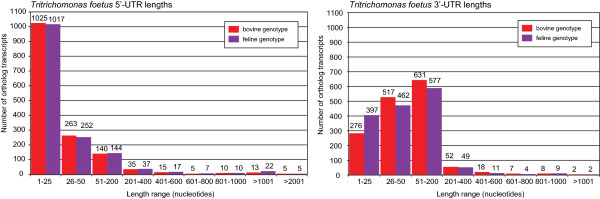
Length comparisons of untranslated regions (UTR) between the bovine and feline T. foetus . The number of transcripts from the 1,511 full-length bovine and feline orthologous transcripts with lengths (in nucleotides) of the 5′UTR (left) and 3′UTR (right) falling within the defined ranges.
Figure 7
Figure 7
Correlation between the length of UTRs and the normalized transcript expression (RPKM) for 1,511 shared ortholog. A non-linear, weighted sum of least square regression model was fitted to plots of the Log10 3′UTR and 5′UTR lengths against the Log10 of normalized expression counts (RPKM) of the respective transcript for the bovine and feline T. foetus genotypes. Regression values (R2) are quote on the individual plots. A-B. 3′UTR and 5′UTR plots respectively, for the feline T. foetus genotype. C-D. 3′UTR and 5′UTR plots respectively, for the bovine T. foetus genotypes.
Figure 8
Figure 8
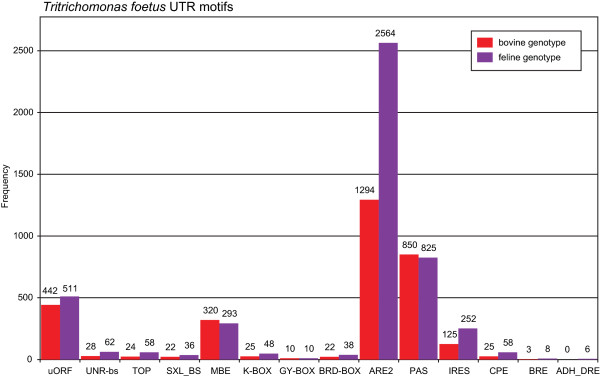
Frequency of regulatory motifs within the untranslated regions (UTR) of full-length orthologous transcripts. Frequency of hits to UTR motifs obtained through UTRscan searches of 1,511 full-length orthologous bovine and feline transcripts against the UTRsite of regulatory motifs. Actual number of hits is presented above each bar. Abbreviations: uORF; upstream open reading frame, UNR-bs; UNR binding site, TOP; terminal oligopyrimidine tract, SXL_BS; SXL bind site, MBE; Musashi binding element, K-Box; K-Box, GY-Box; GY-Box, BRD-Box; BRD-Box, ARE2; AU-rich element, PAS; polyadenylation signal, IRES; internal ribosome entry site, CPE; cytoplasmic polyadenylation element, BRE; Bruno responsive element, ADH_DRE; alcohol dehydrogenase down-regulation control element.
Figure 9
Figure 9
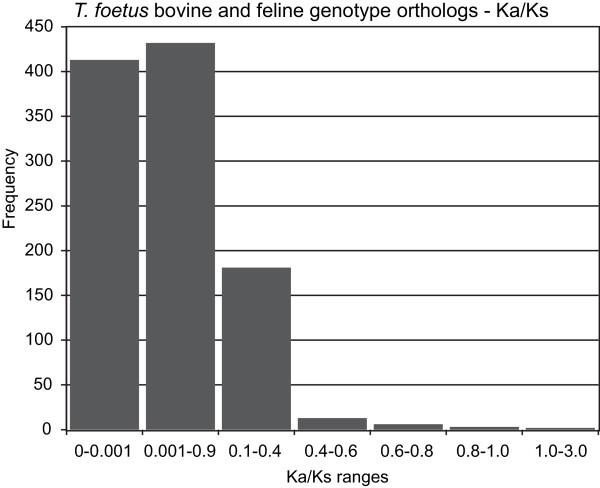
Frequency of Ka/Ks values for full-length orthologous transcripts between the bovine and feline genotype. Frequency of orthologous transcript pairs producing Ka/Ks values within various ranges.

References

    1. Cepicka I, Hampl V, Kulda J. Critical taxonomic revision of parabasalids with description of one new genus and three new species. Protist. 2010;161(3):400–433. doi: 10.1016/j.protis.2009.11.005. - DOI - PubMed
    1. Tachezy J, Tachezy R, Hampl V, Šedinová M, Vaňáčová S, Vrlík M, Van Ranst M, Flegr J, Kulda J. Cattle pathogen Tritrichomonas foetus (Riedmüller, 1928) and pig commensal Tritrichomonas suis (Gruby & Delafond, 1843) belong to the same species. J Eukaryot Microbiol. 2002;49(2):154–163. doi: 10.1111/j.1550-7408.2002.tb00360.x. - DOI - PubMed
    1. Mattos A, Solé-Cava AM, De Carli G, Benchimol M. Fine structure and isozymic characterization of trichomonadid protozoa. Parasitol Res. 1997;83(3):290–295. doi: 10.1007/s004360050249. - DOI - PubMed
    1. Šlapeta J, Müller N, Stack CM, Walker G, Lew-Tabor A, Tachezy J, Frey CF. Comparative analysis of Tritrichomonas foetus (Riedmuller, 1928) cat genotype, T. Foetus (Riedmuller, 1928) cattle genotype and Tritrichomonas suis (Davaine, 1875) at 10 DNA loci. Int J Parasitol. 2012;42(13–14):1143–1149. doi: 10.1016/j.ijpara.2012.10.004. - DOI - PubMed
    1. Mardones FO, Perez AM, Martinez A, Carpenter TE. Risk factors associated with Tritrichomonas foetus infection in beef herds in the province of Buenos Aires, Argentina. Vet Parasitol. 2008;153(3–4):231–237. doi: 10.1016/j.vetpar.2008.01.038. - DOI - PubMed

Publication types

MeSH terms

LinkOut - more resources