


Cumulative live birth rate and assisted reproduction: impact of female age and transfer day
- PMID: 25374657
- PMCID: PMC4216980
Cumulative live birth rate and assisted reproduction: impact of female age and transfer day
Abstract
Background: Many studies on assisted reproductive technology examine live birth rate per cycle. However, after a cycle fails, couples often want to know what their chances are of having a live birth if they continue treatment. From a patients' perspective, the cumulative probability of live birth is more informative.
Materials and methods: This study includes patients who underwent fresh, frozen and non-donor ICSI cycles at our IVF unit between 2006-2012. Patients were divided into two groups; Group 1 represented those who underwent only Day 5 transfers, Group 2 represented only Day 3 transfers. Patients who underwent both were excluded. -Cycles were analyzed until the first live birth or the end of the 3rd cycle. Using Kaplan-Meier analysis, we estimated the cumulative live birth rates for each group and according to female age.
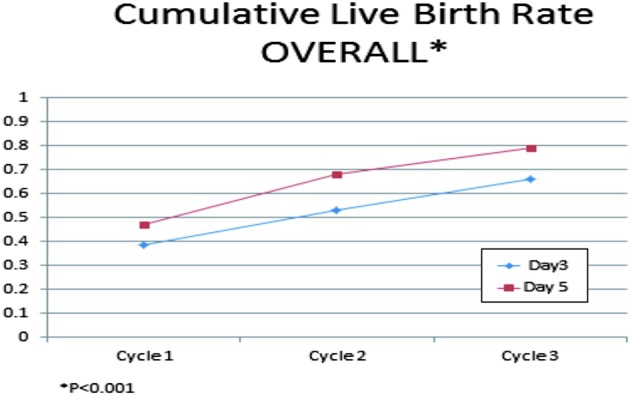
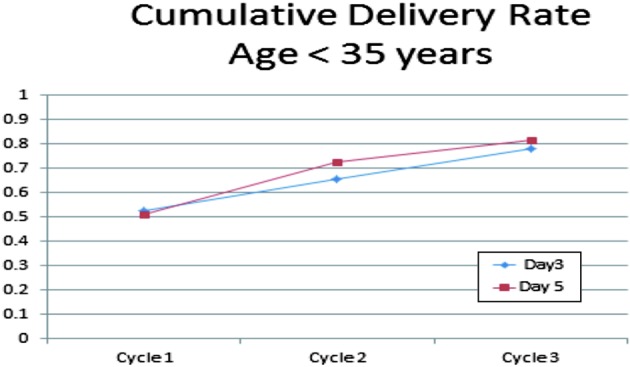
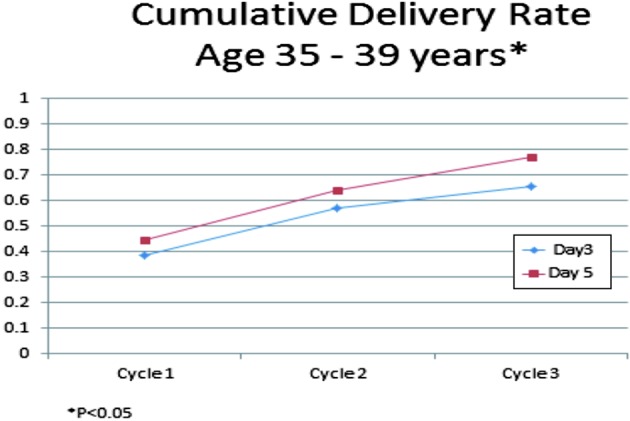
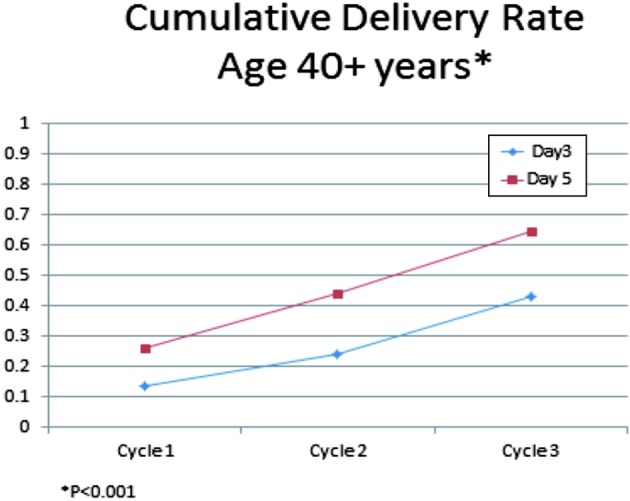
Results: The mean age for Group 1 was significantly lower than for Group 2. After 3 cycles, Group 1's CLBR was 79% versus 66% in Group 2. When analyzing the live births by age and group, there was a significant difference in the CLBR after 3 cycles with the women less than 35 years having the highest CLBR and the women 40 years or older having the lowest CLBR.
Conclusion: In women less than 35 years, excellent CLBR can be achieved irrespective of the transfer day. For women 40 years and above, better results of CLBR are observed with Day 5 transfers. Our findings may impact the counseling of couples considering IVF treatment.
Keywords: ART; ICSI; IVF; cumulative live birth rate; female age; transfer day.
Figures
References
-
- ASRM Practice Committee Opinion. Blastocyst culture and transfer in clinical-assisted reproduction: a committee opinion. Fertil Steril. 2013;99:667–672. - PubMed
-
- Engmann L, Maconochie N, Bekir J, et al. Cumulative probability of clinical pregnancy and live birth after a multiple cycle IVF package: a more realistic assessment of overall and age-specific success rates? Br J Obstet Gynaecol. 1999;106:165–170. - PubMed
-
- Fukuda J, Kumagai J, Kodoma H, et al. Upper limit of the number of IVF-ET treatment cycles in different age groups, predicted by cumulative take-home baby rate. Acta Obstet Gynecol Scand. 2001;80:71–73. - PubMed
-
- Gardner D, Surrey E, Minjarez D, et al. Single blastocyst transfer: a prospective randomized trial. Fertil Steril. 2004;81:551–555. - PubMed
-
- Gnoth C, Godehardt D, Godehardt E, et al. Time to pregnancy: results of the German prospective study and impact on the management of infertility. Hum Reprod. 2003;18:1959–1966. - PubMed
LinkOut - more resources
Full Text Sources