Future therapy of portal hypertension in liver cirrhosis - a guess
- PMID: 25374673
- PMCID: PMC4191223
- DOI: 10.12703/P6-95
Future therapy of portal hypertension in liver cirrhosis - a guess
Abstract
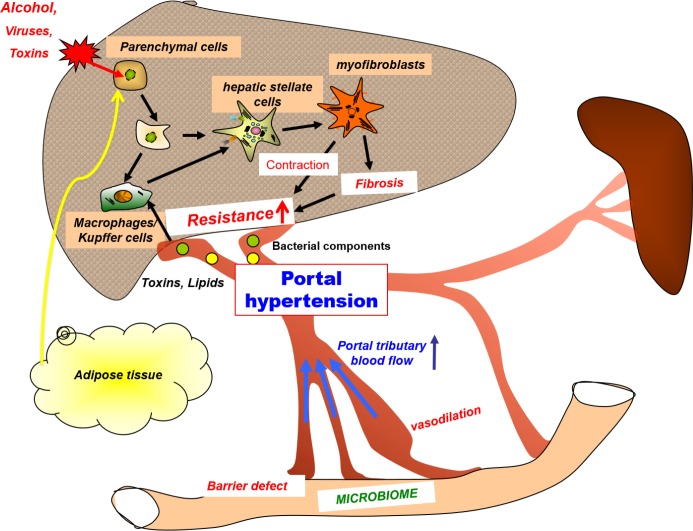
In patients with chronic liver disease, portal hypertension is driven by progressive fibrosis and intrahepatic vasoconstriction. Interruption of the initiating and perpetuating etiology-mostly leading to necroinflammation-is possible for several underlying causes, such as autoimmune hepatitis, hepatitis B virus (HBV) infection, and most recently hepatitis C virus (HCV) infection. Thus, in the long run, lifestyle-related liver damage due to chronic alcoholism or morbid obesity will remain the main factor leading to portal hypertension. Both causes are probably more easily countered by socioeconomic measures than by individual approaches. If chronic liver injury supporting fibrogenesis and portal hypertension cannot be interrupted, a wide variety of tools are available to modulate and reduce intrahepatic resistance and therewith portal hypertension. Many of these have been evaluated in animal models. Also, some well-established drugs, which are used in humans for other indications (for example, statins), are promising if applied early and concomitantly to standard therapy. In the future, more individually tailored strategies must also be considered in line with the spectrum of portal hypertensive complications and risk factors defined by high-throughput analysis of the patient's genome, transcriptome, metabolome, or microbiome.
Figures
References
-
- Lozano R, Naghavi M, Foreman K, Lim S, Shibuya K, Aboyans V, Abraham J, Adair T, Aggarwal R, Ahn SY, Alvarado M, Anderson HR, Anderson LM, Andrews KG, Atkinson C, Baddour LM, Barker-Collo S, Bartels DH, Bell ML, Benjamin EJ, Bennett D, Bhalla K, Bikbov B, Bin Abdulhak A, Birbeck G, Blyth F, Bolliger I, Boufous S, Bucello C, Burch M, et al. Global and regional mortality from 235 causes of death for 20 age groups in 1990 and 2010: a systematic analysis for the Global Burden of Disease Study 2010. Lancet. 2012;380:2095–128. doi: 10.1016/S0140-6736(12)61728-0. - DOI - PMC - PubMed
-
- European Association For The Study Of The Liver. EASL clinical practice guidelines: Management of chronic hepatitis B virus infection. J Hepatol. 2012;57:167–85. - PubMed
Publication types
LinkOut - more resources
Full Text Sources
Other Literature Sources