


Effect of pneumococcal conjugate vaccination in Uruguay, a middle-income country
- PMID: 25375647
- PMCID: PMC4223029
- DOI: 10.1371/journal.pone.0112337
Effect of pneumococcal conjugate vaccination in Uruguay, a middle-income country
Abstract
Background: In 2008, a 7-valent pneumococcal conjugate vaccine (PCV7) was introduced into the routine childhood immunization program in Uruguay, with a 2+1 schedule. In 2010, PCV13 replaced PCV7, and the same 2+1 schedule was used. The effect of these pneumococcal vaccines on the incidence of invasive pneumococcal infections (IPD) and on serotype distribution was analyzed retrospectively, based on passive national laboratory surveillance.
Methods: Data from 1,887 IPD isolates from 5 years before and 5 years after PCV7 introduction (7 before and 3 after PCV13 introduction) was examined to assess the incidence rate per 100,000 age-specific population of all IPD, PCV7-serotypes, and PCV13-serotypes associated IPD among children < 2 years and 2 to 4 years old, and patients ≥ 5 years old. Trends of frequency for each serotype were also analyzed.
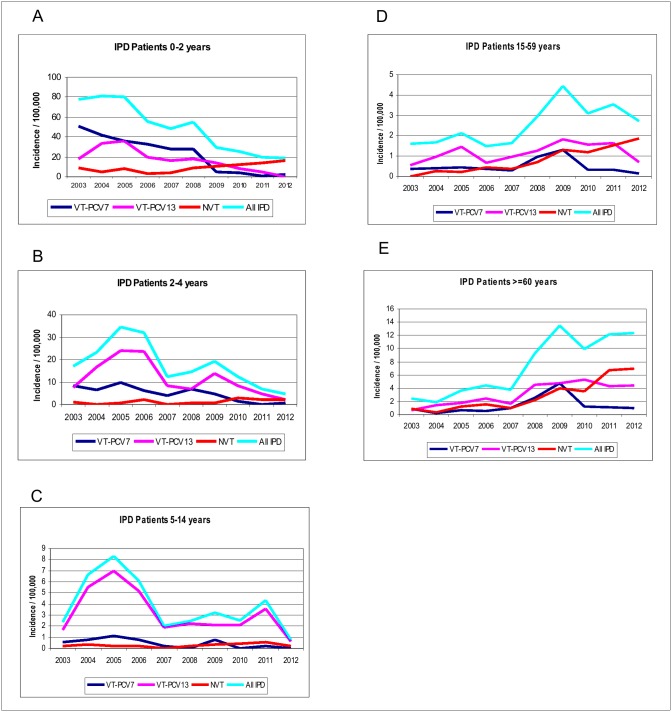
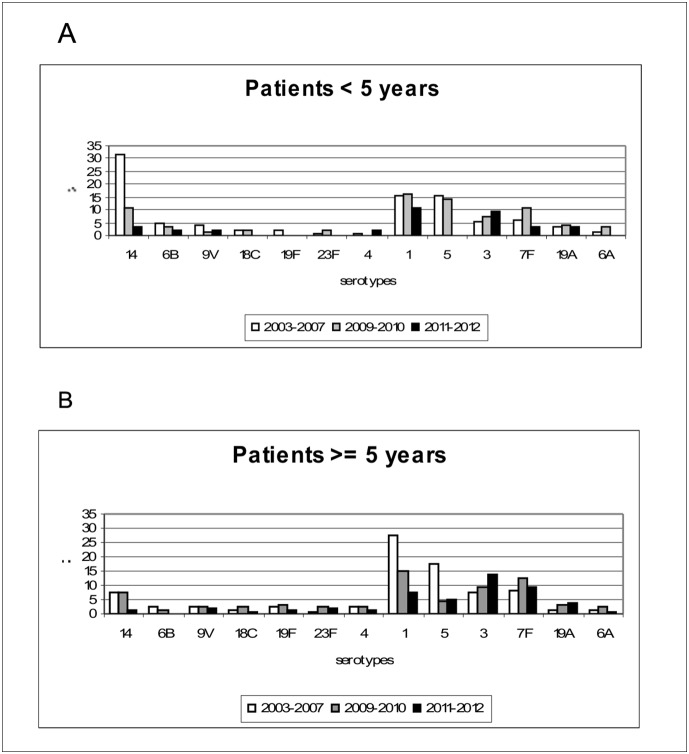
Results: Comparison of pre-vaccination (2003-2007) and post-vaccination (2008-2012) periods showed a significant decrease in IPD incidence among children < 2 years old (IR 68.7 to IR 29.6, p<0.001) and children 2 to 4 years (p < 0.04). IPD caused by serotypes in PCV7 was reduced by 95.6% and IPD caused by 6 serotypes added in PCV13 was reduced by 83.9% in children <5 years old. Indirect effects of both conjugate vaccines were observed among patients ≥ 5 years old one year after the introduction of each vaccine, in 2010 for PCV7 and in 2012 for PCV13. Nevertheless, for reasons that still need to be explained, perhaps due to ascertainment bias, total IPD in this group increased after 2007. In 2012, the relative frequency of vaccine serotypes among vaccinated and unvaccinated population declined, except for serotype 3. Non vaccine serotypes with increasing frequency were identified, in rank order: 12F, 8, 24F, 22F, 24A, 15C, 9N, 10A and 33.
Conclusion: Consecutive immunization with PCV7 and PCV13 has significantly reduced IPD in children < 5 years of age in Uruguay.
Conflict of interest statement
Figures
References
-
- Whitney CG, Farley MM, Hadler J, Harrison LH, Bennett NM, et al. (2003) Decline in invasive pneumococcal disease after the introduction of protein-polysaccharide conjugate vaccine. N Engl J Med 348: 1737–1746. - PubMed
-
- Obaro SK, Adegbola RA, Banya WA, Greenwood BM (1996) Carriage of pneumococci after pneumococcal vaccination. Lancet 348: 271–272. - PubMed
-
- Bettinger JA, Scheifele DW, Kellner JD, Halperin SA, Vaudry W, et al. (2010) The effect of routine vaccination on invasive pneumococcal infections in Canadian children, Immunization Monitoring Program, Active 2000–2007. Vaccine 28: 2130–2136. - PubMed
Publication types
MeSH terms
Substances
LinkOut - more resources
Full Text Sources
Other Literature Sources
Medical
