


Global assessment of seasonal potential distribution of Mediterranean fruit fly, Ceratitis capitata (Diptera: Tephritidae)
- PMID: 25375649
- PMCID: PMC4222914
- DOI: 10.1371/journal.pone.0111582
Global assessment of seasonal potential distribution of Mediterranean fruit fly, Ceratitis capitata (Diptera: Tephritidae)
Abstract
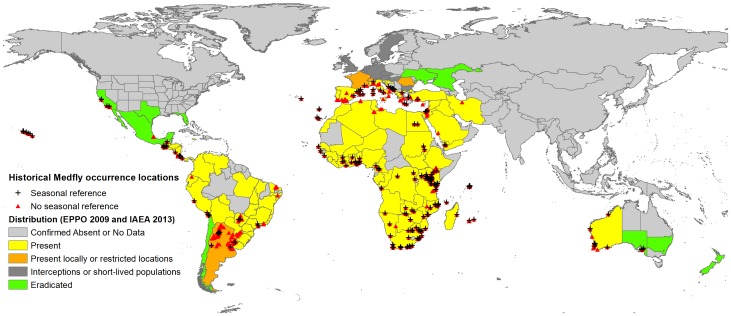
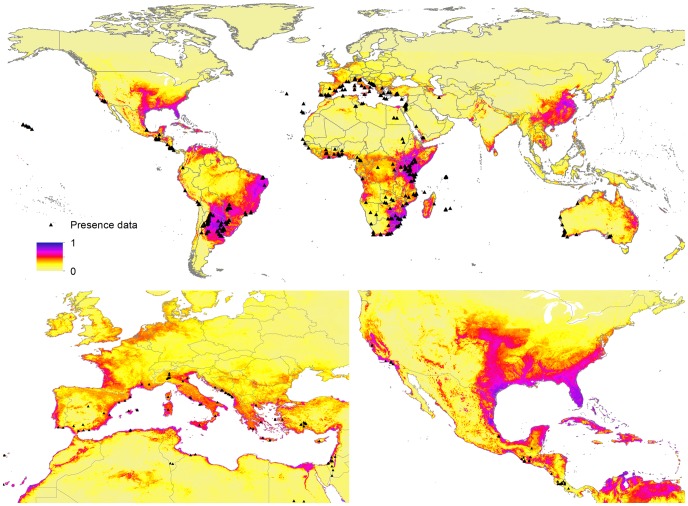
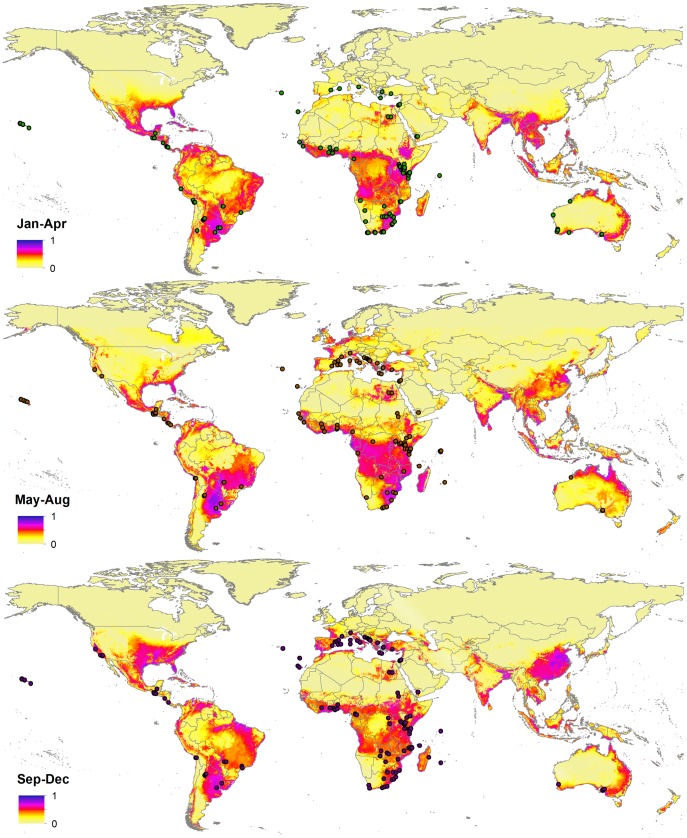
The Mediterranean fruit fly (Medfly) is one of the world's most economically damaging pests. It displays highly seasonal population dynamics, and the environmental conditions suitable for its abundance are not constant throughout the year in most places. An extensive literature search was performed to obtain the most comprehensive data on the historical and contemporary spatio-temporal occurrence of the pest globally. The database constructed contained 2328 unique geo-located entries on Medfly detection sites from 43 countries and nearly 500 unique localities, as well as information on hosts, life stages and capture method. Of these, 125 localities had information on the month when Medfly was recorded and these data were complemented by additional material found in comprehensive databases available online. Records from 1980 until present were used for medfly environmental niche modeling. Maximum Entropy Algorithm (MaxEnt) and a set of seasonally varying environmental covariates were used to predict the fundamental niche of the Medfly on a global scale. Three seasonal maps were also produced: January-April, May-August and September-December. Models performed significantly better than random achieving high accuracy scores, indicating a good discrimination of suitable versus unsuitable areas for the presence of the species.
Conflict of interest statement
Figures
References
-
- Riccardo Scalera, Genovesi P, Franz Essl, Rabitsch W (2012) The impacts of invasive alien species in Europe. Technical Report. Luxembourg: European Environmental Agency. Available: http://www.eea.europa.eu/publications/impacts-of-invasive-alien-species.
-
- Liquido NJ, Cunningham RT, Nakagawa S (1990) Host Plants of Mediterranean Fruit Fly (Diptera: Tephritidae) on the Island of Hawaii (1949–1985 Survey). J Econ Entomol 83: 1863–1878.
-
- Papadopoulos NT, Katsoyannos BI, Kouloussis NA, Hendrichs J, Carey JR, et al. (2001) Early Detection and Population Monitoring of Ceratitis capitata (Diptera: Tephritidae) in a Mixed-Fruit Orchard in Northern Greece. J Econ Entomol 94: 971–978. - PubMed
-
- Gasperi G, Bonizzoni M, Gomulski L, Murelli V, Torti C, et al. (2002) Genetic differentiation, gene flow and the origin of infestations of the medfly, Ceratitis capitata. Genetica 116: 125–135. - PubMed
Publication types
MeSH terms
Grants and funding
LinkOut - more resources
Full Text Sources
Other Literature Sources
Miscellaneous
