


Physical aggression and language ability from 17 to 72 months: cross-lagged effects in a population sample
- PMID: 25375971
- PMCID: PMC4223025
- DOI: 10.1371/journal.pone.0112185
Physical aggression and language ability from 17 to 72 months: cross-lagged effects in a population sample
Abstract
Background: Does poor language ability in early childhood increase the likelihood of physical aggression or is language ability delayed by frequent physical aggression? This study examined the longitudinal associations between physical aggression and language ability from toddlerhood to early childhood in a population sample while controlling for parenting behaviours, non-verbal intellectual functioning, and children's sex.
Methods: Children enrolled in the Quebec Longitudinal Study of Child Development (QLSCD) (N = 2, 057) were assessed longitudinally from 17 to 72 months via parent reports and standardized assessments.
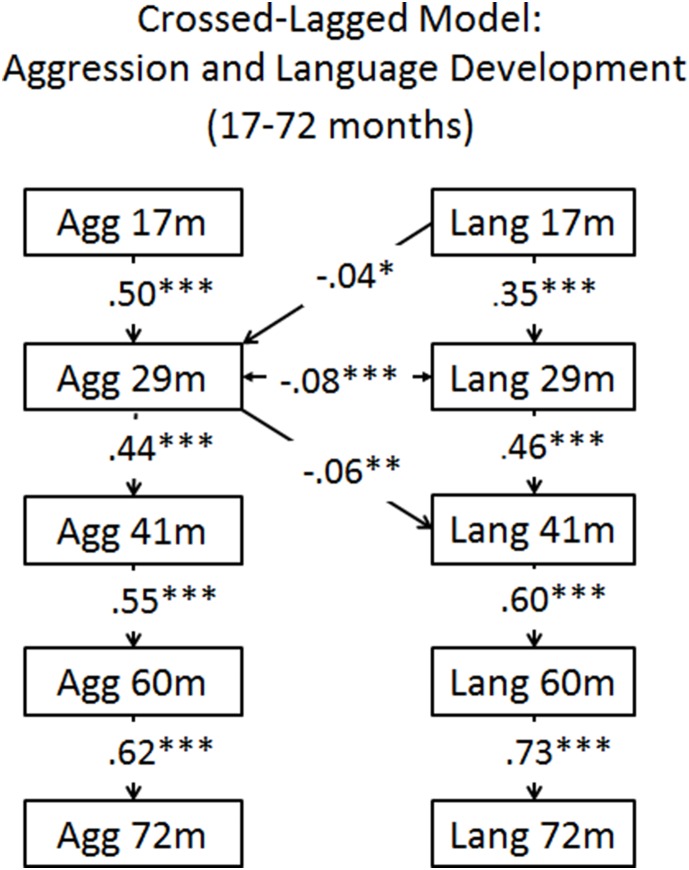
Results: The cross-lagged models revealed modest reciprocal associations between physical aggression and language performance from 17 to 41 months but not thereafter.
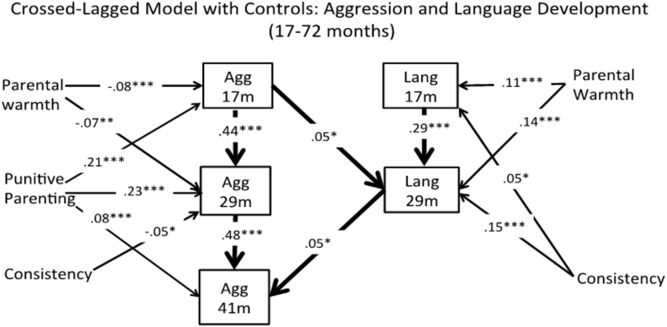
Conclusions: Significant associations between physical aggression and poor language ability are minimal and limited to the period when physical aggression and language performance are both substantially increasing. During that period parenting behaviours may play an important role in supporting language ability while reducing the frequency of physical aggression. Further studies are needed that utilize multiple assessments of physical aggression, assess multiple domains of language abilities, and that examine the potential mediating role of parenting behaviours between 12 and 48 months.
Conflict of interest statement
Figures
References
-
- Alink LRA, Mesman J, Van Zeijl J, Stolk MN, Juffer F, et al. (2006) The early childhood aggression curve: Development of physical aggression in 10- to 50-month-old children. Child Development 77(4): 954–966. - PubMed
-
- Nærde A, Ogden T, Janson H, Zachrisson HD (2014) Normative development of physical aggression from 8 to 26 months. Developmental Psychology 50(6): 1710–1720. Advance online publication. Available: http://dx.doi.org/10.1037/a0036324. - DOI - PubMed
-
- Tremblay RE, Japel C, Perusse D, Mcduff P, Boivin M, et al. (1999) The search for the age of ‘onset’ of physical aggression: Rousseau and Bandura revisited. Criminal Behaviour and Mental Health 9(1): 8–23.
-
- Tremblay RE (2010) Developmental origins of disruptive behaviour problems: the ‘original sin’ hypothesis, epigenetics and their consequences for prevention. Journal of Child Psychology and Psychiatry 51(4): 341–367. - PubMed
MeSH terms
LinkOut - more resources
Full Text Sources
Other Literature Sources
