Disappearance of T Cell-Mediated Rejection Despite Continued Antibody-Mediated Rejection in Late Kidney Transplant Recipients
- PMID: 25377077
- PMCID: PMC4483591
- DOI: 10.1681/ASN.2014060588
Disappearance of T Cell-Mediated Rejection Despite Continued Antibody-Mediated Rejection in Late Kidney Transplant Recipients
Abstract
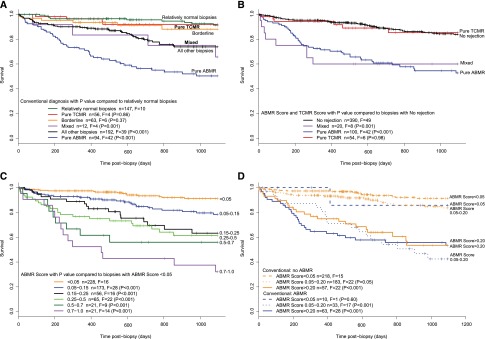
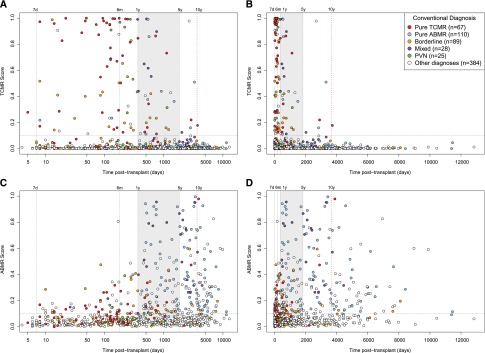
The prevalent renal transplant population presents an opportunity to observe the adaptive changes in the alloimmune response over time, but such studies have been limited by uncertainties in the conventional biopsy diagnosis of T cell-mediated rejection (TCMR) and antibody-mediated rejection (ABMR). To circumvent these limitations, we used microarrays and conventional methods to investigate rejection in 703 unselected biopsies taken 3 days to 35 years post-transplant from North American and European centers. Using conventional methods, we diagnosed rejection in 205 biopsy specimens (28%): 67 pure TCMR, 110 pure ABMR, and 28 mixed (89 designated borderline). Using microarrays, we diagnosed rejection in 228 biopsy specimens (32%): 76 pure TCMR, 124 pure ABMR, and 28 mixed (no borderline). Molecular assessment confirmed most conventional diagnoses (agreement was 90% for TCMR and 83% for ABMR) but revealed some errors, particularly in mixed rejection, and improved prediction of failure. ABMR was strongly associated with increased graft loss, but TCMR was not. ABMR became common in biopsy specimens obtained >1 year post-transplant and continued to appear in all subsequent intervals. TCMR was common early but progressively disappeared over time. In 108 biopsy specimens obtained 10.2-35 years post-transplant, TCMR defined by molecular and conventional features was never observed. We conclude that the main cause of kidney transplant failure is ABMR, which can present even decades after transplantation. In contrast, TCMR disappears by 10 years post-transplant, implying that a state of partial adaptive tolerance emerges over time in the kidney transplant population.
Keywords: T cells; antibody; graft rejection; kidney transplant; microarrays.
Copyright © 2015 by the American Society of Nephrology.
Figures
Comment in
-
Begin at the Beginning to Prevent the End.J Am Soc Nephrol. 2015 Jul;26(7):1483-5. doi: 10.1681/ASN.2014111115. Epub 2015 Jan 2. J Am Soc Nephrol. 2015. PMID: 25556171 Free PMC article. No abstract available.
References
-
- Collins AJ, Foley RN, Chavers B, Gilbertson D, Herzog C, Ishani A, Johansen K, Kasiske BL, Kutner N, Liu J, St. Peter W, Guo H, Hu Y, Kats A, Li S, Li S, Maloney J, Roberts T, Skeans M, Snyder J, Solid C, Thompson B, Weinhandt E, Xiong H, Yusuf A, Zaun D, Arko C, Chen SC, Daniels F, Ebben J, Frazier E, Johnson R, Sheets D, Wang X, Forrest B, Berrini D, Constantini E, Everson S, Eggers P, Agodoa L: US Renal Data System 2013 Annual Data Report. Am J Kidney Dis 63[1 Suppl]: A7, 2014 - PubMed
-
- El-Zoghby ZM, Stegall MD, Lager DJ, Kremers WK, Amer H, Gloor JM, Cosio FG: Identifying specific causes of kidney allograft loss. Am J Transplant 9: 527–535, 2009 - PubMed
-
- Sellarés J, de Freitas DG, Mengel M, Reeve J, Einecke G, Sis B, Hidalgo LG, Famulski K, Matas A, Halloran PF: Understanding the causes of kidney transplant failure: The dominant role of antibody-mediated rejection and nonadherence. Am J Transplant 12: 388–399, 2012 - PubMed
-
- Einecke G, Sis B, Reeve J, Mengel M, Campbell PM, Hidalgo LG, Kaplan B, Halloran PF: Antibody-mediated microcirculation injury is the major cause of late kidney transplant failure. Am J Transplant 9: 2520–2531, 2009 - PubMed
-
- Gaston RS, Cecka JM, Kasiske BL, Fieberg AM, Leduc R, Cosio FC, Gourishankar S, Grande J, Halloran P, Hunsicker L, Mannon R, Rush D, Matas AJ: Evidence for antibody-mediated injury as a major determinant of late kidney allograft failure. Transplantation 90: 68–74, 2010 - PubMed
Publication types
MeSH terms
Substances
LinkOut - more resources
Full Text Sources
Other Literature Sources
Medical
Molecular Biology Databases