. 2015 May-Jun;7(3):446-57.
doi: 10.1002/wnan.1311. Epub 2014 Nov 6.

Open challenges in magnetic drug targeting

Affiliations

Open challenges in magnetic drug targeting

Benjamin Shapiro et al. Wiley Interdiscip Rev Nanomed Nanobiotechnol. 2015 May-Jun.

Abstract

The principle of magnetic drug targeting, wherein therapy is attached to magnetically responsive carriers and magnetic fields are used to direct that therapy to disease locations, has been around for nearly two decades. Yet our ability to safely and effectively direct therapy to where it needs to go, for instance to deep tissue targets, remains limited. To date, magnetic targeting methods have not yet passed regulatory approval or reached clinical use. Below we outline key challenges to magnetic targeting, which include designing and selecting magnetic carriers for specific clinical indications, safely and effectively reaching targets behind tissue and anatomical barriers, real-time carrier imaging, and magnet design and control for deep and precise targeting. Addressing these challenges will require interactions across disciplines. Nanofabricators and chemists should work with biologists, mathematicians, and engineers to better understand how carriers move through live tissues and how to optimize carrier and magnet designs to better direct therapy to disease targets. Clinicians should be involved early on and throughout the whole process to ensure the methods that are being developed meet a compelling clinical need and will be practical in a clinical setting. Our hope is that highlighting these challenges will help researchers translate magnetic drug targeting from a novel concept to a clinically available treatment that can put therapy where it needs to go in human patients.


Figures

Figure 1
Figure 1
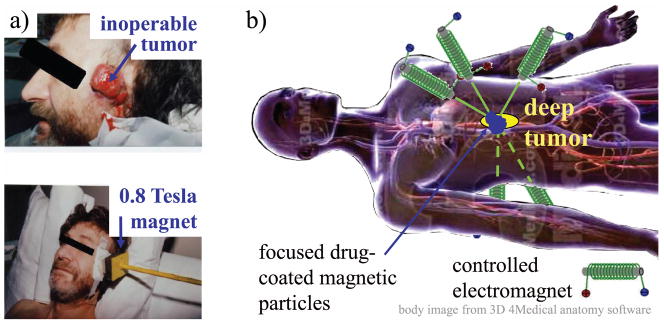
(a) The first human trials in magnetic drug targeting (1). Epidoxorubicin-coated magnetic nano-particles were administered systemically to advanced head and neck and breast cancer patients, and a single permanent magnet was held near inoperable but shallow tumors to concentrate the chemotherapy. (b) A goal in magnetic targeting is to use magnetic fields to focus therapy precisely to any desired target in the body, for example to a deep tumor as illustrated. Currently there are no magnetic systems that can achieve this kind of precise and deep focusing.
Figure 2
Figure 2
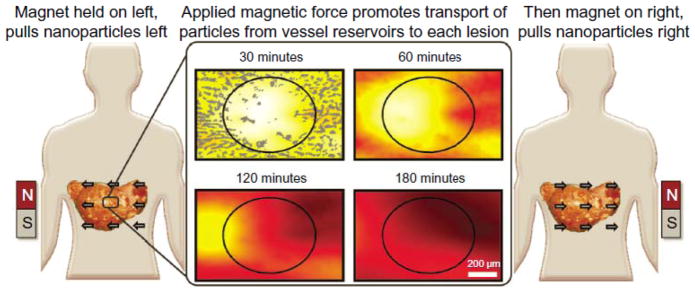
The magnetic sweep concept to reach hundreds of poorly vascularised metastatic tumors. In human autopsy studies of breast cancer patients who died from their disease, we measured vascularisation in and around hundreds of micro-metastases (top middle panel: tumor marked by the black oval, blood vessels marked in gray). A magnet on either side of the patient could pull nano-scale magnetic carriers from the surrounding well-vascularized normal liver into each poorly-vascularized micro-metastasis. Our simulations indicate that there is an optimal nano-particle size: big enough to react to the applied magnet, small enough to move effectively through liver tissue. (See (30) for more details. Figure reproduced with permission from Copyright © 2011 Nacev et al, publisher and licensee Dove Medical Press Ltd.)
Figure 2
Figure 2
The magnetic sweep concept to reach hundreds of poorly vascularised metastatic tumors. In human autopsy studies of breast cancer patients who died from their disease, we measured vascularisation in and around hundreds of micro-metastases (top middle panel: tumor marked by the black oval, blood vessels marked in gray). A magnet on either side of the patient could pull nano-scale magnetic carriers from the surrounding well-vascularized normal liver into each poorly-vascularized micro-metastasis. Our simulations indicate that there is an optimal nano-particle size: big enough to react to the applied magnet, small enough to move effectively through liver tissue. (See (30) for more details. Figure reproduced with permission from Copyright © 2011 Nacev et al, publisher and licensee Dove Medical Press Ltd.)
Figure 3
Figure 3
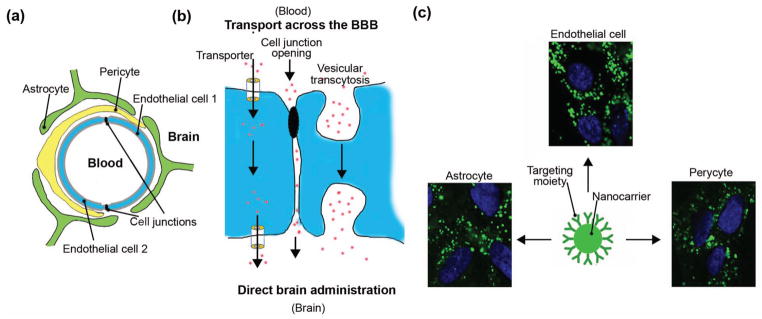
Transport across the blood-brain barrier (BBB). (a) Schematic representation of a blood capillary vessel in the brain. Endothelial cells surround the vessel lumen and seal the passage into the brain by tight cell-cell junctions. Pericytes and astrocytes surround the endothelial lining, further tightening the barrier. (b) Delivery of therapeutics into the brain can be achieved by direct administration through the skull, or by using therapeutics that will cross the BBB. The later involves temporary disruption of the BBB cell-cell junctions (paracellular route) or transport across the endothelial cell (transcellular route), including passage using transporter protein channels or vesicular transcytosis. (c) Nanoparticles coated with ligands which can bind to receptors of vesicular transcytosis (ICAM-1 is shown in this example) results in active uptake by cells of the BBB, including endothelial cells, astrocytes, and pericytes (42).
Figure 4
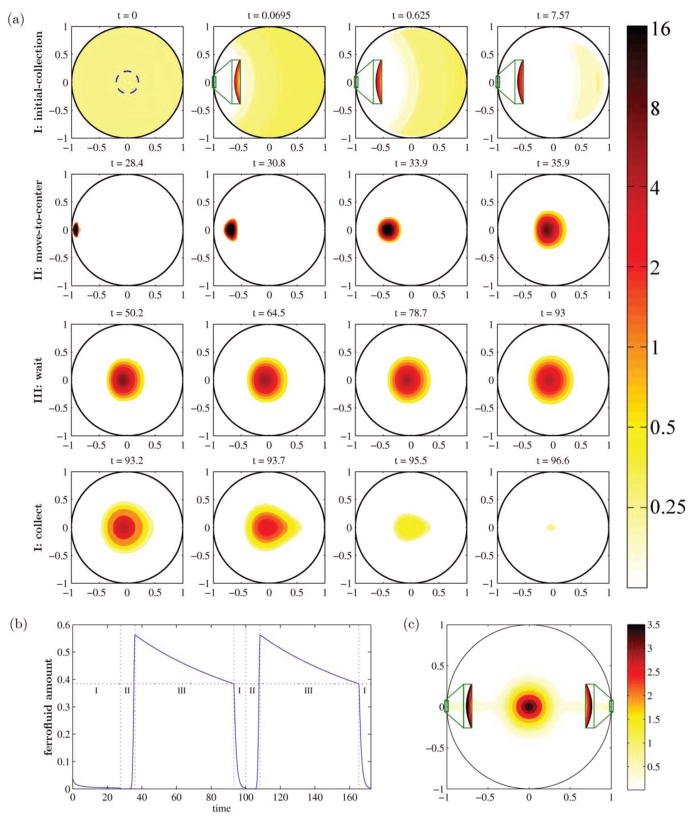
Figure 4
Focusing a ferrofluid to a central target on average in a computer simulation. (a) The concentration of the controlled ferrofluid over time. In phase I, the ferrofluid is collected to the left edge (zooms shown in green boxes). In phase II it is brought to the center with minimal spreading by dynamic control of 8 magnets outside the circular domain (magnets not shown). Then there is a wait step (phase III) and then collection repeats on the right side. (b) The amount of ferrofluid inside the center target at each time. (c) The average ferrofluid concentration. Control achieves a clear hot-spot in the center. (For further details, please see (22). (© 2012 IEEE. Reprinted with permission, from (22), doi: 10.1109/MCS.2012.2189052).

References

    1. Lubbe AS, Bergemann C, Riess H, Schriever F, Reichardt P, et al. Clinical experiences with magnetic drug targeting: a phase i study with 4′-epidoxorubicin in 14 patients with advanced solid tumors. Cancer Research. 1996;56(20):4686–93. - PubMed
    1. Lemke AJ, von Pilsach MIS, Lubbe A, Bergemann C, Riess H, Felix R. Mri after magnetic drug targeting in patients with advanced solid malignant tumors. European Radiology. 2004;14(11):1949–55. - PubMed
    1. Voltairas PA, Fotiadis DI, Michalis LK. Hydrodynamics of magnetic drug targeting. Journal of Biomechanics. 2002;35(6):813–21. - PubMed
    1. Grief AD, Richardson G. Mathematical modeling of magnetically targeted drug delivery. Journal of Magnetism and Magnetic Materials - Proceedings of the Fifth International Conference on Scientific and Clinical Applications of Magnetic Carriers. 2005;293(1):455–63.
    1. Shapiro B, Dormer K, Rutel IB. A two-magnet system to push therapeutic nanoparticles. AIP Conf Proc. 2010;1311(1):77–88. - PMC - PubMed

Publication types

MeSH terms

LinkOut - more resources