Comparative Study
. 2014 Nov 7:14:1157.
doi: 10.1186/1471-2458-14-1157.

Prevalence of chronic medical conditions in Switzerland: exploring estimates validity by comparing complementary data sources

Affiliations
Comparative Study

Prevalence of chronic medical conditions in Switzerland: exploring estimates validity by comparing complementary data sources

Ueli Zellweger et al. BMC Public Health. .

Abstract

Background: Prevalence estimates of chronic medical conditions and their multiples (multimorbidity) in the general population are scarce and often rather speculative in Switzerland. Using complementary data sources, we assessed estimates validity of population-based prevalence rates of four common chronic medical conditions with high impact on cardiovascular health (diabetes mellitus, hypertension, dyslipidemia, obesity).

Methods: We restricted our analyses to patients 15-94 years old living in the German speaking part of Switzerland. Data sources were: Swiss Health Survey (SHS, 2007, n = 13,580); Family Medicine ICPC Research using Electronic Medical Record Database (FIRE, 2010-12, n = 99,441); and hospital discharge statistics (MEDSTAT, 2009-10, n = 883,936). We defined chronic medical conditions based on use of drugs, diagnoses, and measurements.

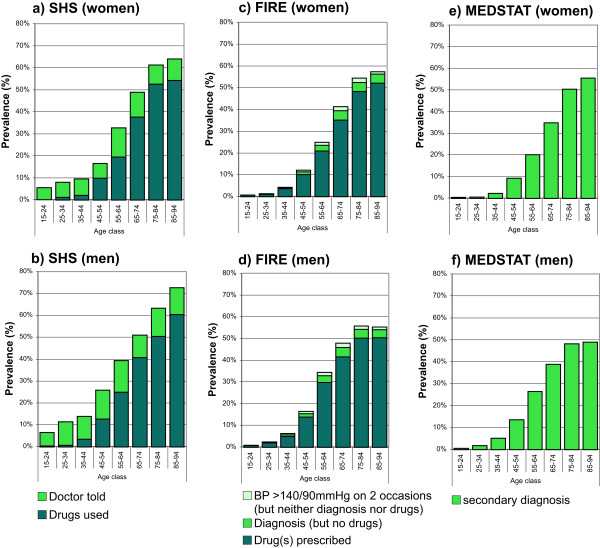
Results: After a careful harmonization of the definitions, a high degree of concordance, especially regarding the age- and gender-specific distribution patterns, was found for diabetes mellitus (defined as drug use or diagnosis in SHS, drug use or diagnosis or blood glucose measurement in FIRE, and ICD-10 codes E10-14 as secondary diagnosis in MEDSTAT) and for hypertension (defined as drug use alone in SHS and FIRE, and ICD-10 codes I10-15 or I67.4 as secondary diagnosis in MEDSTAT). A lesser degree of concordance was found for dyslipidemia (defined as drug use alone in SHS and FIRE, and ICD-10 code E78 in MEDSTAT), and for obesity (defined as BMI ≥ 30 kg/m(2) derived from self-reported height and weight in SHS, from measured height and weight or diagnosis of obesity in FIRE, and ICD-10 code E66 as secondary diagnosis in MEDSTAT). MEDSTAT performed well for clearly defined diagnoses (diabetes, hypertension), but underrepresented systematically more symptomatic conditions (dyslipidemia, obesity).

Conclusion: Complementary data sources can provide different prevalence estimates of chronic medical conditions in the general population. However, common age and sex patterns indicate that a careful harmonization of the definition of each chronic medical condition permits a high degree of concordance.


Figures

Figure 1
Figure 1
Age- and gender-specific prevalence estimates of diabetes mellitus based on complementary data sources and various definitions. For health survey (SHS) (a and b), we defined cases as drug use alone, and drug use or diagnosis of diabetes. For primary care data (FIRE) (c and d), we defined cases as drug use alone, drug use or diagnosis, and drug use or diagnosis or serum glucose measurement (serum glucose ≥11.1 mmol/L or HbA1c ≥6.5%). For hospital discharge statistics (MEDSTAT) (e and f), we defined cases as ICD-10 codes E10-14 as secondary diagnoses. Results based on less than 30 observations are marked by an asterisk. (Data sources: Swiss Federal Statistical Office for Swiss Health Survey [SHS] and Hospital Discharge Statistics [MEDSTAT]; Swiss Family Medicine International Classification of Primary Care Research using Electronic Medical Record project for primary care data [FIRE]).
Figure 2
Figure 2
Age- and gender-specific prevalence estimates of hypertension based on complementary data sources and various definitions. For health survey (SHS) (a and b), we defined cases as drug use alone, and drug use or diagnosis of hypertension. For primary care data (FIRE) (c and d), we defined cases as drug use alone, drug use or diagnosis of hypertension, drug use or diagnosis of hypertension or measurement of increased blood pressure. For hospital discharge statistics (MEDSTAT) (e and f), we defined cases as ICD-10 codes I10-I15 or I67.4 as secondary diagnoses.
Figure 3
Figure 3
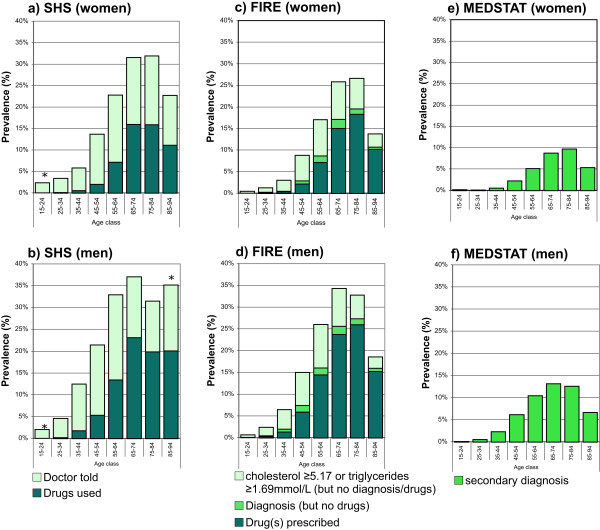
Age- and gender-specific prevalence estimates of dyslipidemia based on different data sources and various definitions. For health survey (SHS) (a and b), we defined dyslipidemia as drug use alone, and drug use or diagnosis of dyslipidemia. For primary care data (FIRE) (c and d), we defined dyslipidemia as drug use alone, drug use or diagnosis of lipid disorder, and drug use or diagnosis of lipid disorder or lipid measurements (either total cholesterol ≥5.17 mmol/L or triglycerides ≥1.69 mmol/L). For hospital discharge statistics (MEDSTAT) (e and f), we defined dyslipidemia as ICD-10 code E78 as secondary diagnosis. Results based on less than 30 observations are marked by an asterisk.
Figure 4
Figure 4
Age- and gender-specific prevalence estimates of obesity based on complementary data sources and various definitions. For health survey (SHS) (a and b), we defined obesity as BMI ≥30 kg/m2 derived from self-reported height and weight. For primary care data (FIRE) (c and d), we defined obesity as BMI ≥30 kg/m2 derived from measured height and weight, and BMI ≥30 kg/m2 derived from measured height and weight or diagnosis of obesity. For hospital discharge statistics (MEDSTAT) (e and f), we defined obesity as ICD-10 code E66 as secondary diagnosis. Results based on less than 30 observations are marked by an asterisk.
Figure 5
Figure 5
Comparison of age- and gender-specific prevalence estimates of diabetes mellitus based on complementary data sources. Diabetes mellitus was defined as drug use or diagnosis of diabetes mellitus in Swiss health survey (SHS), as drug use or diagnosis of diabetes mellitus or glucose measurement (serum glucose ≥11.1 mmol/L or HbA1c ≥6.5%) in primary care data (FIRE), and as ICD-10 codes E10-14 as secondary diagnoses in hospital discharge statistics (MEDSTAT). Results based on less than 30 observations are marked by an asterisk. (Data sources: Swiss Federal Statistical Office for Swiss Health Survey [SHS] and Hospital Discharge Statistics [MEDSTAT]; Swiss Family Medicine International Classification of Primary Care Research using Electronic Medical Record project for primary care data [FIRE]).
Figure 6
Figure 6
Comparison of age- and gender-specific prevalence estimates of hypertension based on complementary data sources. Hypertension was defined as drug use alone in Swiss Health Survey (SHS), as drug use alone in primary care data (FIRE), and as ICD-10 codes I10-I15 or I67.4 as secondary diagnoses in hospital discharge statistics (MEDSTAT). Results based on less than 30 observations are marked by an asterisk. (Data sources: Swiss Federal Statistical Office for Swiss Health Survey [SHS] and Hospital Discharge Statistics [MEDSTAT]; Swiss Family Medicine International Classification of Primary Care Research using Electronic Medical Record project for primary care data [FIRE]).
Figure 7
Figure 7
Comparison of age- and gender-specific prevalence estimates of dyslipidemia based on complementary data sources. Dyslipidemia was defined as drug use alone in Swiss Health Survey (SHS), as drug use alone in primary care data (FIRE), and as ICD-10 code E78 as secondary diagnosis in hospital discharge statistics (MEDSTAT). Results based on less than 30 observations are marked by an asterisk. (Data sources: Swiss Federal Statistical Office for Swiss Health Survey [SHS] and Hospital Discharge Statistics [MEDSTAT]; Swiss Family Medicine International Classification of Primary Care Research using Electronic Medical Record project for primary care data [FIRE]).
Figure 8
Figure 8
Comparison of age- and gender-specific prevalence estimates of obesity based on complementary data sources. Obesity was defined as BMI ≥30 kg/m2 derived from self-reported height and weight in Swiss Health Survey (SHS), as BMI ≥30 kg/m2 derived from measured height and weight or diagnosis of obesity in primary care data (FIRE), and as ICD-10 code s E66 as secondary diagnosis in hospital discharge statistics (MEDSTAT). Results based on less than 30 observations are marked by an asterisk. (Data sources: Swiss Federal Statistical Office for Swiss Health Survey [SHS] and Hospital Discharge Statistics [MEDSTAT]; Swiss Family Medicine International Classification of Primary Care Research using Electronic Medical Record project for primary care data [FIRE]).

References

    1. van den Akker M, Buntinx F, Metsemakers JF, Roos S, Knottnerus JA. Multimorbidity in general practice: prevalence, incidence, and determinants of co-occurring chronic and recurrent diseases. J Clin Epidemiol. 1998;51(5):367–375. doi: 10.1016/S0895-4356(97)00306-5. - DOI - PubMed
    1. Wu SY, Green A. Projection of Chronic Illness Prevalence and Costs Inflation. Santa Monica: RAND Health; 2000.
    1. Rizza A, Kaplan V, Senn O, Rosemann T, Bhend H, Tandjung R. Age- and gender-related prevalence of multimorbidity in primary care: the swiss fire project. BMC Fam Prac. 2012;13(1):113. doi: 10.1186/1471-2296-13-113. - DOI - PMC - PubMed
    1. Bopp M, Zellweger U, Faeh D. Routine data sources challenge international diabetes Federation extrapolations of national diabetes prevalence in Switzerland. Diabetes Care. 2011;34(11):2387–2389. doi: 10.2337/dc11-0157. - DOI - PMC - PubMed
    1. Fortin M, Hudon C, Haggerty J, Akker M, Almirall J. Prevalence estimates of multimorbidity: a comparative study of two sources. BMC Health Serv Res. 2010;10:111. doi: 10.1186/1472-6963-10-111. - DOI - PMC - PubMed
Pre-publication history
    1. The pre-publication history for this paper can be accessed here:http://www.biomedcentral.com/1471-2458/14/1157/prepub

Publication types