. 2015 Jan 2;54(1):144-8.
doi: 10.1002/anie.201409356. Epub 2014 Nov 5.

A systems approach towards an intelligent and self-controlling platform for integrated continuous reaction sequences

Affiliations

A systems approach towards an intelligent and self-controlling platform for integrated continuous reaction sequences

Richard J Ingham et al. Angew Chem Int Ed Engl. .

Abstract

Performing reactions in flow can offer major advantages over batch methods. However, laboratory flow chemistry processes are currently often limited to single steps or short sequences due to the complexity involved with operating a multi-step process. Using new modular components for downstream processing, coupled with control technologies, more advanced multi-step flow sequences can be realized. These tools are applied to the synthesis of 2-aminoadamantane-2-carboxylic acid. A system comprising three chemistry steps and three workup steps was developed, having sufficient autonomy and self-regulation to be managed by a single operator.

Keywords: continuous processing; flow reactors; integrated systems; synthetic methods.


Figures

Figure 1
Figure 1
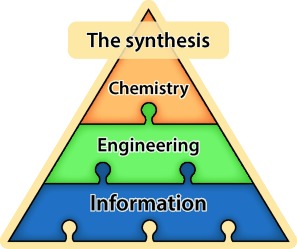
Three layers that must be considered when creating a telescoped flow synthesis procedure: transformation steps (chemical), downstream processing (engineering), and the control system (information).
Figure 2
Figure 2
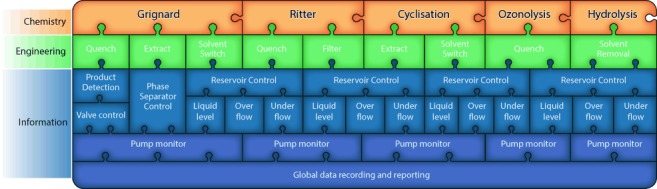
Components of the synthesis system. The chemical transformation operations are connected fluidically; a number of in-line processing operations may be associated with each. Control components such as intermediate reservoirs may interact with multiple chemistry or engineering components. Global monitoring is important for data collection and record keeping.
Scheme 1
Scheme 1
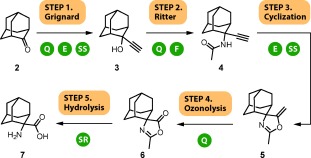
First-generation continuous flow process, with five synthetic operations. Manual operations are indicated by circular icons: Q quenching, E extraction, SS solvent switch, F filtration, SR solvent removal. Conditions: Step 1: ethynyl magnesium bromide (1), THF, 40 °C, 40 min, 90 %; Step 2: 1:2:1 H2SO4/AcOH/Ac2O, MeCN/AcOH, 30 °C, 7 min, 91 %; Step 3: KOH, 40:1 EtOH/H2O, 120 °C, 50 min, 91 %; Step 4: O3, CH2Cl2, 25 °C, 10 s, then solid-supported thiourea, 95 %; Step 5: HCl/AcOH/H2O, 150 °C, 18 min, 94 %.
Scheme 2
Scheme 2
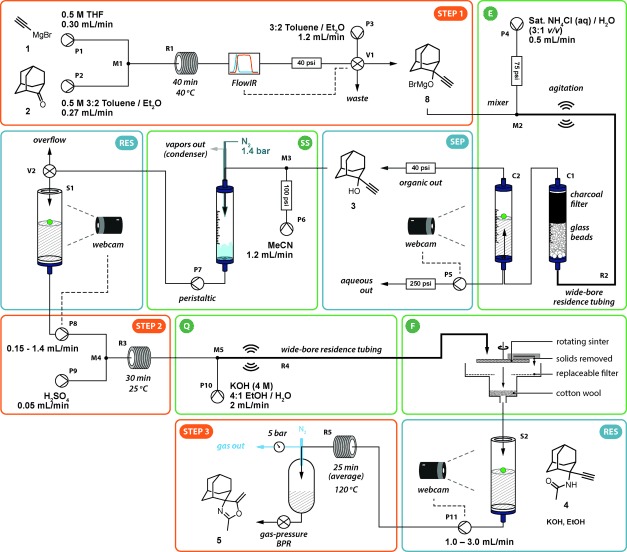
Seven-operation integrated synthesis platform. (P pump, V valve, M mixer, R reactor, C column, S reservoir). The output from the initial Grignard step is subjected to in-line quenching and then computer-controlled liquid–liquid phase separation. This solution undergoes a solvent switch and the output is stored in a reservoir before being used for the Ritter reaction stage. The acidic output is quenched with base and the resulting salts removed by a continuous filter. The filtrate is stored in a second reservoir before finally being heated to undergo cyclization.
Figure 3
Figure 3
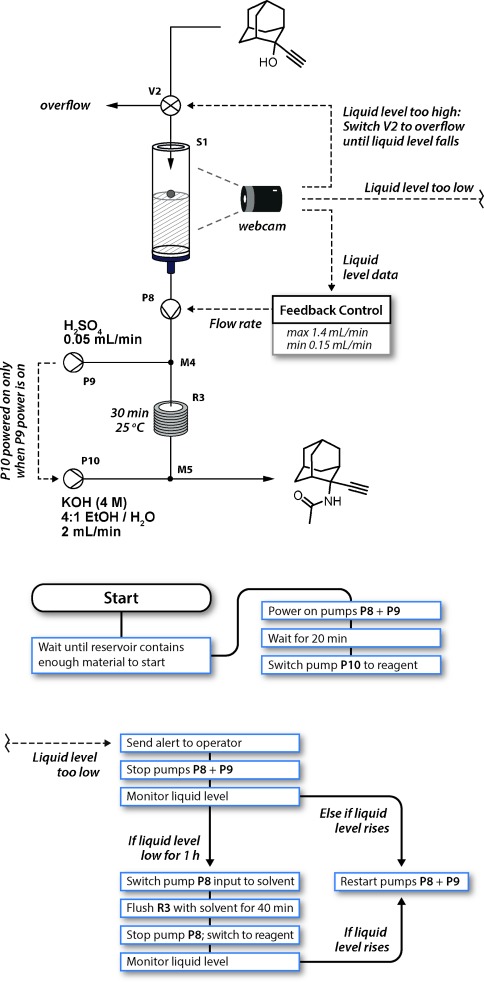
Control algorithms for the components (top) of the Ritter reaction (step 2 in Schemes 1 and 2). The main control sequence (middle) started the Ritter step as soon as sufficient material had been collected from the first step. Whilst running, a simple feedback control algorithm equalized the flow rates between the two steps, slowing or stopping pump P8 if the liquid level dropped. A washing sequence (bottom) was triggered if the reagent pump was stopped for over an hour. Finally, the output was redirected to an overflow if the liquid level rose too high, to prevent flooding.
Scheme 3
Scheme 3
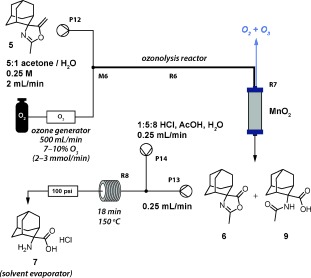
Final chemistry steps: ozonolysis and hydrolysis.

References

    1. Selected recent reviews of flow chemistry
    1. Baxendale IR. J. Chem. Technol. Biotechnol. 2013;88:519–552.
    1. Wegner J, Ceylan S, Kirschning A. Adv. Synth. Catal. 2012;354:17–57.
    1. Hartman RL, McMullen JP, Jensen KF. Angew. Chem. Int. Ed. 2011;50:7502–7519. - PubMed
    2. Angew. Chem. 2011;123
    1. Hamlin TA, Lazarus GML, Kelly CB, Leadbeater NE. Org. Process Res. Dev. 2014;18:1253–1258.

Publication types

MeSH terms