. 2015 Jan;43(Database issue):D1042-8.
doi: 10.1093/nar/gku1061. Epub 2014 Nov 6.

Europe PMC: a full-text literature database for the life sciences and platform for innovation

Collaborators

Europe PMC: a full-text literature database for the life sciences and platform for innovation

Europe PMC Consortium. Nucleic Acids Res. 2015 Jan.

Abstract

This article describes recent developments of Europe PMC (http://europepmc.org), the leading database for life science literature. Formerly known as UKPMC, the service was rebranded in November 2012 as Europe PMC to reflect the scope of the funding agencies that support it. Several new developments have enriched Europe PMC considerably since then. Europe PMC now offers RESTful web services to access both articles and grants, powerful search tools such as citation-count sort order and data citation features, a service to add publications to your ORCID, a variety of export formats, and an External Links service that enables any related resource to be linked from Europe PMC content.


Figures

Figure 1.
Figure 1.
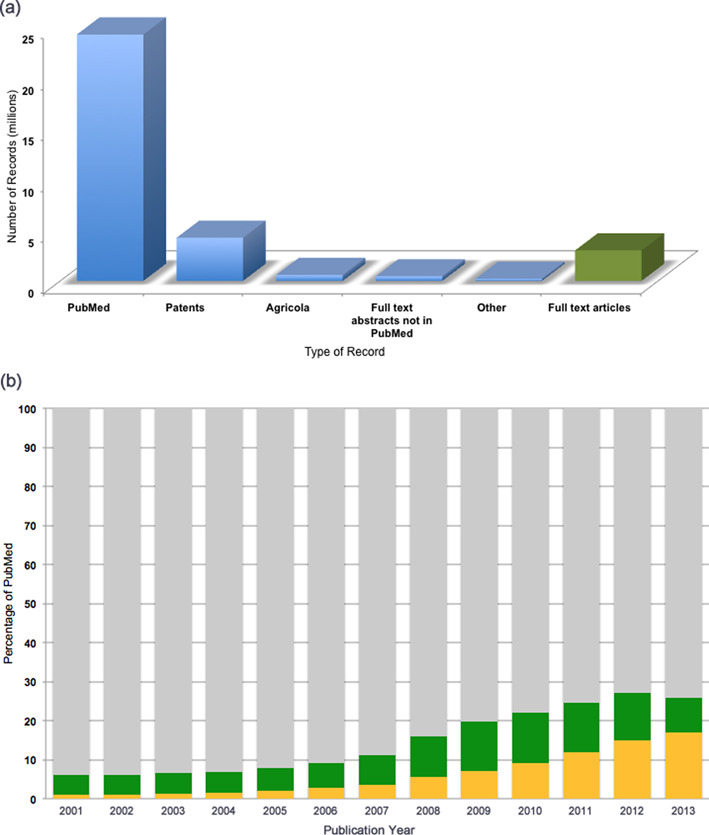
(a) Total scope of content (abstracts and articles) available in Europe PMC. Blue columns represent abstracts; the green column represents full text. Actual numbers of records at the time of writing: PubMed: 24 174 318; Patents: 4 229 297; Agricola: 577 871; Europe PMC full-text abstract not in PubMed: 447 427; Other smaller sources of metadata: 201 988; Europe PMC full text: 2 988 235. (b) Proportion of full-text articles in Europe PMC expressed, for comparative purposes, as a proportion of abstracts available in PubMed (100%, gray bar), per publication year. Open Access full-text articles are in yellow; ‘read only’ full-text articles are in green. For publication year 2012, around 25% of PubMed is available as full text in Europe PMC, and of those, about 50% are available open access. The slight drop in read-only articles seen in 2013 is due to many articles published in 2013 still being under a 12-month embargo period at the time of writing.
Figure 2.
Figure 2.
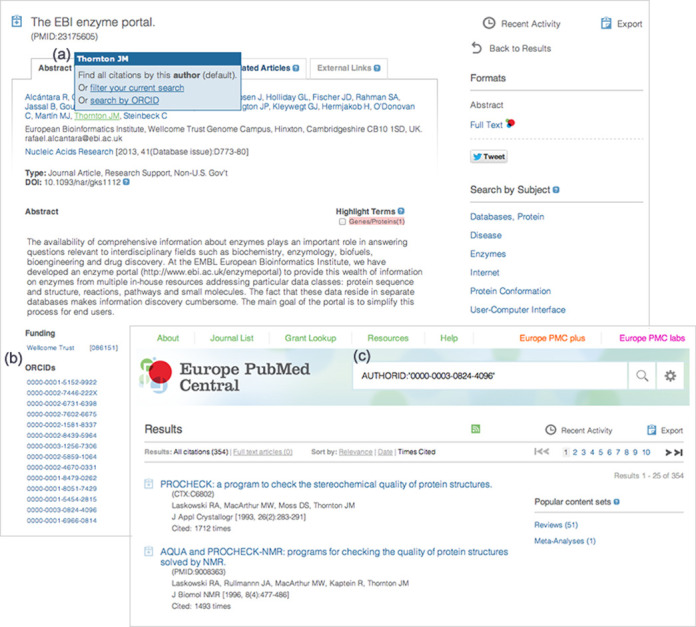
ORCIDs in Europe PMC. ORCIDs can be used to search for authors unambiguously in Europe PMC, and are apparent in several different ways. Abstract pages: (a) If the ORCID has been matched to a specific author in an article, there is an option to use the ORCID instead of the name to search for a particular author. (b) ORCIDs that have claimed the article are listed below the abstract; the name linked to the ORCID is shown on mouse-over and clicking on the ORCID triggers a search. Search page: (c) If you know an ORCID, search for it using the syntax shown, or select ‘ORCID’ from the Bibliographic Fields menu on the Advanced Search Page. Here the results are shown ranked by citation count.
Figure 3.
Figure 3.
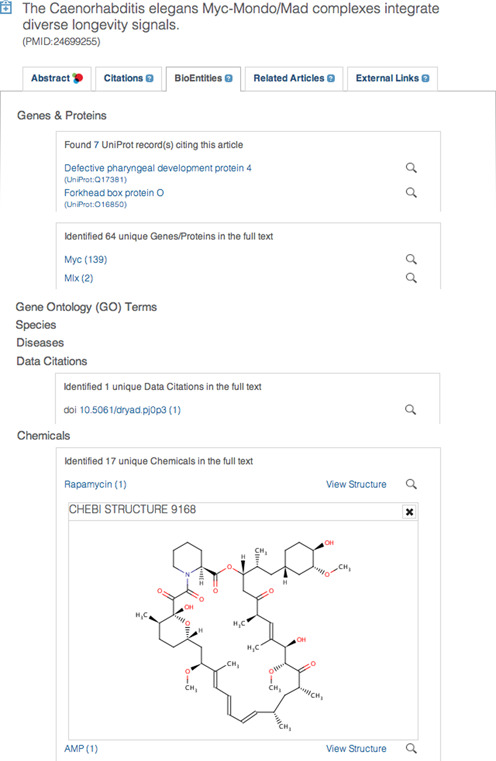
The BioEntities tab in Europe PMC. The BioEntities tab contains rich information on key concepts mined from the article as well as links to and from related data resources. In this example, several Uniprot records cite this article, and we have also found one data citation, to a dataset in the Dryad database (http://datadryad.org). In the case of chemical entities mined from text, we have used a BioJS module (http://www.ebi.ac.uk/Tools/biojs/registry/) to display the chemical structure of the entity (13). The same applies to mined PDB citations (not shown). In other cases, links to the database in question, or to invoke a search of Europe PMC for that concept, are provided. This figure has been modified and abbreviated from the actual screenshot to show the breadth of coverage in this example article.

References

    1. McEntyre J.R., Ananiadou S., Andrews S., Black W.J., Boulderstone R., Buttery P., Chaplin D., Chevuru S., Cobley N., Coleman L.A. UKPMC: a full text article resource for the life sciences. Nucleic Acids Res. 2011;39:D58–D65. - PMC - PubMed
    1. NCBI Resource Coordinators. Database resources of the National Center for Biotechnology Information. Nucleic Acids Res. 2014;42:D7–D17. - PMC - PubMed
    1. Bourne P. Will a biological database be different from a biological journal? PLoS Comput. Biol. 2005;1:179–181. - PMC - PubMed
    1. Hamosh A., Scott A.F., Amberger J.S., Bocchini C.A., McKusick V.A. Online Mendelian Inheritance in Man (OMIM), a knowledgebase of human genes and genetic disorders. Nucleic Acids Res. 2005;33:D514–D517. - PMC - PubMed
    1. Rustici G., Kolesnikov N., Brandizi M., Burdett T., Dylag M., Emam I., Farne A., Hastings E., Ison J., Keays M. ArrayExpress update—trends in database growth and links to data analysis tools. Nucleic Acids Res. 2013;41:D987–D990. - PMC - PubMed

Publication types