Detection of intracellular parasites by use of the CellaVision DM96 analyzer during routine screening of peripheral blood smears
- PMID: 25378575
- PMCID: PMC4290916
- DOI: 10.1128/JCM.01783-14
Detection of intracellular parasites by use of the CellaVision DM96 analyzer during routine screening of peripheral blood smears
Abstract
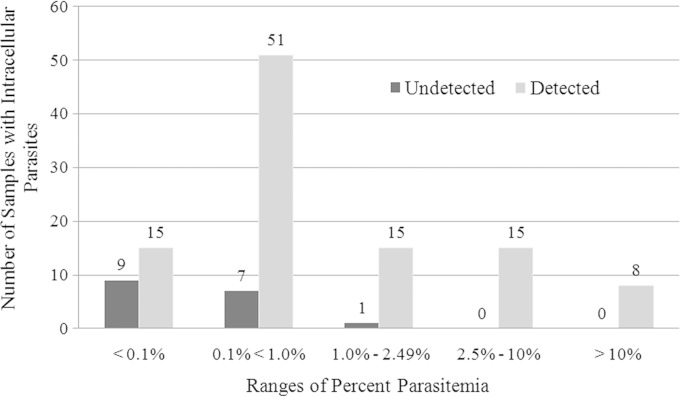
Conventional microscopy is the gold standard for malaria diagnosis. The CellaVision DM96 is a digital hematology analyzer that utilizes neural networks to locate, digitize, and preclassify leukocytes and characterize red blood cell morphology. This study compared the detection rates of Plasmodium and Babesia species on peripheral blood smears utilizing the CellaVision DM96 with the rates for a routine red blood cell morphology scan. A total of 281 slides were analyzed, consisting of 130 slides positive for Plasmodium or Babesia species and 151 negative controls. Slides were blinded, randomized, and analyzed by CellaVision and microscopy for red cell morphology scans. The technologists were blinded to prior identification results. The parasite detection rate was 73% (95/130) for CellaVision and 81% (105/130) for microscopy for positive samples. The interobserver agreement between CellaVision and microscopy was fair, as Cohen's kappa coefficient equaled 0.36. Pathologist review of CellaVision images identified an additional 15 slides with parasites, bringing the total number of detectable positive slides to 110 of 130 (85%). Plasmodium ovale had the lowest rate of detection at 56% (5 of 9); Plasmodium malariae and Babesia spp. had the highest rate of detection at 100% (3/3 and 6/6, respectively). The detection rate by CellaVision was 100% (23/23) when the parasitemia was ≥2.5%. The detection rate for <0.1% parasitemia was 63% (15/24). Technologists appropriately classified all negative specimens. The percentage of positive specimens detectable by CellaVision (73%) approaches results for microscopy on routine scan of peripheral blood smears for red blood cell morphology.
Copyright © 2015, American Society for Microbiology. All Rights Reserved.
Figures
References
-
- World Health Organization. 2012. World malaria report 2012. World Health Organization, Geneva, Switzerland.
-
- Centers for Disease Control and Prevention. 2012. Malaria surveillance—United States, 2010. MMWR Surveill Summ 61(2):1–17. - PubMed
-
- Lee HK, Kim SI, Chae H, Kim M, Lim J, Oh EJ, Kim Y, Park YJ, Lee W, Han J. 2012. Sensitive detection and accurate monitoring of Plasmodium vivax on routine complete blood count using automatic blood cell analyzer (DxH800). Int J Lab Hematol 34:201–207. doi: 10.1111/j.1751-553X.2011.01383.x. - DOI - PubMed
-
- Mabunda S, Aponte JJ, Tiago A, Alonso P. 2009. A country-wide malaria survey in Mozambique. II. Malaria attributable proportion of fever and establishment of malaria case definition in children across different epidemiological settings. Malar J 8:74. doi: 10.1186/1475-2875-8-74. - DOI - PMC - PubMed
MeSH terms
LinkOut - more resources
Full Text Sources
Other Literature Sources
Medical
Miscellaneous