


Synthesis, characterization, and stability of iron (III) complex ions possessing phenanthroline-based ligands
- PMID: 25379358
- PMCID: PMC4219584
- DOI: 10.4236/ojic.2013.31002
Synthesis, characterization, and stability of iron (III) complex ions possessing phenanthroline-based ligands
Abstract
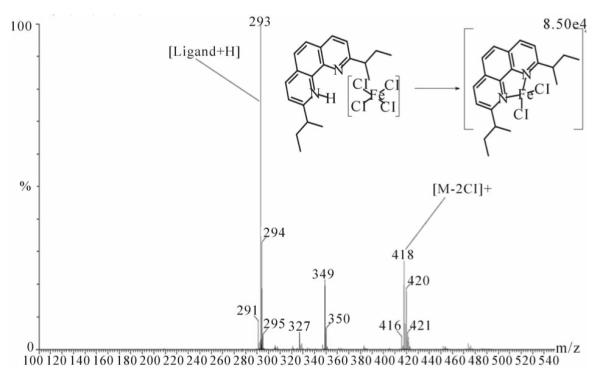
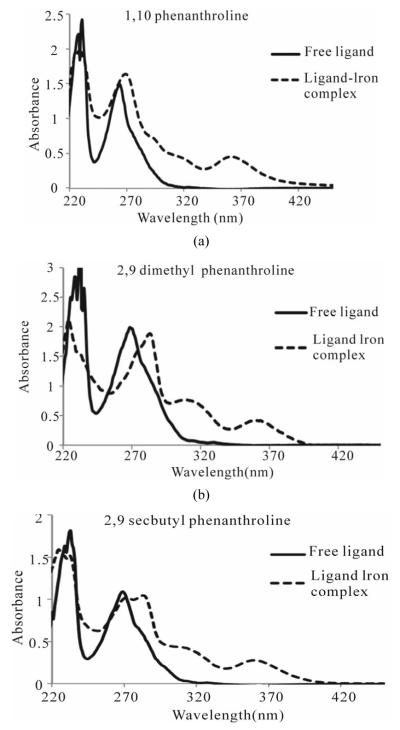
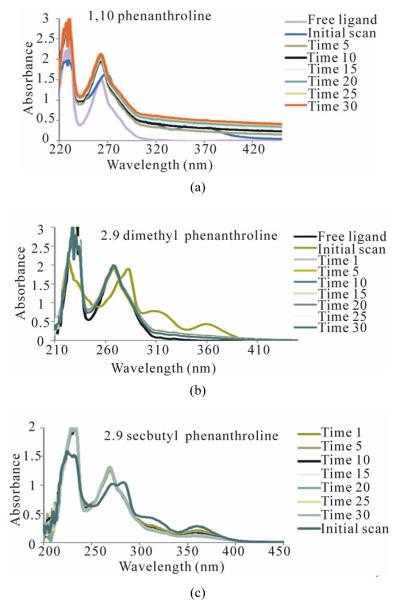
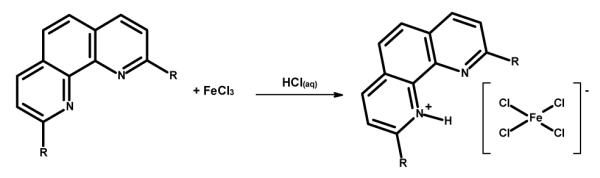
It has previously been demonstrated that phenanthroline-based ligands used to make gold metallotherapuetics have the ability to exhibit cytotoxicity when not coordinated to the metal center. In an effort to help assess the mechanism by which these ligands may cause tumor cell death, iron binding and removal experiments have been considered. The close linkage between cell proliferation and intracellular iron concentrations suggest that iron deprivation strategies may be a mechanism involved in inhibiting tumor cell growth. With the creation of iron (III) phen complexes, the iron binding abilities of three polypyridal ligands [1,10-phenanthroline (phen), 2,9-dimethyl-1, 10-phenanthroline (methylphen), and 2,9-di-sec-butyl-1, 10-phenanthroline ( sec-butylphen)] can be tested via a competition reaction with a known iron chelator. Therefore, iron (III) complexes possessing all three ligands were synthesized. Initial mass spectrometric and infrared absorption data indicate that iron (III) tetrachloride complex ions with protonated phen ligands (RphenH+) were formed: [phenH][FeCl4], [methylphenH][FeCl4], [ sec-butylphenH][FeCl4]. UV-Vis spectroscopy was used to monitor the stability of the complex ions, and it was found that the sec-butylpheniron complex was more stable than the phen and methylphen analogues. This was based on the observation that free ligand was observed immediately upon the addition of EDTA to the [phenH][FeCl4] and [methylphenH] [FeCl4] complex ions.
Keywords: Complex Ions; Iron (III); Phenanthroline; Polypyridyl Ligands.
Figures
References
-
- Wein AN, Stockhausen AT, Hardcastle KI, Saadein MR, Peng S, Wang D, Eichler JF. Tumor cytotoxicity of 5,6-dimethyl-1,10-phenanthroline and its corresponding gold (III) complex. Journal of Inorganic Biochemistry. 2011;105:663–668. doi:10.1016/j.jinorgbio.2011.01.006. - PubMed
-
- Sun R, Che C. The anti-cancer properties of gold (III) compounds with dianionic porphyrin and tetradentate ligands. Coordination Chemistry Reviews. 2009;253:1682–1691. doi:10.1016/j.ccr.2009.02.017.
-
- Messori L, Abbate F, Marcon G, Orioli P, Fontani M, Mini E, Mazzei T, Carotti S, O’Connell T, Zanello P. Gold (III) complexes as potential anti-tumor agents: Solution chemistry and cytotoxic properties of some selected gold (III) compounds. Journal of Medicinal Chemistry. 2000;43:3541–3548. doi:10.1021/jm990492u. - PubMed
-
- Cinellu MA, Maiore L, Manassero M, Casini A, Arca M, Fiebig H-H, Kelter G, Michelucci E, Pieraccini G, Gabbiani C, Messori L. [Au2 (phen2Me)2(μ-O)2](PF6)2, a novel dinuclear gold (III) complex showing excellent antiproliferative properties. ACS Medicinal Chemistry Letters. 2010;1:336–339. - PMC - PubMed
-
- Hudson ZD, Sanghvi CD, Rhine MA, Ng JJ, Bunge SD, Hardcastle KI, Macbeth C, Eichler JF. Synthesis and characterization of gold (III) complexes possessing 2,9-dialkylphenanthroline ligands: To bind or not to bind? Dalton Transactions. 2009;28:7473–7480. doi:10.1039/b823215f. - PubMed
Grants and funding
LinkOut - more resources
Full Text Sources
Other Literature Sources