


The home environment and childhood obesity in low-income households: indirect effects via sleep duration and screen time
- PMID: 25381553
- PMCID: PMC4233039
- DOI: 10.1186/1471-2458-14-1160
The home environment and childhood obesity in low-income households: indirect effects via sleep duration and screen time
Abstract
Background: Childhood obesity disproportionally affects children from low-income households. With the aim of informing interventions, this study examined pathways through which the physical and social home environment may promote childhood overweight/obesity in low-income households.
Methods: Data on health behaviors and the home environment were collected at home visits in low-income, urban households with either only normal weight (n = 48) or predominantly overweight/obese (n = 55) children aged 6-13 years. Research staff conducted comprehensive, in-person audits of the foods, media, and sports equipment in each household. Anthropometric measurements were collected, and children's physical activity was assessed through accelerometry. Caregivers and children jointly reported on child sleep duration, screen time, and dietary intake of foods previously implicated in childhood obesity risk. Path analysis was used to test direct and indirect associations between the home environment and child weight status via the health behaviors assessed.
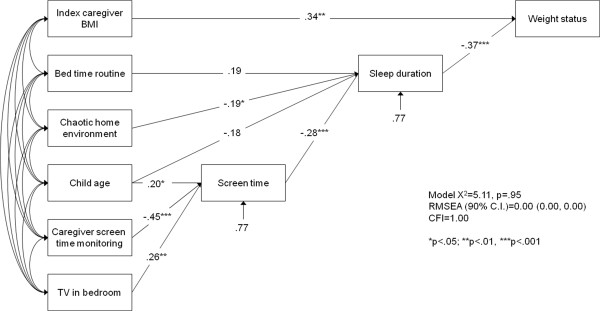
Results: Sleep duration was the only health behavior associated with child weight status (OR = 0.45, 95% CI: 0.27, 0.77), with normal weight children sleeping 33.3 minutes/day longer on average than overweight/obese children. The best-fitting path model explained 26% of variance in child weight status, and included paths linking chaos in the home environment, lower caregiver screen time monitoring, inconsistent implementation of bedtime routines, and the presence of a television in children's bedrooms to childhood overweight/obesity through effects on screen time and sleep duration.
Conclusions: This study adds to the existing literature by identifying aspects of the home environment that influence childhood weight status via indirect effects on screen time and sleep duration in children from low-income households. Pediatric weight management interventions for low-income households may be improved by targeting aspects of the physical and social home environment associated with sleep.
Figures
References
-
- Ogden CL, Lamb MM, Carroll MD, Flegal KM. Obesity and socioeconomic status in children and adolescents: United States, 2005–2008. NCHS Data Brief. 2010;51:1–8. - PubMed
-
- Booth SL, Sallis JF, Ritenbaugh C, Hill JO, Birch LL, Frank LD, Glanz K, Himmelgreen DA, Mudd M, Popkin BM, Rickard KA, St Jeor S, Hays NP. Environmental and societal factors affect food choice and physical activity: rationale, influences, and leverage points. Nutr Rev. 2001;59(3 Pt 2):S21–S39. - PubMed
Pre-publication history
-
- The pre-publication history for this paper can be accessed here:http://www.biomedcentral.com/1471-2458/14/1160/prepub
Publication types
MeSH terms
Grants and funding
LinkOut - more resources
Full Text Sources
Other Literature Sources
Medical
