


Variation at HLA-DRB1 is associated with resistance to enteric fever
- PMID: 25383971
- PMCID: PMC5099079
- DOI: 10.1038/ng.3143
Variation at HLA-DRB1 is associated with resistance to enteric fever
Abstract
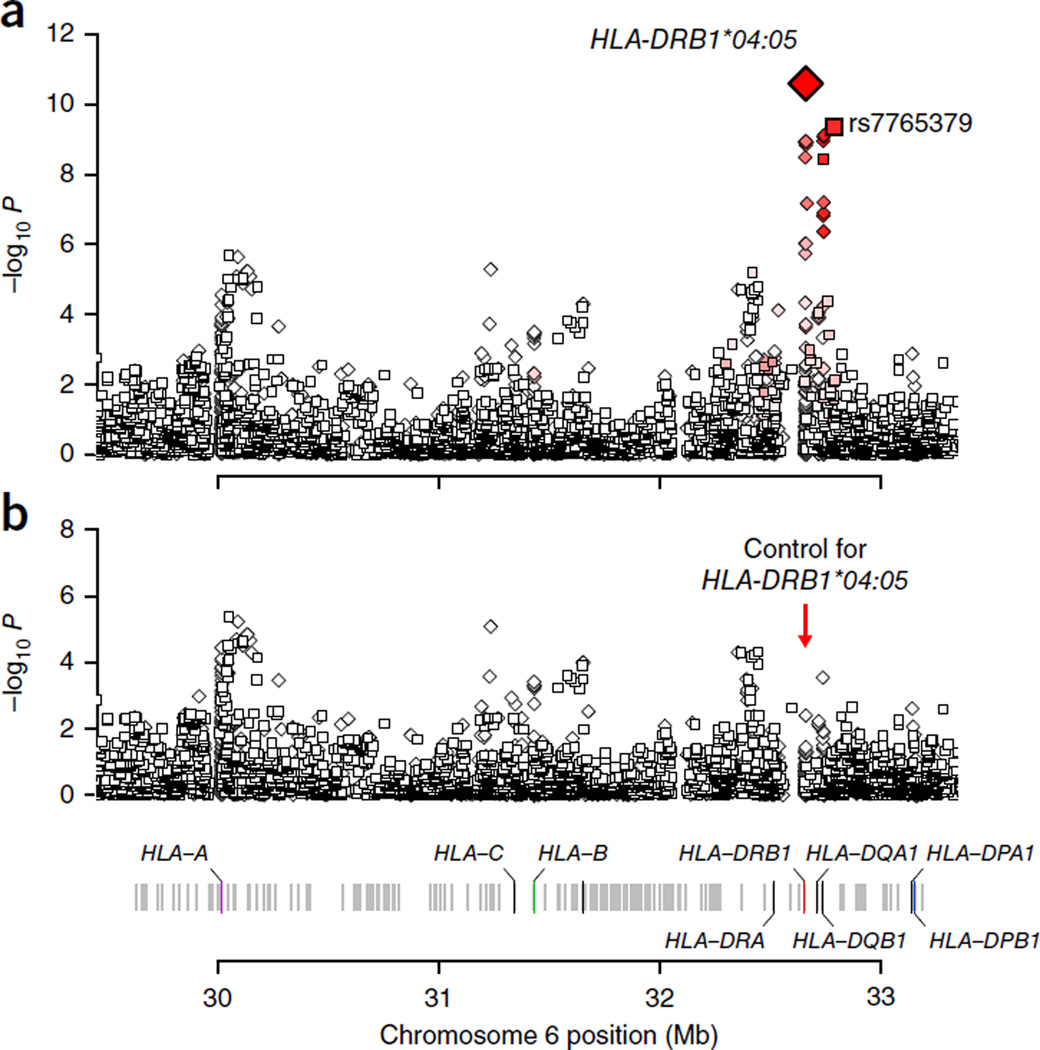
Enteric fever affects more than 25 million people annually and results from systemic infection with Salmonella enterica serovar Typhi or Paratyphi pathovars A, B or C(1). We conducted a genome-wide association study of 432 individuals with blood culture-confirmed enteric fever and 2,011 controls from Vietnam. We observed strong association at rs7765379 (odds ratio (OR) for the minor allele = 0.18, P = 4.5 × 10(-10)), a marker mapping to the HLA class II region, in proximity to HLA-DQB1 and HLA-DRB1. We replicated this association in 595 enteric fever cases and 386 controls from Nepal and also in a second independent collection of 151 cases and 668 controls from Vietnam. Imputation-based fine-mapping across the extended MHC region showed that the classical HLA-DRB1*04:05 allele (OR = 0.14, P = 2.60 × 10(-11)) could entirely explain the association at rs7765379, thus implicating HLA-DRB1 as a major contributor to resistance against enteric fever, presumably through antigen presentation.
Figures
References
-
- McGregor AC, Waddington CS, Pollard AJ. Prospects for prevention of Salmonella infection in children through vaccination. Curr. Opin. Infect. Dis. 2013;26:254–262. - PubMed
Publication types
MeSH terms
Substances
Grants and funding
LinkOut - more resources
Full Text Sources
Other Literature Sources
Research Materials
