


'The clocks that time us'--circadian rhythms in neurodegenerative disorders
- PMID: 25385339
- PMCID: PMC4344830
- DOI: 10.1038/nrneurol.2014.206
'The clocks that time us'--circadian rhythms in neurodegenerative disorders
Abstract
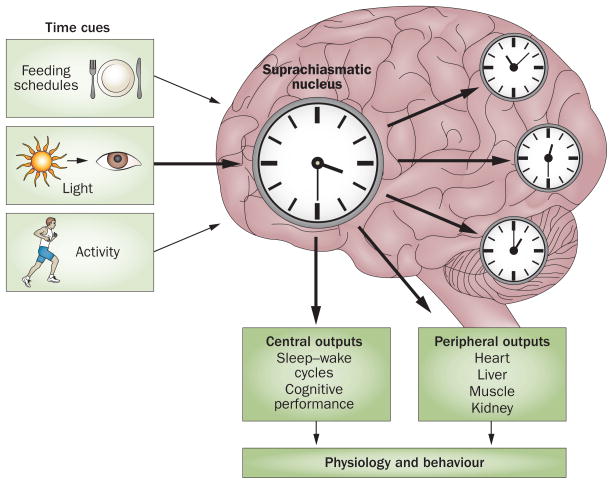
Circadian rhythms are physiological and behavioural cycles generated by an endogenous biological clock, the suprachiasmatic nucleus. The circadian system influences the majority of physiological processes, including sleep-wake homeostasis. Impaired sleep and alertness are common symptoms of neurodegenerative disorders, and circadian dysfunction might exacerbate the disease process. The pathophysiology of sleep-wake disturbances in these disorders remains largely unknown, and is presumably multifactorial. Circadian rhythm dysfunction is often observed in patients with Alzheimer disease, in whom it has a major impact on quality of life and represents one of the most important factors leading to institutionalization of patients. Similarly, sleep and circadian problems represent common nonmotor features of Parkinson disease and Huntington disease. Clinical studies and experiments in animal models of neurodegenerative disorders have revealed the progressive nature of circadian dysfunction throughout the course of neurodegeneration, and suggest strategies for the restoration of circadian rhythmicity involving behavioural and pharmacological interventions that target the sleep-wake cycle. In this Review, we discuss the role of the circadian system in the regulation of the sleep-wake cycle, and outline the implications of disrupted circadian timekeeping in neurodegenerative diseases.
Conflict of interest statement
The authors declare no competing interests.
Figures
References
-
- Swaab DF, Fliers E, Partiman TS. The suprachiasmatic nucleus of the human brain in relation to sex, age and senile dementia. Brain Res. 1985;342:37–44. - PubMed
-
- Cassone VM, Speh JC, Card JP, Moore RY. Comparative anatomy of the mammalian hypothalamic suprachiasmatic nucleus. J Biol Rhythms. 1988;3:71–91. - PubMed
-
- Golombek DA, Rosenstein RE. Physiology of circadian entrainment. Physiol Rev. 2010;90:1063–1102. - PubMed
-
- Dardente H, Cermakian N. Molecular circadian rhythms in central and peripheral clocks in mammals. Chronobiol Int. 2007;24:195–213. - PubMed
Publication types
MeSH terms
Grants and funding
LinkOut - more resources
Full Text Sources
Other Literature Sources
Medical
