. 2014 Nov 25;111(47):16854-9.
doi: 10.1073/pnas.1415396111. Epub 2014 Nov 10.

Influenza A virus nucleoprotein selectively decreases neuraminidase gene-segment packaging while enhancing viral fitness and transmissibility

Affiliations

Influenza A virus nucleoprotein selectively decreases neuraminidase gene-segment packaging while enhancing viral fitness and transmissibility

Christopher B Brooke et al. Proc Natl Acad Sci U S A. .

Abstract

The influenza A virus (IAV) genome is divided into eight distinct RNA segments believed to be copackaged into virions with nearly perfect efficiency. Here, we describe a mutation in IAV nucleoprotein (NP) that enhances replication and transmission in guinea pigs while selectively reducing neuraminidase (NA) gene segment packaging into virions. We show that incomplete IAV particles lacking gene segments contribute to the propagation of the viral population through multiplicity reactivation under conditions of widespread coinfection, which we demonstrate commonly occurs in the upper respiratory tract of guinea pigs. NP also dramatically altered the functional balance of the viral glycoproteins on particles by selectively decreasing NA expression. Our findings reveal novel functions for NP in selective control of IAV gene packaging and balancing glycoprotein expression and suggest a role for incomplete gene packaging during host adaptation and transmission.

Keywords: genome packaging; genome segmentation; host adaptation; influenza virus; nucleoprotein.


Conflict of interest statement

The authors declare no conflict of interest.

Figures
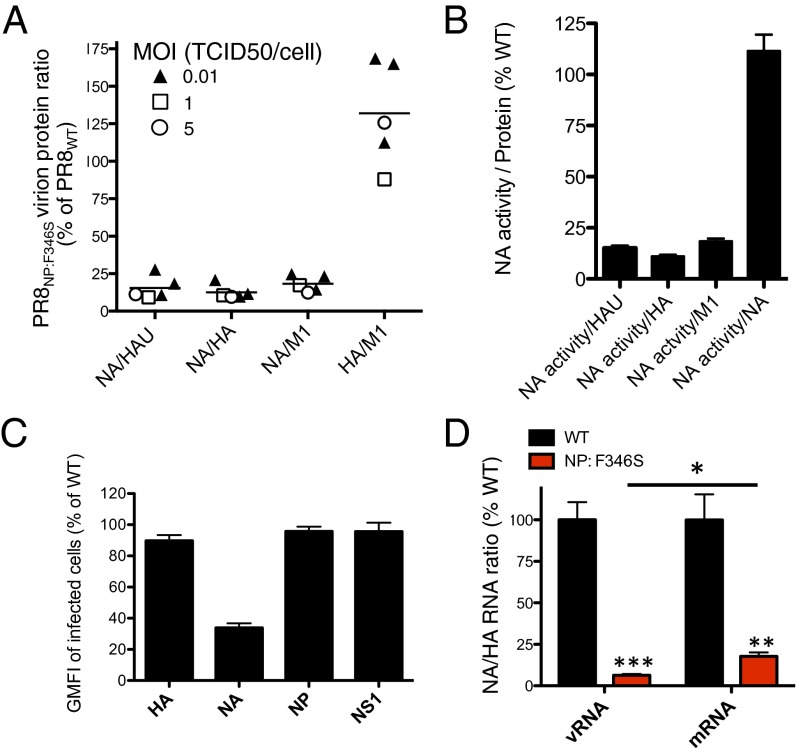
Fig. 1.
Fig. 1.
NP modulates virion glycoprotein balance through epistatic control of NA expression. (A) Relative protein content of HA, NA, and M1 in purified particle preparations. P < 0.0001 for differences between all NA ratios for PR8WT and PR8NP:F346S (one-way ANOVA, Tukey test). Each data point represents a comparison of independent stocks of PR8WT and PR8NP:F346S grown at the indicated MOIs. (B) NA activity for purified PR8NP:F346S normalized to average HAU or HA or M1 protein as a percentage of the PR8WT control, presented as mean ± SEM; P < 0.0001 for differences between all NA ratios compared with the matched wild-type control (one-way ANOVA, Tukey test). (C) Relative viral protein expression as determined by geometric mean fluorescence intensity (GMFI) on MDCK cells infected at an MOI <0.05 with PR8WT or PR8NP:F346S that stained positive for the indicated viral proteins. PR8NP:F346S values are presented as the mean percentage of PR8WT ± SEM of three technical replicates. (D) Relative copy numbers of HA and NA vRNA and mRNA in FACS-sorted, singly infected HA+NA+ cells presented as mean ± SEM, as determined by strand-specific quantitative real-time RT-PCR (*P < 0.05; **P < 0.01; ***P < 0.001; t test).
Fig. 2.
Fig. 2.
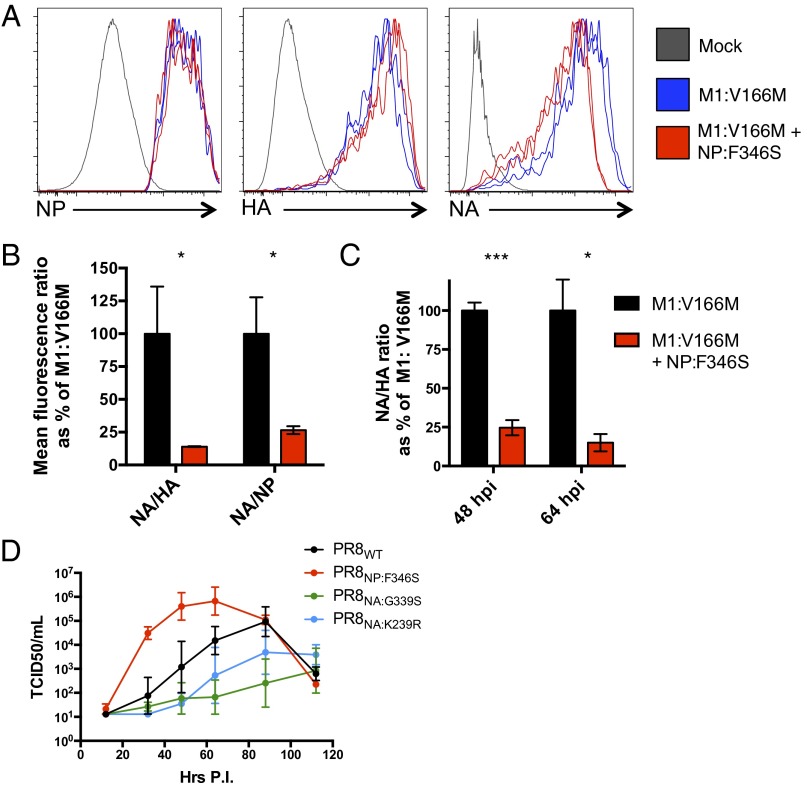
NP controls NA expression in vivo. (A and B) Viral protein expression in nasal turbinate cells collected from guinea pigs (n = 2) 48 h after i.n. infection with 103 TCID50 of PR8M1:V166M or PR8M1:V166M+NP:F346S viruses as determined by flow cytometry. (A) Comparison of NP, HA, and NA expression within NP+HA+NA+ cells. (B) The mean per-cell fluorescence ratios for the indicated stains were calculated for NP+HA+NA+ cells. Data represent the mean ± SEM (*P < 0.05; t test). (C) Ratio of NA activity (determined using MUNANA substrate) and HA content measured by ELISA in nasal wash from animals (n = 3) infected with 103 TCID50 of PR8M1:V166M or PR8M1:V166M+NP:F346S viruses. Data are presented as mean ± SEM (***P < 0.001 *P < 0.05; t test). (D) Nasal wash titers from guinea pigs infected i.n. with 500 TCID50 of the indicated viruses (n = 3). Data are presented as mean ± SEM.
Fig. 3.
Fig. 3.
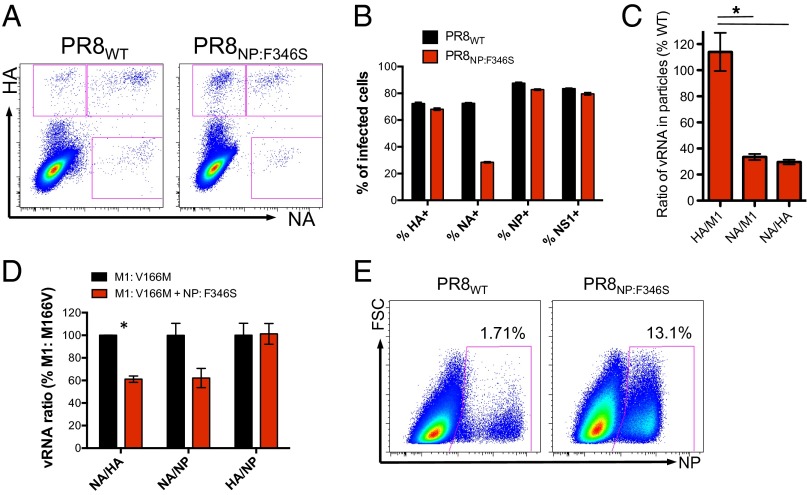
NP selectively reduces relative NA gene-segment packaging. (A) Representative flow cytometry plots of viral protein expression in cells infected at an MOI <0.05 with equal HAEU. (B) The population expression pattern illustrated as the percentage of cells in A that expressed detectable levels of the indicated proteins. Data represent mean ± SEM of three technical replicates. (C) Relative HA, NA, and M vRNA content in purified PR8NP:F346S virus preparations determined by quantitative RT-PCR as a percentage of the matched PR8WT controls. Data are presented as mean ± SEM (*P < 0.05; t test). (D) Relative abundance of vRNA segments as determined by quantitative PCR in nasal wash of PR8M1:V166M+NP:F346S-infected guinea pigs (n = 2) 48 hpi as a percent of values from PR8M1:V166M-infected guinea pigs. Data are presented as mean ± SEM (*P < 0.05; t test). (E) NP expression in MDCK cells infected at an MOI of 0.01 TCID50 per cell with PR8WT or PR8NP:F346S.
Fig. 4.
Fig. 4.
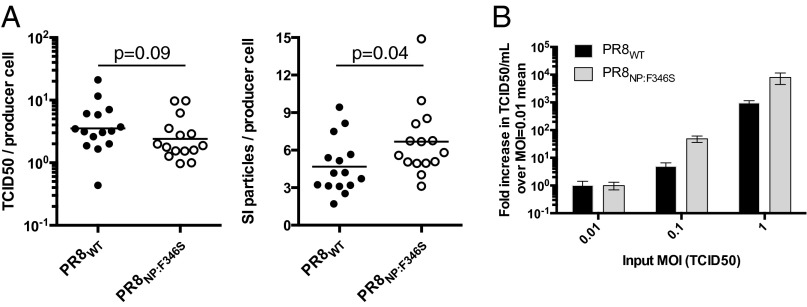
SI particles contribute to replication through multiplicity reactivation. (A) Mean TCID50 and SI particle output per HA+NP+NA+NS1+ producer cell by 8–9 hpi. Data are pooled from two independent experiments, and each point represents the value obtained from a single culture. P = 0.0885 for TCID50; P = 0.0406 for SI particles; Mann–Whitney test. (B) Virus output (in TCID50/mL) from MDCK cells infected for 8 h with PR8WT or PR8NP:F346S presented as the fold increase over output at an MOI of 0.01 for three stocks grown in parallel at each MOI ± SEM. Interaction between strain and MOI: P = 0.0308 by two-way ANOVA.
Fig. 5.
Fig. 5.
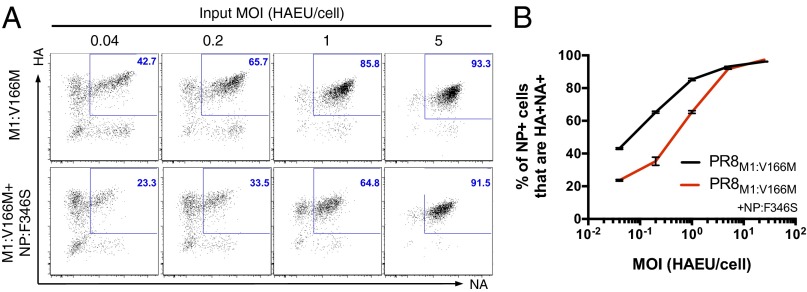
The frequency of viral protein coexpression increases with MOI. MDCK cells were infected for 9 h with PR8M1:V166M or PR8M1:V166M+NP:F346S at the indicated MOIs, and the percentage of NP+ cells that also express HA and NA was determined by flow cytometry. (A) Representative dot plots. (B) Mean ± SEM of two replicates per condition.
Fig. 6.
Fig. 6.
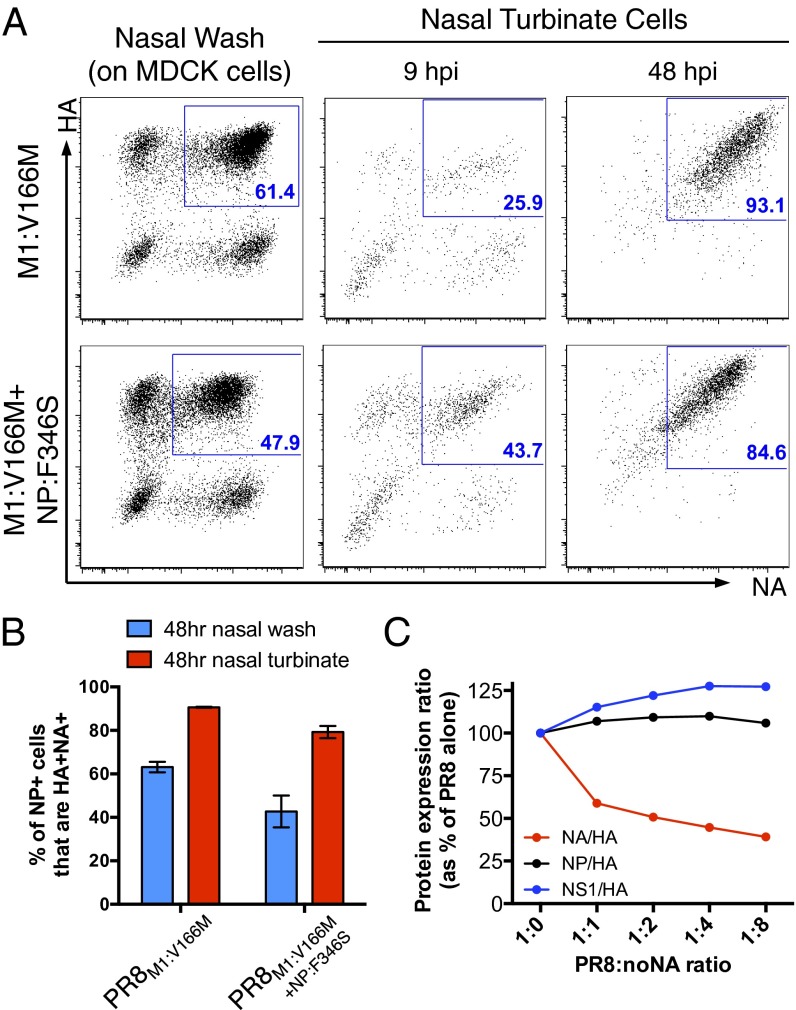
Coinfection is common in the guinea pig upper airway during IAV infection. (A and B) Guinea pigs were infected i.n. with 103 TCID50 (or 106 for the 9 hpi time point) of PR8M1:V166M or PR8M1:V166M+NP:F346S. Nasal wash and turbinates were collected 9 and 48 hpi. (A) Representative dot plots showing NP+ MDCK cells following ex vivo infection at an MOI <0.05 with 48 hpi nasal wash or NP+ nasal turbinate cells collected at 9 or 48 hpi. (B) The percentage of 48 hpi NP+ nasal turbinate cells that also were HA+NA+ was determined and compared with MDCK cells infected at an MOI <0.05 with nasal washes from the same animals. Data represent the mean ± SD of two animals per virus. (C) Relative expression of HA, NP, NA, and NS1, as determined by flow cytometry, in HA+NP+NA+ Vero cells following infection with PR8WT at an MOI of 10 HAEU per cell alone or with increasing doses of PR8NoNA. Data represent the mean percentage change in ratios of the indicated proteins compared with PR8WT alone ± SEM for three technical replicates.

References

    1. Molinari NA, et al. The annual impact of seasonal influenza in the US: Measuring disease burden and costs. Vaccine. 2007;25(27):5086–5096. - PubMed
    1. Nelson MI, et al. Multiple reassortment events in the evolutionary history of H1N1 influenza A virus since 1918. PLoS Pathog. 2008;4(2):e1000012. - PMC - PubMed
    1. Holmes EC, et al. Whole-genome analysis of human influenza A virus reveals multiple persistent lineages and reassortment among recent H3N2 viruses. PLoS Biol. 2005;3(9):e300. - PMC - PubMed
    1. Ince WL, Gueye-Mbaye A, Bennink JR, Yewdell JW. Reassortment complements spontaneous mutation in influenza A virus NP and M1 genes to accelerate adaptation to a new host. J Virol. 2013;87(8):4330–4338. - PMC - PubMed
    1. Bonhoeffer S, Chappey C, Parkin NT, Whitcomb JM, Petropoulos CJ. Evidence for positive epistasis in HIV-1. Science. 2004;306(5701):1547–1550. - PubMed

Publication types

LinkOut - more resources