


Fourteen-month-old infants use interpersonal synchrony as a cue to direct helpfulness
- PMID: 25385778
- PMCID: PMC4240967
- DOI: 10.1098/rstb.2013.0400
Fourteen-month-old infants use interpersonal synchrony as a cue to direct helpfulness
Abstract
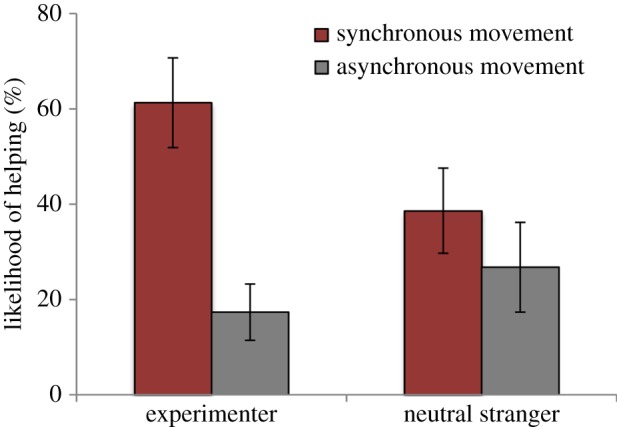
Musical behaviours such as dancing, singing and music production, which require the ability to entrain to a rhythmic beat, encourage high levels of interpersonal coordination. Such coordination has been associated with increased group cohesion and social bonding between group members. Previously, we demonstrated that this association influences even the social behaviour of 14-month-old infants. Infants were significantly more likely to display helpfulness towards an adult experimenter following synchronous bouncing compared with asynchronous bouncing to music. The present experiment was designed to determine whether interpersonal synchrony acts as a cue for 14-month-olds to direct their prosocial behaviours to specific individuals with whom they have experienced synchronous movement, or whether it acts as a social prime, increasing prosocial behaviour in general. Consistent with the previous results, infants were significantly more likely to help an experimenter following synchronous versus asynchronous movement with this person. Furthermore, this manipulation did not affect infant's behaviour towards a neutral stranger, who was not involved in any movement experience. This indicates that synchronous bouncing acts as a social cue for directing prosociality. These results have implications for how musical engagement and rhythmic synchrony affect social behaviour very early in development.
Keywords: infancy; interpersonal synchrony; music; rhythm; social development.
© 2014 The Author(s) Published by the Royal Society. All rights reserved.
Figures
References
-
- Dissanayake E. 2006. Ritual and ritualization: musical means of conveying and shaping emotion in humans and other animals. In Music and manipulation: on the social uses and social control of music (eds Brown S, Voglsten U.), pp. 31–56. New York, NY: Berghahn Books.
-
- Brown S. 2000. Evolutionary models of music: from sexual selection to group selection. In Perspectives in ethology, volume 14: evolution, culture and behaviour (eds Tonneau S, Thompson NS.), pp. 231–281. New York, NY: Kluwer Academic Publishers.
-
- Trainor LJ, Hannon EE. 2012. Musical development. In The psychology of music (ed Deutsch D.), pp. 423–498. London, UK: Elsevier Inc.
-
- Trehub S, Trainor L. 1998. Singing to infants: lullabies and play songs. Adv. Infancy Res. 12, 43–77.
-
- Freeman WJ. 2000. A neurobiological role of music in social bonding. In The origins of music (eds Wallin N, Merkur B, Brown S.), pp. 1–13. Cambridge, MA: MIT Press.
Publication types
MeSH terms
LinkOut - more resources
Full Text Sources
Other Literature Sources
Medical
