Epidemiology of meningitis in an HIV-infected Ugandan cohort
- PMID: 25385864
- PMCID: PMC4347329
- DOI: 10.4269/ajtmh.14-0452
Epidemiology of meningitis in an HIV-infected Ugandan cohort
Abstract
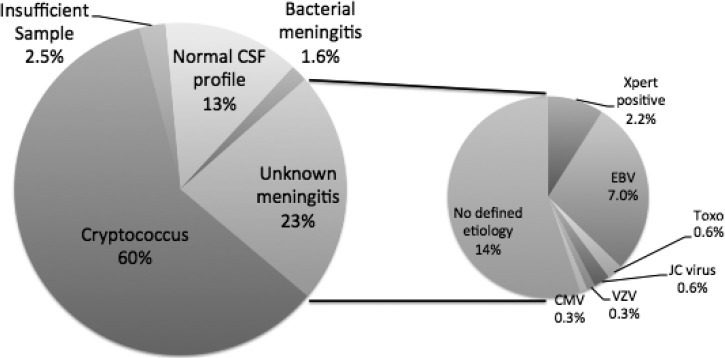
There is limited understanding of the epidemiology of meningitis among human immunodeficiency virus (HIV)-infected populations in sub-Saharan Africa. We conducted a prospective cohort study of HIV-infected adults with suspected meningitis in Uganda, to comprehensively evaluate the etiologies of meningitis. Intensive cerebrospiral fluid (CSF) testing was performed to evaluate for bacterial, viral, fungal, and mycobacterial etiologies, including neurosyphilis,16s ribosomal DNA (rDNA) polymerase chain reaction (PCR) for bacteria, Plex-ID broad viral assay, quantitative-PCR for HSV-1/2, cytomegalovirus (CMV), Epstein-Barr virus (EBV), and Toxoplasma gondii; reverse transcription-PCR (RT-PCR) for Enteroviruses and arboviruses, and Xpert MTB/RIF assay. Cryptococcal meningitis accounted for 60% (188 of 314) of all causes of meningitis. Of 117 samples sent for viral PCR, 36% were EBV positive. Among cryptococcal antigen negative patients, the yield of Xpert MTB/RIF assay was 22% (8 of 36). After exclusion of cryptococcosis and bacterial meningitis, 61% (43 of 71) with an abnormal CSF profile had no definitive diagnosis. Exploration of new TB diagnostics and diagnostic algorithms for evaluation of meningitis in resource-limited settings remains needed, and implementation of cryptococcal diagnostics is critical.
© The American Society of Tropical Medicine and Hygiene.
Figures
References
-
- WHO Health Topics: Meningitis. 2013. http://www.who.int/topics/meningitis/en/ Available at. Accessed January 20, 2013.
-
- WHO . Standardized Treatment of Bacterial Meningitis in Africa in Epidemic and Non-Epidemic Situations. Geneva: WHO Press; 2007. WHO/CDS/EPR/2007.3.
-
- Hakim JG, Gangaidzo IT, Heyderman RS, Mielke J, Mushangi E, Taziwa A, Robertson VJ, Musvaire P, Mason PR. Impact of HIV infection on meningitis in Harare, Zimbabwe: a prospective study of 406 predominantly adult patients. AIDS. 2000;14:1401–1407. - PubMed
Publication types
MeSH terms
Substances
Grants and funding
- T32AI055433/AI/NIAID NIH HHS/United States
- T32 HD068229/HD/NICHD NIH HHS/United States
- U01 AI089244/AI/NIAID NIH HHS/United States
- K23AI073192/AI/NIAID NIH HHS/United States
- R21NS065713/NS/NINDS NIH HHS/United States
- R21 NS065713/NS/NINDS NIH HHS/United States
- U01AI089244/AI/NIAID NIH HHS/United States
- R25TW009345/TW/FIC NIH HHS/United States
- T32 AI055433/AI/NIAID NIH HHS/United States
- T32HD068229/HD/NICHD NIH HHS/United States
- K23 AI073192/AI/NIAID NIH HHS/United States
- R25 TW009345/TW/FIC NIH HHS/United States
LinkOut - more resources
Full Text Sources
Other Literature Sources
Medical