


Green areas around homes reduce atopic sensitization in children
- PMID: 25388016
- PMCID: PMC4303942
- DOI: 10.1111/all.12545
Green areas around homes reduce atopic sensitization in children
Abstract
Background: Western lifestyle is associated with high prevalence of allergy, asthma and other chronic inflammatory disorders. To explain this association, we tested the 'biodiversity hypothesis', which posits that reduced contact of children with environmental biodiversity, including environmental microbiota in natural habitats, has adverse consequences on the assembly of human commensal microbiota and its contribution to immune tolerance.
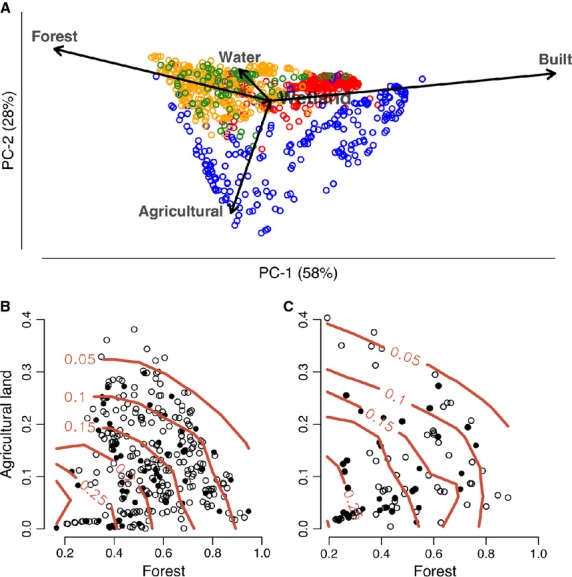
Methods: We analysed four study cohorts from Finland and Estonia (n = 1044) comprising children and adolescents aged 0.5-20 years. The prevalence of atopic sensitization was assessed by measuring serum IgE specific to inhalant allergens. We calculated the proportion of five land-use types--forest, agricultural land, built areas, wetlands and water bodies--in the landscape around the homes using the CORINE2006 classification.
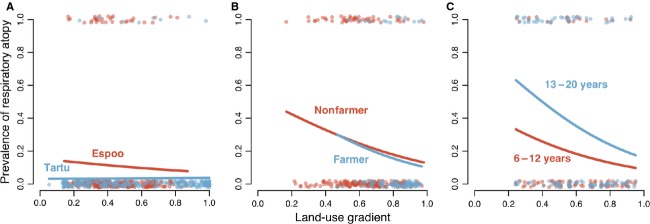
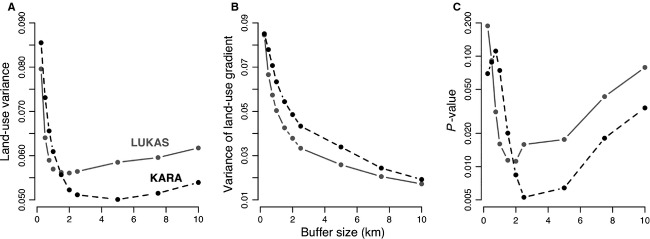
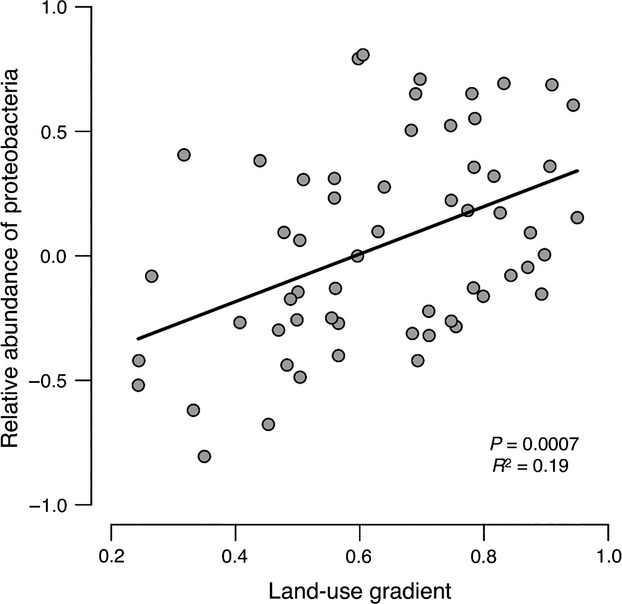
Results: The cover of forest and agricultural land within 2-5 km from the home was inversely and significantly associated with atopic sensitization. This relationship was observed for children 6 years of age and older. Land-use pattern explained 20% of the variation in the relative abundance of Proteobacteria on the skin of healthy individuals, supporting the hypothesis of a strong environmental effect on the commensal microbiota.
Conclusions: The amount of green environment (forest and agricultural land) around homes was inversely associated with the risk of atopic sensitization in children. The results indicate that early-life exposure to green environments is especially important. The environmental effect may be mediated via the effect of environmental microbiota on the commensal microbiota influencing immunotolerance.
Keywords: Proteobacteria; allergen-specific IgE; biodiversity hypothesis; farming environment; skin microbiota.
© 2014 The Authors. Allergy Published by John Wiley & Sons Ltd.
Figures
References
-
- Asher MI, Montefort S, Björkstén B, Lai CK, Strachan DP, Weiland SK, et al. Worldwide time trends in the prevalence of symptoms of asthma, allergic rhinoconjunctivitis, and eczema in childhood: ISAAC Phases One and Three repeat multicountry cross-sectional surveys. Lancet. 2006;368:733–743. - PubMed
-
- Eder W, Ege MJ, von Mutius E. The asthma epidemic. N Engl J Med. 2006;355:2226–2235. - PubMed
-
- Riedler J, Braun-Fahrländer C, Eder W, Schreuer M, Waser M, Maisch S, et al. Exposure to farming in early life and development of asthma and allergy: a cross-sectional survey. Lancet. 2001;358:1129–1133. - PubMed
-
- Schram ME, Tedja AM, Spijker R, Bos JD, Williams HC, Spuls PI. Is there a rural/urban gradient in the prevalence of eczema? A systematic review. Br J Dermatol. 2010;162:964–973. - PubMed
Publication types
MeSH terms
Substances
LinkOut - more resources
Full Text Sources
Other Literature Sources
