. 2014 Nov 12:14:568.
doi: 10.1186/s12879-014-0568-2.

Cross-sectional study of cytomegalovirus shedding and immunological markers among seropositive children and their mothers

Cross-sectional study of cytomegalovirus shedding and immunological markers among seropositive children and their mothers

Jennifer D Stowell et al. BMC Infect Dis. .

Abstract

Background: Congenital cytomegalovirus (CMV) is the leading infectious cause of birth defects in the United States. To better understand factors that may influence CMV transmission risk, we compared viral and immunological factors in healthy children and their mothers.

Methods: We screened for CMV IgG antibodies in a convenience sample of 161 children aged 0-47 months from the Atlanta, Georgia metropolitan area, along with 32 mothers of children who screened CMV-seropositive. We assessed CMV shedding via PCR using saliva collected with oral swabs (children and mothers) and urine collected from diapers using filter paper inserts (children only).

Results: CMV IgG was present in 31% (50/161) of the children. Half (25/50) of seropositive children were shedding in at least one fluid. The proportion of seropositive children who shed in saliva was 100% (8/8) among the 4-12 month-olds, 64% (9/14) among 13-24 month-olds, and 40% (6/15) among 25-47 month-olds (P for trend=0.003). Seropositive mothers had a lower proportion of saliva shedding (21% [6/29]) than children (P<0.001). Among children who were shedding CMV, viral loads in saliva were significantly higher in younger children (P <0.001); on average, the saliva viral load of infants (i.e., <12 months) was approximately 300 times that of two year-olds (i.e., 24-35 months). Median CMV viral loads were similar in children's saliva and urine but were 10-50 times higher (P<0.001) than the median viral load of the mothers' saliva. However, very high viral loads (> one million copies/mL) were only found in children's saliva (31% of those shedding); children's urine and mothers' saliva specimens all had fewer than 100,000 copies/mL. Low IgG avidity, a marker of primary infection, was associated with younger age (p=0.03), higher viral loads in saliva (p=0.02), and lower antibody titers (p=0.005).

Conclusions: Young CMV seropositive children, especially those less than one year-old may present high-risk CMV exposures to pregnant women, especially via saliva, though further research is needed to see if this finding can be generalized across racial or other demographic strata.


Figures
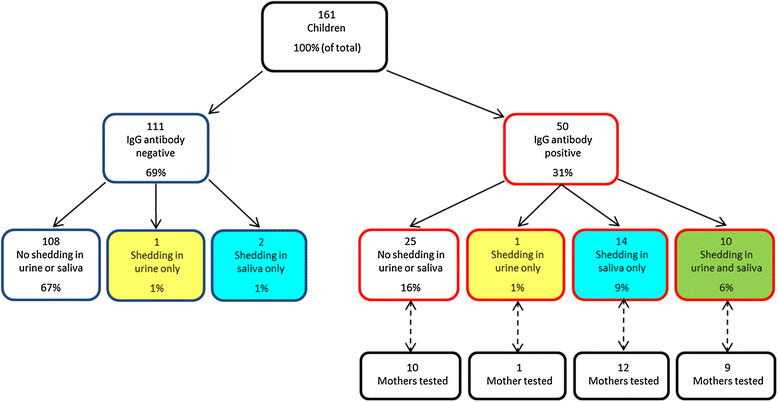
Figure 1
Figure 1
Number, antibody status, and CMV shedding status of children enrolled in the study. Red outlines represent children with CMV IgG antibody and blue outlines represent children without CMV IgG antibody. Yellow shading represents children shedding CMV in urine only, blue shading represents children shedding in saliva only, and green shading represents children shedding in both urine and saliva. CMV testing was also done in a subset of mothers of children who were CMV antibody positive.
Figure 2
Figure 2
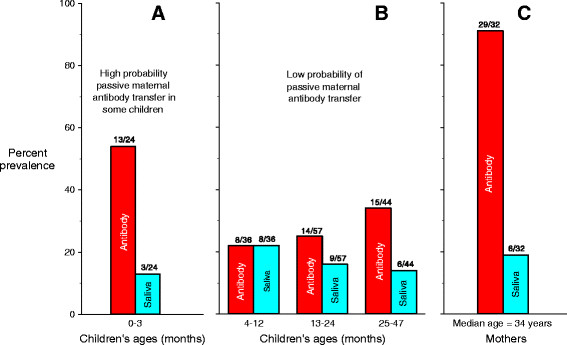
Prevalences of CMV IgG antibody and CMV shedding in saliva among children as a function of age in months. Prevalences of CMV IgG antibody and CMV shedding in saliva are also shown for the mothers who were screened. Red shading represents antibody results and blue shading represents saliva results. Panel A shows data from children ages 0-3 months; Panel B shows data from children ages 4-47 months; Panel C shows data from mothers. Antibody prevalences of mothers and children are not directly comparable because the children came from an unselected population whereas the mothers were selected for testing only if their children were CMV-seropositive, and therefore the seroprevalence among mothers was higher than would be expected in a general population.
Figure 3
Figure 3
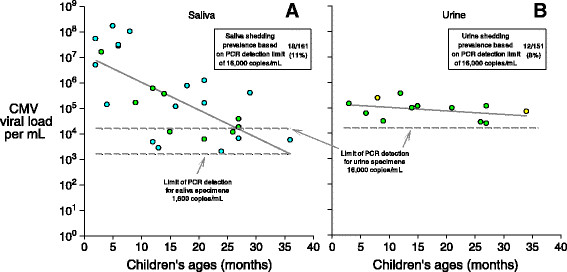
CMV viral loads per mL as a function of Children's ages in months. Panel A shows results for saliva viral loads and panel B shows results for urine viral loads. Circles are only plotted for children who were shedding; negative results (i.e., viral loads below the limit of detection) are not plotted. Yellow circles represent children shedding CMV in urine only, blue circles represent children shedding in saliva only, and green circles represent children shedding in both urine and saliva. The regression line in Panel A is log10 (CMV viral load) =7.1 - 0.108 (age in months), with r2 = 0.46 and P < 0.001; the regression line in Panel B is log10 (CMV viral load) =5.2 - 0.014 (age in months), with r2 = 0.14 and P = 0.22.
Figure 4
Figure 4
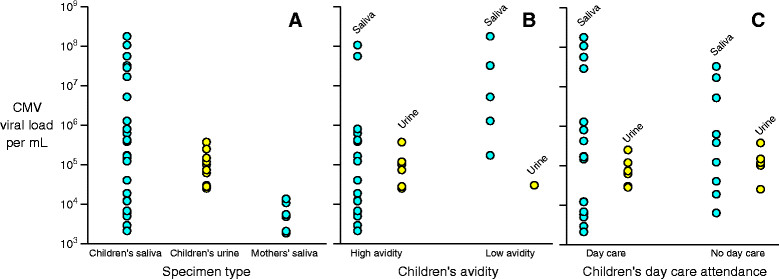
CMV viral loads per mL stratified by three different variables. Panel A shows viral loads stratified by specimen type (saliva vs. urine) and source (child vs. mother). Panel B shows viral loads for children only stratified by whether the child had high or intermediate versus low CMV IgG antibody avidity. Panel C shows viral loads stratified by day care attendance. Circles are only plotted for children who were shedding; negative results (i.e., viral loads below the limit of detection) are not plotted. Blue circles represent saliva results and yellow circles represent urine results.
Figure 5
Figure 5
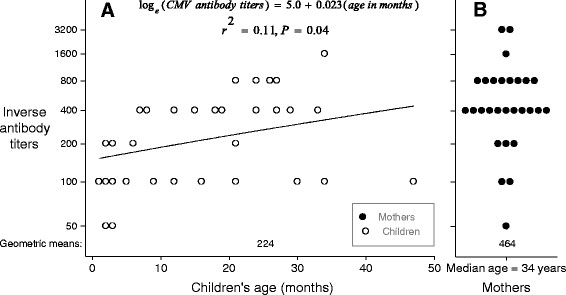
CMV IgG antibody titers among children and mothers. Panel A shows antibody titers as a function of age in months, including a regression line plotted to show the linear relationship between age in months and loge viral loads. Panel B shows antibody titers among mothers, who had a median age of 34 years. Overall geometric mean antibody titers for children and for mothers are shown near the bottom of each panel. Circles are only plotted for individuals who had CMV IgG antibodies; negative results (i.e., antibody titers of zero) are not plotted. Black circles represent mothers' results and white circles represent Children's results.
Figure 6
Figure 6
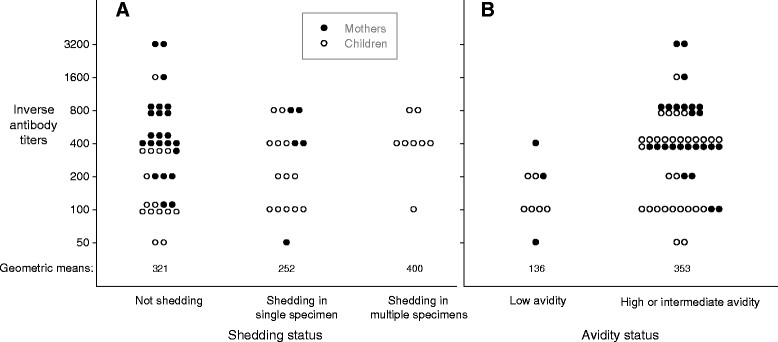
CMV IgG antibody titers as a function of CMV shedding status and CMV IgG antibody avidity status. Panel A shows antibody titers for individuals not shedding CMV, shedding CMV in only one specimen (urine or saliva), or shedding CMV in both urine and saliva. Panel B shows antibody titers for individuals with low avidity versus high or intermediate avidity. Geometric mean antibody titers for each category are shown near the bottom of each panel. Circles are only plotted for individuals who had CMV IgG antibodies; negative results (i.e., antibody titers of zero) are not plotted. Black circles represent mothers' results and white circles represent Children's results. For easier viewing, some of the circles are slightly offset from their true values; actual values for inverse antibody titers consisted only of the following: 50, 100, 200, 400, 800, 1600, and 3200.

References

    1. Cannon MJ, Davis KF. Washing our hands of the congenital cytomegalovirus disease epidemic. BMC Public Health. 2005;5(1):70. doi: 10.1186/1471-2458-5-70. - DOI - PMC - PubMed
    1. Knowledge and practices of obstetricians and gynecologists regarding cytomegalovirus infection during pregnancy--United States, 2007. MMWR Morb Mortal Wkly Rep. 2008, 57 (3): 65-68. - PubMed
    1. Korver AMH, de Vries JJC, de Jong JW, Dekker FW, Vossen A, Oudesluys-Murphy AM. Awareness of congenital cytomegalovirus among doctors in the Netherlands. J Clin Virol. 2009;46:S11–S15. doi: 10.1016/j.jcv.2009.09.006. - DOI - PubMed
    1. Manicklal S, Emery VC, Lazzarotto T, Boppana SB, Gupta RK. The "silent" global burden of congenital cytomegalovirus. Clin Microbiol Rev. 2013;26(1):86–102. doi: 10.1128/CMR.00062-12. - DOI - PMC - PubMed
    1. Schleiss MR. Cytomegalovirus vaccine development. Human Cytomegalovirus. 2008;325:361–382. doi: 10.1007/978-3-540-77349-8_20. - DOI - PMC - PubMed

MeSH terms